
Homes attacked during anti-immigration riots in Belfast 'had been blacklisted for months' by extremist groups

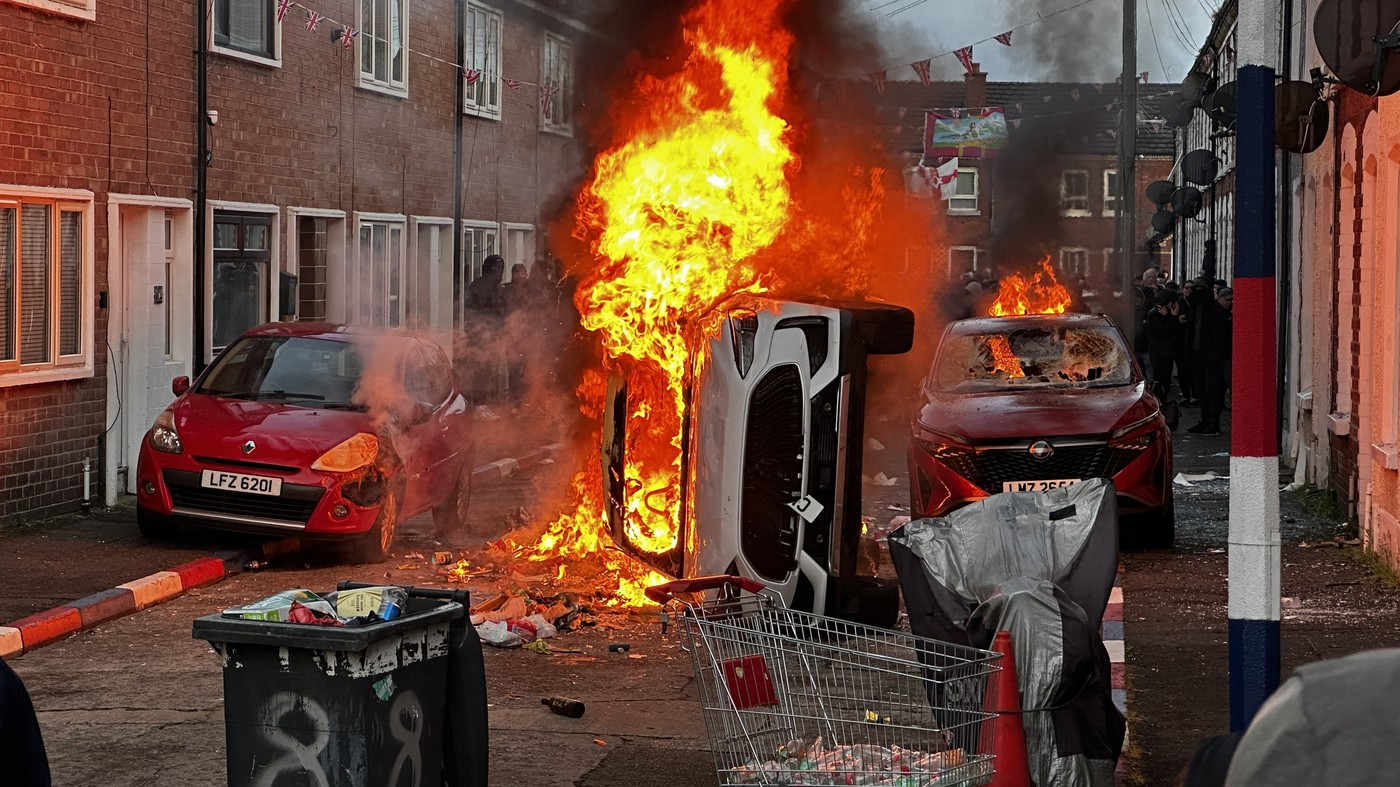
The police in Northern Ireland were warned for months by local volunteers that several homes of migrants in the Belfast area were being targeted by anti-migration groups, The Guardian writes. The houses in question were targeted by angry mobs after Monday's attack, in which a Sudanese migrant seriously injured a local man.
The Police Service of Northern Ireland (PSNI) has been repeatedly warned over the past eight months that anti-immigration activists were circulating the addresses of properties targeted by riots in Belfast over the past two days.
The Accountability Project Northern Ireland, a volunteer group set up last summer to monitor anti-immigration activity, sent dozens of police reports on this between November 2025 and June 2026, The Guardian writes.
They warned of a growing focus on housing in multiple occupation (HMO) by anti-immigration and far-right groups, a phenomenon they first noticed in August 2025.
In the riots of the last few days, triggered after a Sudanese refugee seriously injured a local, numerous migrants were targeted, without discrimination, including Romanians.
A blacklist
According to The Guardian, a so-called blacklist of addresses has been circulating among far-right groups since August 2025 and was sent to the PSNI in January 2026.
Among the addresses on that list were those targeted during this week's anti-immigration unrest.
The Guardian saw a screenshot of an email sent to a PSNI inspector in January with such a list attached.
Volunteers say a similar list is now circulating on social media and messaging apps amid this week's riots.
The PSNI warned earlier this week against the distribution of home addresses, adding that it had left families and residents “extremely affected”.
“Anyone caught funding or helping to house these animals will be held to be just as guilty”
Reports to the PSNI have largely focused on activity in the Newtownabbey area, north of Belfast, which has been at the center of some of the worst unrest in recent days.
Speaking on BBC Radio 4's Today programme, John Blair, Alliance MP for South Antrim, said the area had seen “a mob unleashed in a series of acts of violence and destruction”.
Reports to police also cited a Facebook post which stated that collective housing in the Glengormley area “will now be treated as legitimate targets and dealt with accordingly”.
The post continued: “Anyone caught funding or helping to house these animals will be held as equally guilty.”
Community groups helped vulnerable families leave the affected areas
Glengormley has been one of the areas affected by anti-immigration unrest in recent days, with masked men torching homes.
Anti-racism campaigners expressed anger and frustration that months of repeated warnings had gone unheeded in the run-up to days of rioting.
Community groups described how they helped vulnerable families leave the areas, while volunteers organized support for ethnic minority students traveling for GCSE exams.
Activists also said some ethnic minority workers were leaving work early because of concerns about the safety of their journey home.
The dozens of reports of attacks on dwellings in shared accommodation (HMOs) were part of around 50 referrals to the PSNI from August 2025 to date.
“Serious Question Marks”
“We saw the so-called blacklist currently circulating in Belfast and immediately recognized it as the same list sent to the PSNI in January,” a spokesman for the group said.
“The fact that concerns about the escalation of the conflict were raised months ago, and some of the streets in question have now been attacked, raises serious questions about the extent to which those warnings have been heeded,” he said.
The PSNI were told that the people in the homes targeted were being described as “fighting age men” who could be “rapists” and “murderers” and that calls were being made for people to “start taking a stand”.
In an email sent to a PSNI inspector on June 5, the volunteer group outlined growing concerns and said some members of ethnic minority communities were stockpiling food because they were unsure what might happen in the coming months. The PSNI did not respond.
Three days later, Hadi Alodid stabbed Stephen Ogilvie in a violent attack. The family of the stabbing victim condemned the violent protests.
A spokesman for End Deportations Belfast said the strategy used during the Belfast riots was the same as that used in Northern Ireland since the 1970s.
“They set up roadblocks and checked drivers' IDs around the hospitals,” he said. “These roadblocks are intended to exhaust police resources, and then they move to certain areas to commit pogroms,” he said.
The second night of violence
Violent clashes between police and protesters involved in anti-immigration riots also took place near Belfast on Wednesday evening.
Law enforcement used water cannons to disperse a violent crowd after they were targeted by bricks and firebombs.
It was the second night in a row that violent protests rocked the Northern Irish capital. The riots erupted after a Belfast man lost an eye and suffered other serious injuries in an attack by a Sudanese refugee on Monday.
On Wednesday night, police dispersed a crowd of around 300 people who set fire to a lorry and threw bricks and firebombs at them near the Sandyknowes roundabout, near Newtownabbey, 13km north of Belfast.
Disturbances were also reported in Derry and Coleraine, but overall there were fewer incidents than on Tuesday, when crowds targeted ethnic minorities. With their faces masked, some of the protesters set fire to buses and vehicles and set fire to some houses on Tuesday evening.
Romanians affected by the riots
So far, 21 people from Northern Ireland have requested consular assistance from the Romanian authorities for the issuance of travel documents, in the context of the recent violence in Belfast, inform sources from the Ministry of Foreign Affairs (MAE), quoted by Agerpres.
According to the respective sources, there are 20 Romanian citizens – 13 adults and seven children – and one foreign citizen, namely four families, three people who are relatives and a couple.
On Thursday, the Romanian consul from Edinburgh traveled to Belfast to discuss the tense situation with the police and the local authorities.
About 20,000 Romanians live in Northern Ireland.
The homes of three Romanian families were vandalized in the context of the violence in Belfast on Tuesday night, the MAE informed on Wednesday. One of these families was relocated with the help of relatives.
The Romanian citizens are currently safe and have expressed their intention to return to Romania as soon as possible. According to the available information, the MAE also shows, no victims of Romanian citizenship were reported.
The precedent of 2025
The disturbances in Northern Ireland are the latest episodes of violence to break out in the UK in response to a crime committed or alleged to have been committed by a migrant.
Immigration has, over time, been reduced to Northern Ireland due to the three-decade conflict between Irish nationalists and pro-British “loyalists”, as well as the British military.
However, migration has increased in recent years, and both Northern Ireland and parts of the Republic of Ireland have seen a rise in anti-immigration sentiment.
In the summer of 2025, the Romanian community was targeted by the local uprising in the Northern Irish town of Ballymena, County Antrim, after two Romanian teenagers were accused of attempted rape.
The charges against the two were dropped in the fall of 2025.
Calls for protests
Billionaire Elon Musk also tried to play a role in the whole story, who incited protests and redistributed numerous messages denouncing the situation in the United Kingdom.
Musk backed nationalist activist Tommy Robinson, who called for protests after “yet another attack by invaders on our people”.
“Only by protesting REPETITELY and LOUD will any change happen!!” Musk said.
Northern Ireland's Justice Minister Naomi Long told Reuters that “bad faith actors”, who previously would have had difficulty finding the province on a map, were trying to exploit the understandable fear and anger sparked by the knife attack to target those with the same skin colour.
“Don't allow your sincere concerns to be manipulated by bad faith actors,” she said.


