The firing of clay vessels as it was thousands of years ago, accessible to the public. “See the discovered object and try to find out how it was made”

The general public occasionally has special opportunities to learn how the objects they admire in museums were made and perhaps ask questions about how they were made.
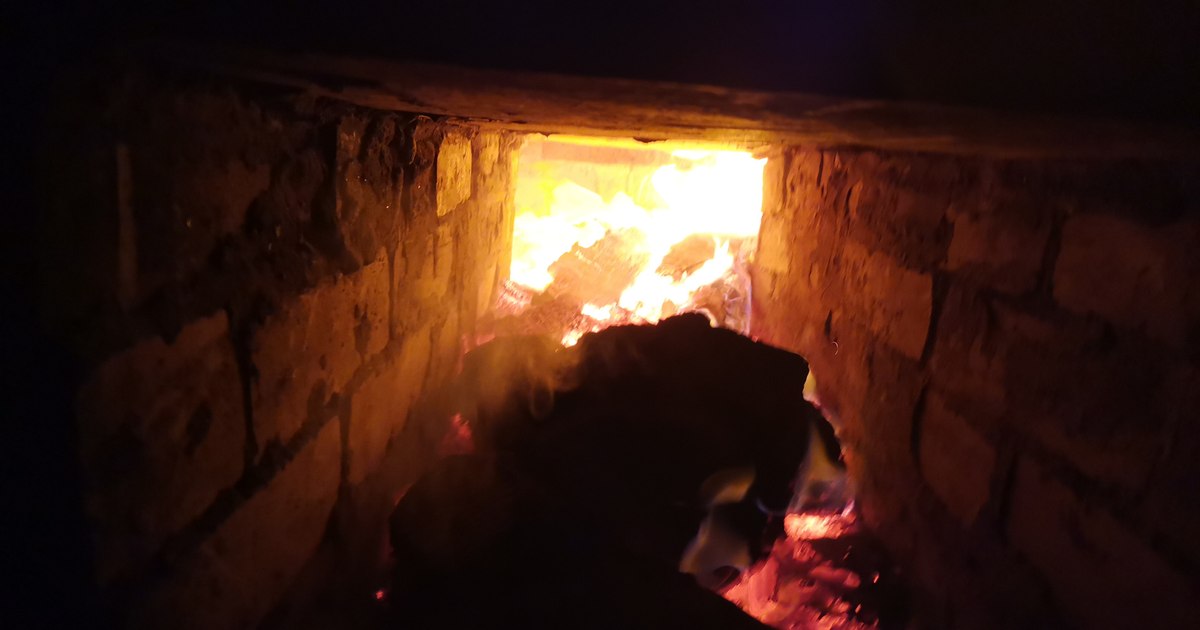
The burning process took at least 8 hours PHOTO: Alina Mitran
Experimental archeology often begins as play. This is what children perceive in the first phase, who love to model the clay with their bare hands. At the Olt County Museum, during the summer, holiday workshops are organized, and children of all ages have the opportunity, at the “Gunka and Spiru Vergulescu House”, a section of the museum, to find out, by practicing, how ceramic objects were made 7,000 years ago.
Archaeologist Lucian Truță has the patience and passion to guide their curiosity. It is a different kind of history lesson, which children – and not only them, because the workshops are also open to adults – learn without realizing it.
Thus, archeology exhibitions take on another dimension.
“It's like reading a book, but from the end. You see the finished object, the discovered object, and you try to find out how it was made, going backwards, somehow”Lucian Truță explains what experimental archeology is.
The archaeologist carries out clay modeling activities in the museum every year, especially during the children's vacation. He does not use the potter's wheel, but a process prior to its discovery, and once a year the actual clay vessels are fired in the kiln built in the yard of the “Casa Gunka si Spiru Vergulescu” section, in Slatina.
The place where everything happens – the house of the painter Spiru Vergulescu, donated to the municipality of Slatina, today a museum – allowed the archaeologist to build a furnace in the courtyard. Thus, the shaped vessels are transformed into utilitarian objects.
“If we exceed the temperature – they melt, if it's too little – they don't burn”
And if the workshop where pots and various other clay objects are shaped is open many days a year, the experimental firing takes place, as a rule, only once in 12 months. The furnace, built according to the principles of furnaces from the Eneolithic era, must be full for efficient combustion, and enough vessels are collected in a year.
The burning of objects made in the last year took place recently. It was one of the actions proposed by the “Night of museums”, arousing quite a lot of interest. The process was finalized well after the end of the visitor program, because the firing is controlled, taking care not to exceed the optimum temperature, because such an accident would compromise the result.
Ceramic vessels before firing PHOTO: Lucian Truță archive
“It is an oven that was also used in the Eneolithic period. It was not made of brick, but dug into the ground. We had to resort to this because here we have a very unstable ground. Burning takes a minimum of eight hours, depending on the type of wood,” explained Lucian Truță.
Ceramic vessels after experimental firing PHOTO: Lucian Truță archive
During the firing session the temperature should be maintained between 700-900 degrees Celsius. “If we exceed – they melt, if it is too little – they do not burn. If there are large temperature differences during burning – they break”, the archaeologist explained. There are details that, although he knew them in theory, gained a completely different meaning by experimenting, because Lucian Truță has so far built at least six combustion furnaces. He experienced with whole generations of children – first at the Children's Palace, later in workshops at school and now at the museum – the old occupation that it is difficult to say if, researching what is discovered in the archaeological sites and corroborating with what has been transmitted in practice until today, we have fully discerned.
About 48 hours after the completion of the firing, the result came: out of more than 20 clay vessels, only three broke, which shows that the process was conducted carefully, the firing being a successful one. Along with the ceramic dishes that can actually be used for food preparation, objects made by the children were also burned, which, if they return to the museum, they will even be able to take home.
“I would like adults to come too”
The activity in the clay modeling workshop is seen more like a game by the little ones. The museographer would like, in time, to attract adults to do this as well. And the interest is there, the busy schedule of adults seems to be the obstacle instead. On the other hand, the gain would be enormous, those who have tried it are convinced and who speak of a real therapeutic effect, beyond the things you find out.
The mystery of the black color of clay vessels admired at all fairs. “It seems to me that the fire brings out enough colors, I don't need to add more”
The clay modeling workshops were organized at the Olt County Museum for the first time in 2018. The current oven is being rebuilt, the first one from the “Gunka and Spiru Vergulescu” section dating from 2019-2020.
Adults, unlike children, are interested in knowing as much as possible about the process of firing ceramic objects. That's how they found out that this oven is inspired by archeological discoveries, especially Cucutenian ovens, with two combustion chambers.
In the Oboga area of Olt, famous half a century ago for its pottery, there are still today a few families of potters who burn clay vessels in kilns, but they are different from the one built at the museum, the museographer states.
“Even today there are ovens in Oboga, but they are different from this one, they have two burners, it is a hearth specially arranged for dishes. This is a furnace that can be used for both oxidizing firing and reducing firing, that is, the vessels can come out either brick or red or black, depending on what is desired”Lucian Truță also stated.
From the museographer's explanations, those interested learn that it is not the color of the clay that determines the color of the vessel, but the type of firing. Oxidizing firing produces brick-red vessels, and when reductive firing is used the vessels will be black in the end.
As for the technique of making clay vessels, techniques are used that do not involve the potter's wheel. One of these is direct lifting, the vessel being constructed from a single piece of clay. Most of all, explains Lucian Truță, he uses combined techniques – direct lifting, to which he adds clay rolls, but this depends on the size of the pot being made. After the vessel has been made, it is polished with a very fine river stone to close the pores. The dishes need a long period of time for drying, which should not take place in direct sunlight. Only after complete drying can they be burned.
The secret of clay pots that keep water cold
After firing, the dishes can actually be used, being 100% utilitarian ceramics. “Being vessels for common use, and being unglazed, even if they are polished on the inside, they are still very, very porous. And then they must be prepared beforehand. That is, they must be filled with water and then boiled with water with flour or something very rich in starch, which will enter and plug the pores of the vessel, otherwise it would lose water. After a few boilings like this, the pores of the vessel become clogged”Lucian Truță also specified. You can also use milk, for the same purpose, or even vegetable or animal fats to clog the pores. Later, the dishes can be used including using an open fire. They can also be used for storage.
To keep the water cold, on the other hand, the pores should not be blocked, because the vessel will lose water through the pores, but at the same time it keeps it cold. It is the secret that the potters knew, and the jugs used to store the water were not glazed, precisely to keep the temperature low. Today, because we use the dishes mainly for decorative purposes, we prefer them glazed, but for purely aesthetic reasons.
The workshops at the Night of the Museums that also captivated the parents. “I wish you were my history teacher”
The experimentally fired vessels at the museum are not intended for sale, although many visitors would like them. Instead, they will be used in future activities, at culinary events that are periodically hosted by the museum section.
Annually, other vessels are added to the old ones. Archaeologist Lucian Truță takes care of the entire process, from bringing the clay necessary for modeling to firing and preparing the vessels for use, and in the years since he has been carrying out these activities, he has attracted other colleagues from the museum who are passionate about the whole process.
The clay is brought “from all the places where I find it”, adds the archaeologist. There are red, yellow, gray, even black clays, the color varying depending on the minerals in the composition. The color of the burnt dishes will depend on the type of burning.
Children are the most enthusiastic students of archaeologist Lucian Truță PHOTO: Alina Mitran
Those who visited the clay modeling workshop begin to see with different eyes the ceramic objects that they later discover in the archaeological exhibitions.
Even researchers who experiment have a different perspective. “It's not just a craft. It is also an attempt to understand certain things that escape us. We have no way of finding them out except by doing this”says the archaeologist. By experimenting with similar objects, you can find the meaning of various objects discovered in archaeological sites, which today we assume could have been used for one purpose or another. Children are by far much more curious, they have a rich imagination, and the workshops held with them are always challenging, Lucian Truță also specified.