Magnitude 7.8 earthquake in the Philippines, followed by tsunami warning. Residents fled to higher ground

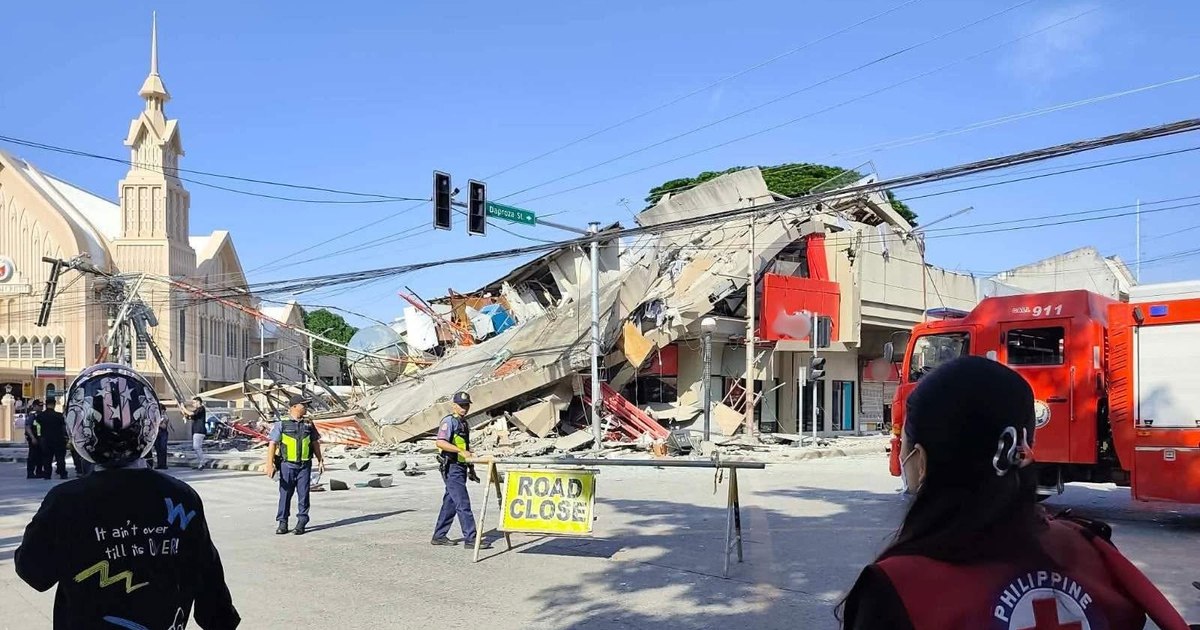
A powerful 7.8-magnitude earthquake shook the southern Philippines on Monday morning, causing panic among the population and triggering tsunami warnings in several coastal regions.
Several buildings collapsed as a result of the earthquake/PHOTO: X
According to the German Research Center for Geosciences (GFZ), the earthquake occurred at a depth of 10 kilometers and had its epicenter near the island of Mindanao. Initially, experts had estimated the magnitude at 8.2, but this was later revised to 7.8.
Philippine authorities immediately issued tsunami warnings and asked residents in coastal areas to evacuate to higher ground.
“Based on local tsunami scenarios, waves that may exceed one meter above the normal tidal level are expected, and in closed bays and straits, they could be even higher,” the Philippine Institute of Volcanology and Seismology said.
Residents of the provinces of Sarangani, Davao Occidental, Tawi-Tawi, Sulu, Basilan, Zamboanga del Sur, Zamboanga Sibugay, Sultan Kudarat and South Cotabato were advised to immediately leave coastal areas and move inland.
In the city of Alabel, in the province of Sarangani, the head of the local police, Benjie Ancheta, said that the headquarters of the institution suffered cracks immediately after the earthquake, which occurred right during the flag raising ceremony. A building belonging to the Jollibee restaurant chain also collapsed.
“It's the strongest earthquake I've ever experienced“, the Investigation told Reuters.
Although no casualties were reported immediately after the earthquake, several people fainted due to panic and the intensity of the earthquake.
The region continues to be affected by successive aftershocks, with magnitudes ranging from 1.3 to 3.7 degrees.
The Pacific Tsunami Warning Center, in turn, issued an alert regarding the possibility of dangerous waves in the next three hours along the coasts of Indonesia, the Philippines, the state of Palau, Taiwan and Papua New Guinea.
Instead, New Zealand's National Emergency Management Agency announced that the earthquake did not pose a tsunami risk to the country's territory.
“Based on the information available at this time, the preliminary assessment indicates that this earthquake is unlikely to have generated a tsunami affecting New Zealandă”, stated the representatives of the institution.
The Philippines and Indonesia lie on the so-called “Pacific Ring of Fire,” one of the most seismically active zones on the globe, where tectonic plates meet and frequently generate earthquakes and volcanic eruptions.