LIVE: 1,500,000 people out of 2,500,000 have voted in Armenia's crucial election. Contradictory polls at the polls

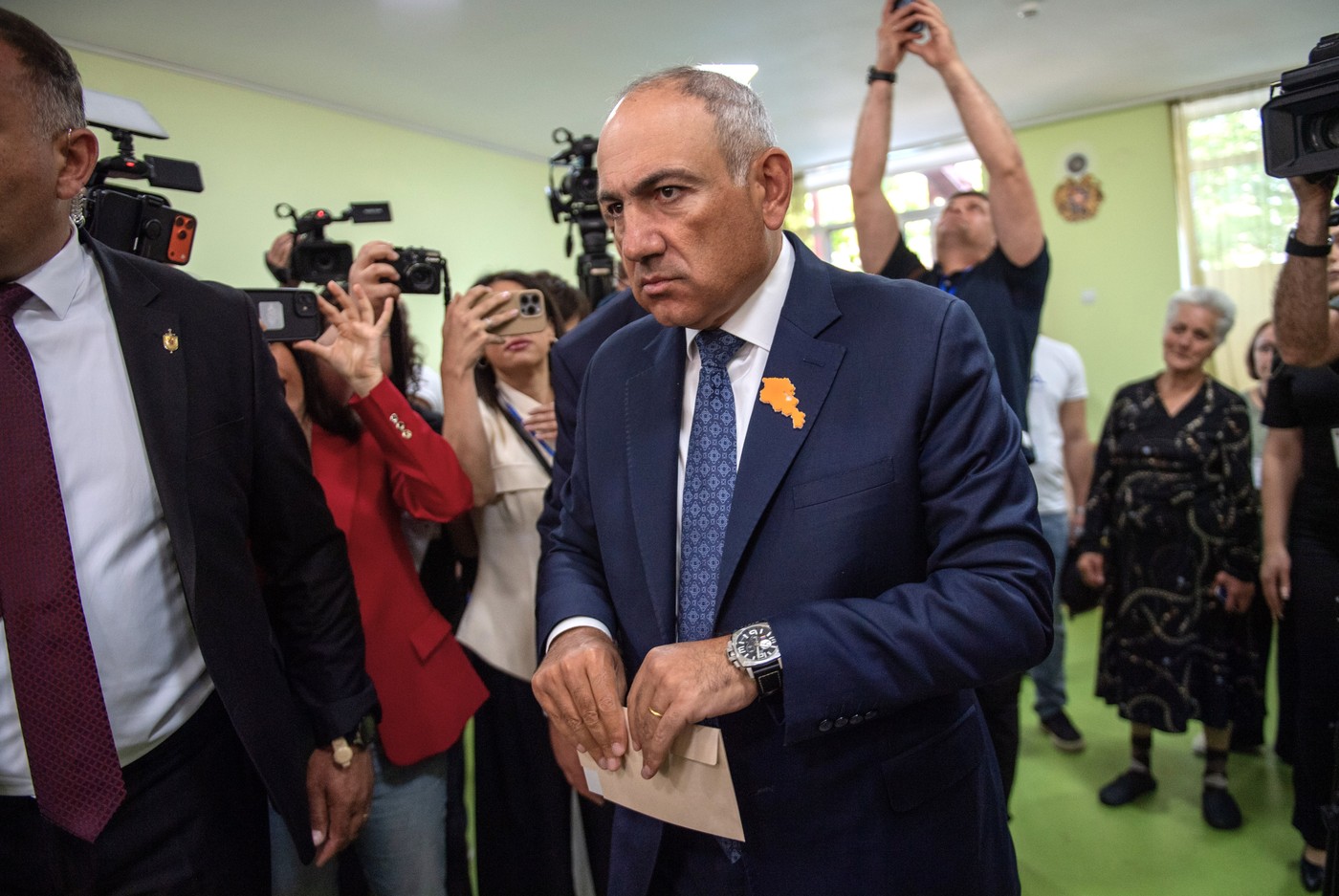
Showdown between a pro-European party and one controlled by a billionaire close to Russia in Armenia's parliamentary elections on Sunday.
Prime Minister Nikol Pashinian's pro-Western party not only needs to win, but also to keep its majority if it wants to reform the Constitution, a condition for signing the long-awaited peace with Azerbaijan. In addition, he wants to introduce the necessary reforms for Armenia to obtain the status of a candidate for EU membership.
On the other hand, the majority of the opposition does not want to break ties with Russia, which recently imposed sanctions on Armenian agricultural products, against the backdrop of Armenia's approach to the EU and the deterioration of relations between Yerevan and Moscow.
According to the Central Electoral Commission (CEC), 59.97% of voters turned up at the polls, i.e. approximately 1.5 million of the approximately 2.5 million voters. Voting in the diaspora is not allowed.
If no party manages to obtain a majority in parliament, a second round will be held within nine days.
Contradictory polls at the polls
The Social Contract Party of the pro-Western Armenian Prime Minister Nikol Pashinian would have won with an absolute majority the legislative elections held on Sunday, according to exit polls ordered by this party, while independent polls claim that, on the contrary, the opposition parties would obtain an absolute majority and that Pashinian's formation is indeed in first place, but without being a majority, reports the EFE news agency, quoted by Agerpres.
Thus, while some polls give the Civil Contract party an absolute majority, others predict a narrow victory for it over the main opposition party, Strong Armenia, led by the Russian-Armenian businessman Samvel Karapetian, who is under house arrest.
According to one of the polls ordered by the governing party Civil Contract, this party would obtain 56.7%, and the opposition formation Strong Armenia would have only 17.5% of the votes.
Meanwhile, one of the independent polls conducted by the local Telegram channels indicates a victory for Pashinian's party with 32.7% of the votes, compared to 29% for the Strong Armenia party and 13.2% for the Armenia bloc. According to this poll, the opposition, if it formed an alliance, would obtain 52.9% of the votes cast on Sunday.
High turnout at the polls
By 5:00 p.m. local time, 48.9% of voters had voted, close to the percentage recorded during the entire voting day in the previous elections in 2021.
The voter turnout level of 48.9% was registered at 17.00 local time, three hours before the polls closed, JAM News informs.
Under these conditions, it is likely that the level of attendance will eventually exceed the percentage from the 2021 parliamentary elections when, according to the IFES Elections Guide, the attendance was 49.3%.
The ruling party needs a clear victory
The election comes as Armenia's relations with Russia have become a major election issue as Moscow has stepped up pressure on the small South Caucasus country by imposing restrictions on Armenian imports and threatening to raise Russian oil and gas prices.
Prime Minister Nikol Pashinian's Civil Contract party, which has made moves toward the West since 2018, faces three pro-Russian opposition parties.
The Civil Contract was rated in the opinion polls at 32% of the options, in second place being the pro-Russian party Strong Armenia, which recorded around 11%.
Strong support for Pashinian would give him a mandate to end peace talks with Azerbaijan, with which Armenia has been at war on and off since the late 1980s, as well as normalize relations with Turkey, a key ally of the Baku regime, Reuters notes.
The election is being watched closely in Europe, with the EU keen to gain an ally in the region after Georgia, Armenia's neighbor to the north, suddenly swerved from a pro-Western path
Pashinian would need a two-thirds majority in parliament to call a referendum to change the country's constitution, a key requirement of Azerbaijan to sign a peace deal.
Pashinian faced a wave of criticism from the opposition, which accused him of capitulating to Azerbaijan after the 2023 war. The opposition is led by Strong Armenia, a party formed last year by billionaire Samvel Karapetian, which wants to keep the country close to Russia, which supplies it with energy and buys much of its exports.
Karapetian was able to vote despite being placed under house arrest for allegedly plotting to overthrow the government by force, charges he has dismissed as politically motivated.
How trust in Russia collapsed
For decades, Armenia's security has been based on its alliance with Russia, formalized through membership of the Collective Security Treaty Organization (CSTO).
This architecture collapsed when Azerbaijan launched the 2022-2023 aggression. It was a direct attack on the sovereign territory of Armenia and not on the region disputed by the two states as in previous conflicts. More than 250 square kilometers of Armenia's sovereign territory are still under Azerbaijani occupation.
Although seen as a reliable ally, Moscow found reasons not to intervene. “The Russians managed to find a way to diplomatically avoid this situation,” said one Armenian political scientist, who asked not to be named.
The consequences for public opinion were dramatic. Russia, which two decades ago enjoyed over 85–90% approval among Armenians, is now seen as a threat by about a third of the population. “It's more a matter of caution, of pragmatism, of not provoking the bear,” the political scientist said, “rather than sharing particularly positive feelings toward Moscow.”
However, Armenia remains closely tied to Russia in ways that make any definitive break strategically dangerous. Moscow controls essential infrastructure – railways, energy – and remains a dominant trading partner.