Europe dreams of a “nuclear renaissance”. The problem is that Putin has the keys [OPINIA]


The topic of nuclear energy in Europe has taken on a new importance in recent years. This results both from the European Commission's efforts to become independent from Russian energy resources and from the transition to a low- and zero-emission economy. It's not just about improving air quality. To avoid the most catastrophic effects of climate change, greenhouse gas emissions should be reduced to zero by about the middle of this century.
Germany remains the largest economy in the European Union and largely determines the direction of development of the entire community, which is why changes taking place in the German energy sector trigger particularly heated discussions.
The last German nuclear power plants were disconnected from the grid in spring 2023. Until recently, they supplied approximately one third of the electricity consumed in the country. Currently, they have been replaced by renewable energy sources, which cover approximately half of the demand.
If Germany decided that nuclear was too expensive and problematic, why should the rest of Europe go in the opposite direction? Especially when one of the biggest beneficiaries of the “nuclear renaissance” may turn out to be Vladimir Putin.
Just recently, the President of the European Commission, Ursula von der Leyen, criticized Germany for abandoning nuclear energy. Also in Germany itself there are right-wing politicians who would like to bring nuclear power plants back to life, but there are not many of them.
The latest study commissioned by the German government indicates that in terms of greenhouse gas emissions during electricity production, nuclear power plants are comparable to renewable energy sources, primarily solar and wind energy – both on land and at sea. It would therefore seem that nuclear energy will play a key role in the fight against climate change. However, experts from the Oko Institute considered the scenario in which nuclear energy becomes the main pillar of the global energy transformation to be unrealistic.
Why?
Because nuclear energy has many other very serious practical disadvantages.
The costly illusion of a “nuclear renaissance”
First of all, it is about the high costs of energy production, which hinder the rapid spread of nuclear power plants. According to the study authors:
- in Europe, the cost of nuclear energy is from 15 to 19 eurocents per kilowatt hour (approx. PLN 0.64–0.81/kWh),
- and in North America from 15 to 16 eurocents per kilowatt hour (approx. PLN 0.64–0.68/kWh).
Meanwhile, solar and wind energy cost much less than 10 euro cents per kilowatt hour (less than approximately PLN 0.43/kWh). For example, the average cost of energy from onshore wind farms is estimated at approximately 3.6 eurocents per kilowatt hour (approx. PLN 0.15/kWh).
However, it is not only the high price that limits the development of nuclear energy. To significantly reduce greenhouse gas emissions in the energy sector, approximately 30 GW of new capacity would need to be launched annually, which is equivalent to the construction of 25-30 large nuclear reactors each year.
NewsLubuski / East News
Power plant in Bełchatów (illustrative photo)
In recent decades, this rate has been only about 10 GW per year, barely enough to replace old power plants that are being decommissioned. Such a rapid acceleration of the construction of new facilities seems unrealistic. Even if the number of new projects increases, nuclear energy simply will not be able to play a significant role in global energy production by 2050. The construction cycle of a nuclear power plant lasts about 20 years, and sometimes even longer.
At this point, it is worth asking Ursula von der Leyen, who tirelessly advocates the construction of new nuclear power plants – which require the largest investment outlays of all energy sources – one question: when exactly are these investments supposed to help Europe free itself from dependence on Russian supplies or reduce emissions? In 20 years? In 30? For 50? What's the plan?
The climate also works against the atom
There is another aspect that receives relatively little attention. Currently, approximately half of the electricity in the European Union comes from renewable sources. Germany intends to increase this share to 80%. by 2030, and they are not the only country in Europe with such ambitious goals. The question arises how nuclear and renewable energy should cooperate in one power system. With a large share of wind and solar energy, rapid changes in grid load are necessary, for which nuclear power plants are simply not suitable.
Adam Warżawa / PAP
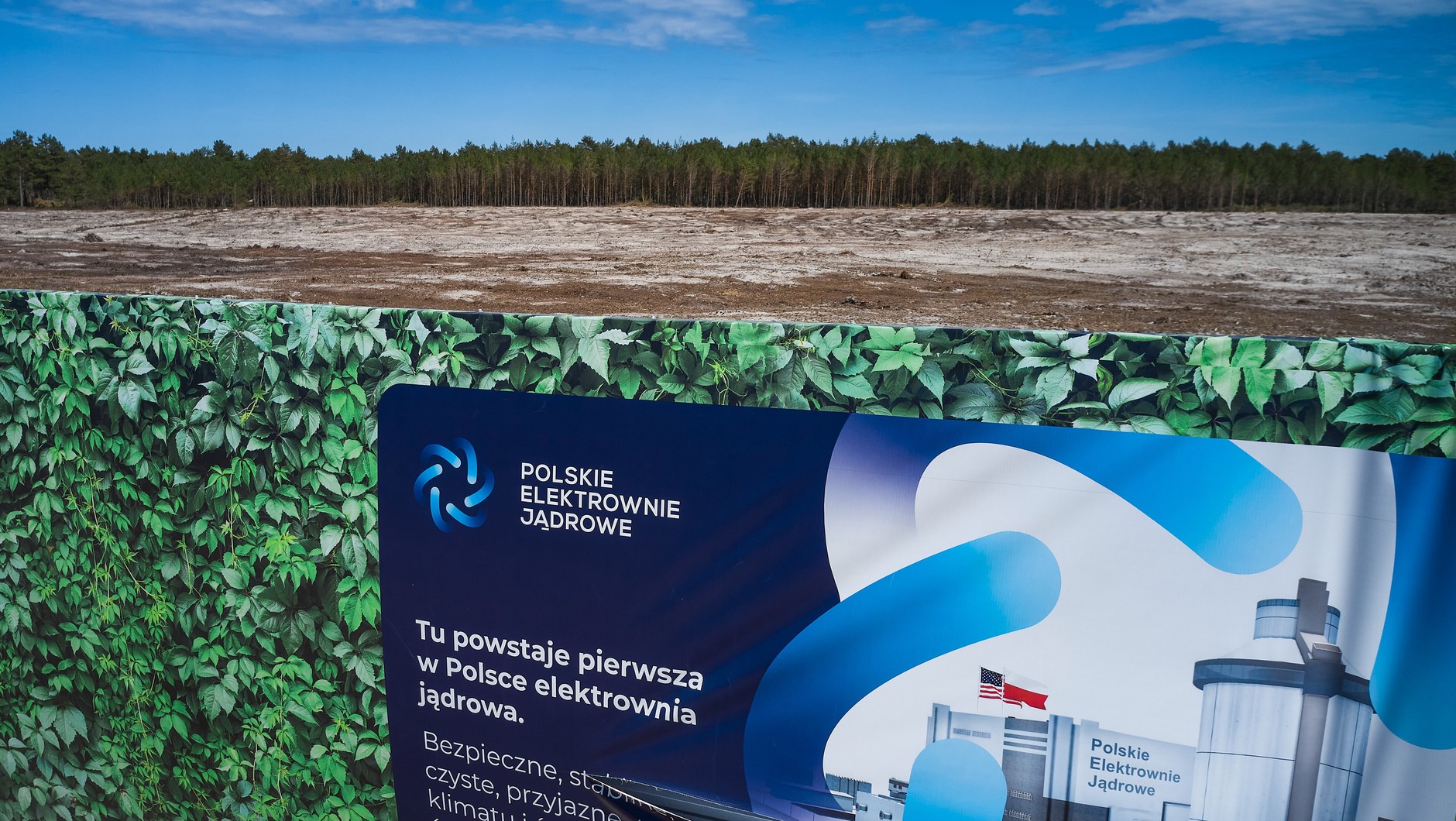
Choczewo. Area for construction of the power plant in 2024.
However, if the power plant is built on a large river, other serious risks arise. Heat waves, droughts or heavy rainfall may negatively impact nuclear safety.
The authors of the study by the Oko Institute assume that in the most optimistic variant, the share of nuclear energy in global electricity production will remain at the current level of approximately 9%. However, even this would require a significant increase in the pace of construction of new reactors. For comparison, in 1996 the share of nuclear energy was 17%. The most realistic forecast for 2050 assumes a share of only 3-4%.
Every road leads to Rosatom
And finally, the last point. Even if we turn a blind eye to all the problems related to nuclear energy, print the missing money, grab the banner with the slogan “Atom for all” and go into battle, at least one very inconvenient problem remains.
A wide expansion of nuclear energy – both in Europe and in the world – is currently impossible without the Russian Rosatom, which has enormous capabilities of enriching uranium and building nuclear power plants. Throughout all four years of the war, supplies of enriched uranium from Russia to the European Union were neither interrupted nor significantly reduced. This shows the scale of dependence, even though the dreamed-of “nuclear renaissance” has not even begun yet.
Postmodern Studio / Shutterstock
Rosatom is a Russian state nuclear corporation headquartered in Moscow and a global leader in nuclear technologies, power plant construction and fuel supplies.
For nuclear power to return, we need to think like Putin
Today's European reality is that a “nuclear renaissance” requires the fulfillment of at least two conditions:
- 1
reconciliation with Putin
- 2
and adopting his approach to money.
In other words, recognizing that there will never be a shortage of financial resources and that economic efficiency is of little importance.
Without meeting these conditions, the European “nuclear renaissance” will be limited mainly to Brussels' financial support for Paris. France, which is heavily dependent on nuclear energy, urgently needs funds to build new power plants to replace aging reactors that will soon be shut down. The cost of these ambitious plans exceeds EUR 100 billion (approx. PLN 424 billion), so sharing the expenses with Brussels is an extremely tempting prospect.
And this is not about expanding the network of nuclear power plants, but only about maintaining the current level of the share of nuclear energy. And France is no exception in this respect in the European Union.
The fundamental problem of nuclear energy is that its use is always associated with high costs and economic losses. No wonder Germany no longer wants to participate in this. The new wave of “nuclear renaissance” did not occur because nuclear energy became cheaper, more efficient or safer than before. It appeared because the existing system does not want to change. For the same reason, Europe was unable to oppose Putin and the war against Ukraine more effectively.
For now, however, this whole “renaissance” exists mainly on paper. And that's most likely where it will stay.