SOURCES The Tomac government, deadlocked: Nicușor Dan has the votes, but refuses the support of the sovereignists

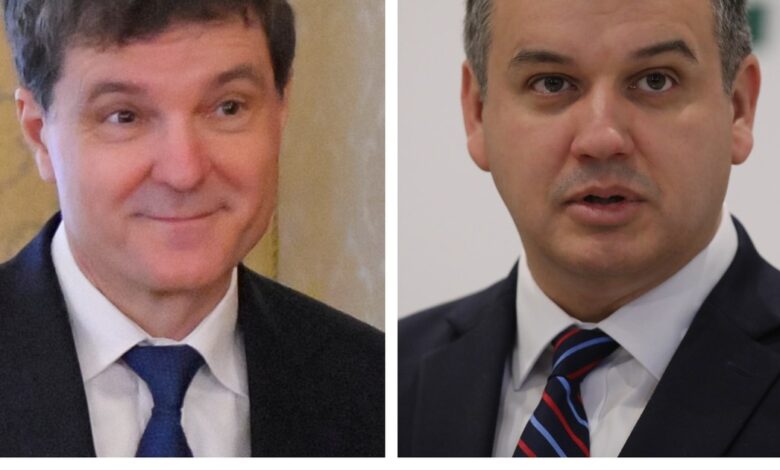
President Nicușor Dan is in a paradoxical situation: he has, in theory, the necessary votes for the installation of the Tomac Government, but refuses to use them. PSD, UDMR and the group of national minorities are not enough, and filling the majority with sovereign parliamentarians from SOS and POT is a scenario that the head of state wants to avoid at all costs.
Nicușor Dan wants Eugen Tomac (PMP) as president PHOTO Mediafax
President Nicușor Dan had several talks with USR leaders in which he asked them to vote for the investiture of a government led by Eugen Tomac, even if they then remain in opposition with the PNL, claim political sources for “Adevărul”. President Nicușor Dan is trying to gather a majority to support the Tomac government, his favorite for the position of prime minister.
The head of state had talks with the party leaders, but also with other parliamentarians to test a majority. For example, Nicușor Dan asked those from the USR to take into account a vote for the installation of the government, then to remain in the opposition. USR has publicly announced that it will not vote for a government in which PSD is a part.
The same decision was adopted by the PNL, a party that is determined to stay with Ilie Bolojan even in the opposition. Most USR leaders are of the opinion that the party should not vote for a government led by Eugen Tomac, with one exception: the cabinet should be made up only of technocrat ministers, unrelated to PSD.
But the PSD is not willing to give up the government. The social democrats have agreed to give up the position of prime minister, but they want to have politically assumed portfolios, claim the quoted sources.
Gabriel Biriș's warning
Gabriel Biriş, lawyer specialized in taxation, and former secretary of state in the Ministry of Finance explained to “Adevarul” that Romania needs a government with a solid parliamentary majority, not an improvised solution. The main stake is the ability of the executive to continue and launch reforms. However, a prime minister who leads a party, has not entered Parliament and has no economic or administrative experience will be overtaken by the political ministers around him, without real authority over them.
It shows that the main obstacles to a possible technocrat government involve difficulties related to emergency ordinances and the fact that certain measures do not even get to be discussed in Parliament.
“Consider that any emergency ordinance must go through analysis. That is, receive approvals that all go through the Ministry of Justice.
Well? How do you do it if the Minister of Justice does not respond to orders? And you're late. You have no idea how many meetings, and before the fall of the government, how many ordinance or HG projects reach the CES (Economic and Social Council) and are postponed because they did not have an opinion from the Ministry of Justice. So even with a strong political prime minister, Mr. Bolojan, the Ministry of Justice under the PSD was delaying their approvals”, emphasizes the expert.
Romanians do not want a technocratic Government
At the same time, an Avangarde survey shows that the majority of Romanians do not support the option of a government of technocrats, nor the appointment of an independent prime minister.
According to survey data, 53% of respondents believe that appointing an independent prime minister from outside the political parties to lead a government made up of former coalition parties is a bad idea. Only 36.5% appreciate this option, while 10.5% did not express an opinion.
Also, the idea of a government of technocrats is rejected by 52.7% of those surveyed, while 37.5% say they would support such a formula.
Who is Eugen Tomac?
Eugen Tomac was appointed honorary advisor for the relationship with Romanians everywhere, a position he took over from October 2025.
His institutional career began in 2006, when he was appointed an expert within the Presidential Administration, having duties in managing relations with Romanians outside the borders.
Three years later, during the Emil Boc government, he was appointed secretary of state at the Department for Romanians Everywhere, a mandate he continued in the Executive led by Mihai Răzvan Ungureanu.
During this period, he supported and implemented several educational and cultural programs dedicated to the Romanian communities in Ukraine, Serbia and the Republic of Moldova. In 2012, he resigned from his position to take the step into parliamentary politics.
Eugen Tomac was re-elected on February 1, at the head of the Popular Movement Party.
We remind you that the Government led by Ilie Bolojan was dismissed on April 5 through a no-confidence motion adopted by the Parliament. The Cabinet remained at Victoria Palace in an interim capacity until a new government was installed to provide for the day-to-day affairs of state. During all this time, President Nicușor Dan summoned the parliamentary parties to the Cotroceni Palace for consultations in order to appoint a candidate for the position of prime minister.