Biomethane – or at least the principles of supporting this branch of renewable energy – are back in the game. After months of pressure from the industry, the government decided to separate the planned regulations on this subject from the regulations facilitating investments in wind farms. This is a proposed amendment to the RES Act, which we wrote about for the first time at the beginning of the year.
Read also: These investments have the least chance. BGK wants to help them
The government wanted to combine instruments for biomethane producers – primarily the introduction of an auction support system for larger installations – with tools for windmill investors. Due to the latter, the bill being prepared was at risk of being vetoed; After the rejection of the previous version of the distance act, there are no major illusions about President Karol Nawrocki's attitude towards onshore wind energy. Organizations representing the biomethane sector therefore pressed for separate proceedings in the regulations. The decision on this subject was made last week, which the industry clearly welcomed.
Biomethane for 400 thousand households
According to the draft National Energy and Climate Plan, after 2030, biomethane is to replace natural gas, thereby leading to the gradual decarbonization of this fuel. As industry estimates show, the Polish biomethane production potential reaches a maximum of 16 billion cubic meters. annually, to which the resources of our agriculture will significantly contribute. For comparison, in 2025, the Polish gas transmission system contained less than 23 billion cubic meters. raw material, which was the highest result in history.
Investments in biomethane plants are planned in Poland by, among others, Biorig – a three-year-old daughter company of Solarig with Spanish roots, which operates on the renewable energy and energy storage market in 12 countries. Biorig started its operations on the domestic market in Spain, where it is currently developing and implementing 26 biomethane installations producing, among others: for recipients in the Nordic countries, then it began to expand in Italy and is currently planning activities in Poland.
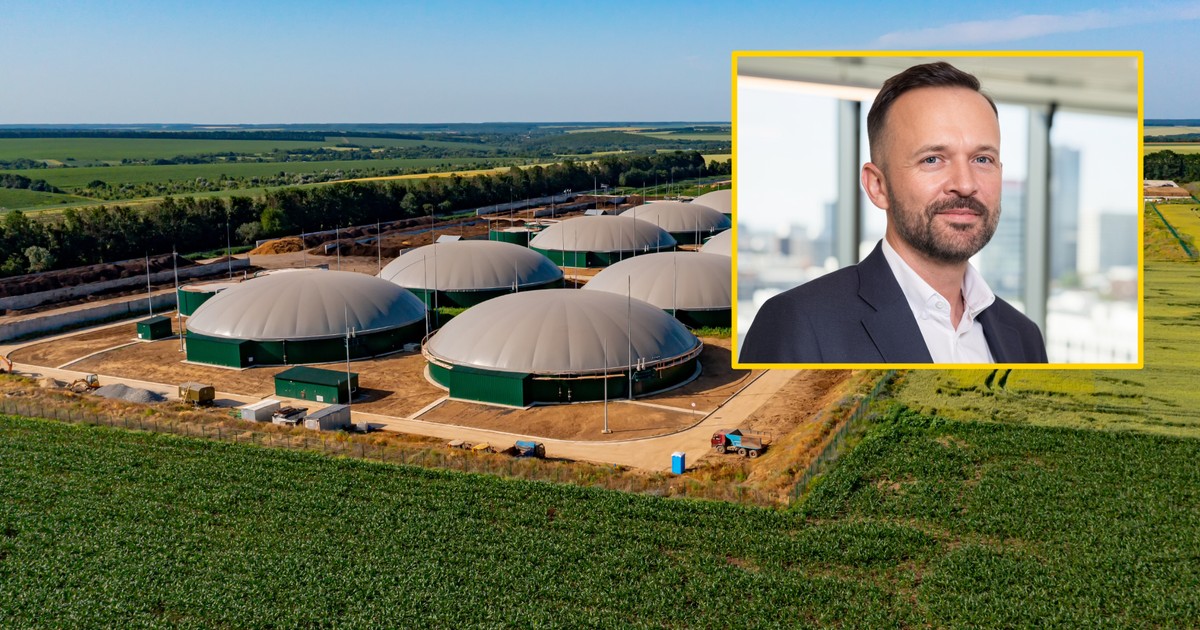
— By 2030, we would like to produce the equivalent of approximately 1 TWh of electricity from biomethane per year, which corresponds to the demand of approximately 400,000 people. households. We plan to invest approximately EUR 350 million for this purpose – says Piotr Kosior, country manager of Biorig in Poland, in an interview with Business Insider.
Piotr Kosior, country manager at Biorig
|
Biorig / Biorig
Minimum profitability from 3 MW
The exact scale of the investment is not yet known; the company is considering about 20 installations producing biomethane and connected to the gas network, although it may turn out that it will be more profitable and easier to build 25 smaller ones. Piotr Kosior says that a lot depends on what regulations and support instruments for the industry will ultimately be introduced.
— So far, state support for biogas plants in the form of feed-in tariffs concerned mainly smaller installations. At Biorig, we target large and mature projects that need other solutions, including, above all, a system of contracts for difference for biomethane installations with a capacity of at least 1 MW. We therefore hope that such solutions will come into force, says a representative of Biorig, referring to the regulations that the government is currently working on. He adds that it is assessed by the company the minimum profitability for investments in biomethane plants starts from 3 MW.
“We focus on a model integrated with agriculture”
When planning development in Poland, Biorig already has a specific strategy. — Biomethane can also be produced from municipal waste, but we focus on a business model integrated with agriculture. Agricultural and breeding waste, such as straw or slurry, allows us to achieve the largest negative carbon footprint, i.e. absorbing greenhouse gas emissions, and at the same time contributes most strongly to the implementation of a circular economy. The used substrate can also be used to produce digestate, i.e. ecological fertilizer, explains Kosior. He also declares that the company will “cope” with the logistics related to the transport and collection of waste from agricultural producers.
Is the Polish countryside prepared for this? Piotr Kosior replies that we have “very solid foundations” for the production of biomethane. — There are over six million cereal crops and almost 1.3 million farms in Poland. We have the potential to become the fifth producer of biomethane in Europe, he says.
Read also: Huge losses for Polish farmers. Efficiency increases won't help
“Developed demand ecosystem”
So what's missing? As we have already said, regulations that will support larger installations and, apart from contracts for difference for the sale of fuel introduced into the gas network, will also ensure the possibility of directly connecting installations to this network. Kosior refers to the example of Italy, where support is already relatively developed.
— It is about supporting CAPEX, i.e. investment outlays, but above all about assistance in bearing operating costs, i.e. the tariff system. Stable revenues through contracts for difference provide projects with financial certainty as well as bankability, he says.
Italy also focused on the other side of the equation, or, as our interlocutor puts it, “a developed demand ecosystem.” — Biomethane is more expensive than natural gas today. If we want businesses to decide to buy it, which will be beneficial for everyone in the long run by reducing the carbon footprint and strengthening independence from fuel imports, we should choose solutions similar to those used in Italy. Transport companies or industrial plants that use biomethane receive subsidies that are a real benefit for business – says Piotr Kosior. To sum up, he states that stimulating the development of biomethane requires the integration of several policies – energy and agricultural, but also industrial and transport.