Article by Andrei Niculescu – Published Sunday, May 31, 2026, 3:59 p.m. / Updated Sunday, May 31, 2026, 3:59 p.m.
“What Paris didn't see” is a title I gave, also here, in August 2023while Luis Enrique was just at the beginning of his adventure at PSG. I was then referring to the observations that French journalists made after the matches, highlighting not only the possession or the number of passes (around 1000 most of the time), but the feeling of the team in the true sense of the word that Luis Enrique was starting to put on stage.
“When have Paris players been so active before losing the ball?”, was the question, rather the remark, of the journalists when it came to the concerted, energetic and not chaotic pressing that PSG showed.
“For the first time in recent years, PSG has acquired a human face, not one polished with gold, which has often been proven to be counterfeit,” I wrote at the time. And we added: “Luis Enrique's challenge now is to make the leaders in Qatar (first of all) understand that in order to make the desired performance, it is necessary to give up the idea of glamour, of Hollywood, in favor of intense work”.
It was still the period in which Mbappe was the supreme leader, in which the memory of Messi still existed, in which the nostalgia for the flashes of Neymar had not faded and in which names such as Sergio Ramos or Verratti seemed very difficult to replace.
“Luis Enrique is the best thing that happened to PSG since Ancelotti left”, cI concluded, without pretending to be a great visionary. Of course, no one could have predicted what was to come. And here I go back to today's headline, because this is what Paris saw. And I am now referring to the club as an institution, to its officials, but certainly also to the supporters, who unconditionally stood by Lucho even in the (not few) moments when the press was looking for him in a hurry.
Paris saw in Luis Enrique the man capable of making the hundreds of millions spent in vain be forgottenon “glamour” and a lot of pampering and to build, quite possibly, an era in European football.
With his style, often disheveled, often misunderstood, often inspired, very often brilliant and extremely rarely overwhelmed, Luis Enrique became the best thing that happened in the history of PSG.
Today he is the best coach in the world, he took the baton from Pep Guardiola, with whom he shares not only an old friendship and a common past but also most of the ideas, but he took it further, becoming the model that everyone is now rushing to copy.
It takes two for the show
This final in Budapest was not the show we would have liked. In a way, neither was last year's in Munich, except that there we were overwhelmed by the quality of the football act proposed by the Parisians. At a football match, in order to have a show, both sides need to be present. Last year, Inter was not at the match, this year Arsenal was, but it did not honor the brilliance that the final of such a competition should offer.
However, PSG showed that they know how to be an emotionally stable team, capable of endlessly trying to find a breach in an opposing system that seemed without cracks. Luis Enrique's men did not lose their patience, nor did they lose their lucidity, understanding that such a defensive gear needs a small error to provide a possibility.
Then, they didn't lose their confidence in the moments when the main actors left the stage, being replaced by others more accustomed to secondary roles. However, Paris finished this final with Beraldo, Goncalo Ramos and Zabarnyi on the field, the latter becoming a downright anecdote for Luis Enrique, who also managed the feat of making a Russian and a Ukrainian fight shoulder to shoulder and then enjoy shoulder to shoulder. Maybe Lucho deserves the Nobel Peace Prize too, don't you think?
Really all the guns on Arteta?
Mikel Arteta, on the other hand, is now a target. Everyone is rooting for him and the way he thought out the strategy for this final. Compared to what Luis Enrique had at his disposal, Arsenal's bench was teeming with talent and attacking players capable, perhaps even willing, of playing football. And not just the bank, the whole lot, actually.
However, Arteta chose a path that helped him succeed in the championship, where we all understood, in the end, that the end justifies the means. That Premier League title had already become an obsession and had to be won by any means.
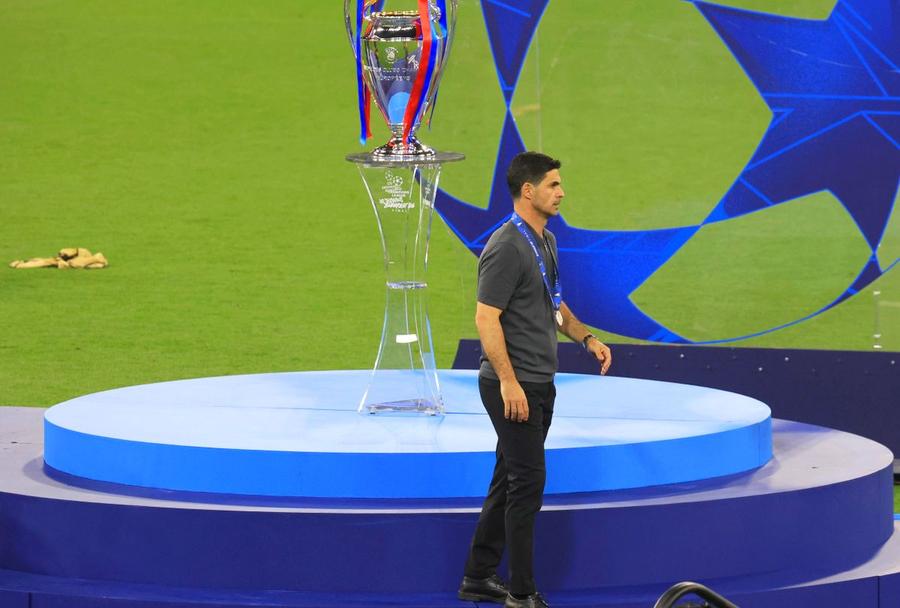
Mikel Arteta / PHOTO: Ionuț Iordache (GSP.ro)
I expected, however, maybe not only me, maybe many others, that once the priority objective was checked, Arteta would try in Budapest to show that he is not a defensive coach, obsessed only with the idea of not scoring, that he is not an old-style Simeone, because even Cholo has changed in recent years, but he can continue the role of Guardiola's disciple.
“In the name of Guardiola”, headlined “Gazzetta dello Sport” in the pages dedicated to the final, obviously including Arteta in the equation, because Mikel spent enough time with coach Pep, infinitely more than Luis Enrique, to not mention here the years spent under the command of Arsene Wenger. In Budapest, Arteta seemed closer to David Moyes, another technician with whom he shared the dressing room for a long time (at Everton), the only aspect taken from Guardiola in this final being the 4 central defenders thrown into the field from the first, just as Pep did in 2023, against Inter.
But football punishes you when you don't treat it with respect. The fact that Arsenal had less possession on Saturday than in 2006, when they lost to Barcelona in Paris, but were outnumbered for more than 70 minutes, is detail enough.
The Gunners did not manage to collect 200 correct passes, which again says a lot. Football has two phases, I have always said this and I will repeat it again and again, attack and defense. Attack scores goals, defense wins games, possibly trophies. Arsenal's attack did not work in Budapest, however, because the fundamental idea was to defend. And I don't think there is, in this sense, a stronger irony of fate than the fact that Arsenal have not lost a game this season in the Champions League, but they have lost the trophy.
Normally, Arteta will have to change from next season. He is called to do this, he is urged by everyone. For Arsenal, failure in the Champions League final is not a drama, because the objective of this season has been achieved. And if we look at the course of the Premier League in recent years, the three successive championships finished in second place, we notice that Arteta and his team always knew how to learn from failures and progress.
In the Champions League, during the last three years, it meant: “quarters”, semi-final, final. The trophy should follow, but that requires Arteta to understand how things work in this competition. It is what, in fact, makes the difference between a good coach and an epoch-making coach.
The man without fear of failure
And now I return to Luis Enrique. Because that's normal. Winner takes all, right?! “The winner takes it all / The loser standing small”, it's a famous song, I hope you know what it's about, even though it's quite old. But the referee says something else: “Beside the victory / That's her destiny”.
Luis Enrique's fate was cruel, and on this matter, you have my word of honor, I still cannot speak, write or think without a lump in my throat.
The way he managed to overcome the hardest test that life can give him explains enough of the success he has today. When you lose so much, you never fear failure. Because failure is gone from your vocabulary. That, in fact, was what Paris saw in him. And that's why, sooner or later, he too will have a statue. The statue of a king in the park of the princes.