“A simple spy office in a strategic place.” Adrian Papahagi explains why the closing of the Russian Consulate in Constanta is a historic signal

The Supreme Council of Defense of the Country decided on Friday, following the drone attack in Galati, to close the Russian Consulate in Constanța and to declare the Russian consul as persona non grata. The decision was hailed by some as a firm signal, but criticized by others as insufficient. Why did it not go further, until the closure of the entire Russian diplomatic mission in Romania? And what should happen so that the Romanian state no longer tolerates the presence on the national territory of the so-called Russian diplomats? “Adevărul” analyzed this topic with Adrian Papahagi, professor at Babeș-Bolyai University in Cluj-Napoca.
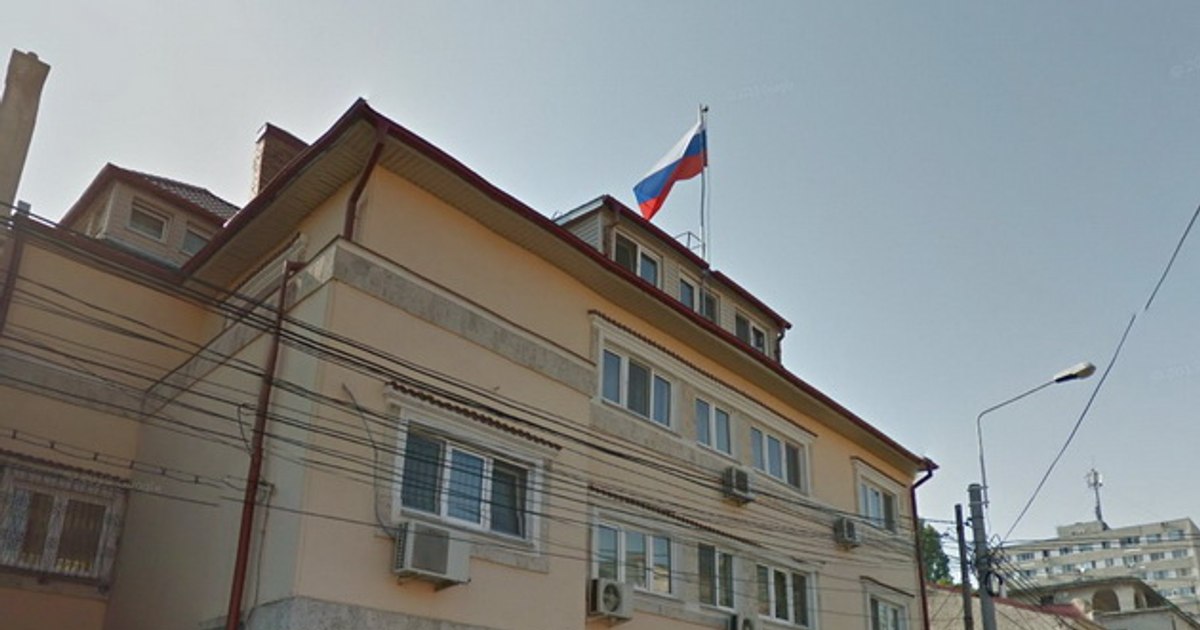
Russian Consulate in Constanta. PHOTO: Mid.ru
Professor Adrian Papahagi praised the decision of the Romanian authorities, which he qualifies as a strong diplomatic signal sent to the Russian Federation.
“On a diplomatic level, yes, they seem sufficient to me, because there are some very strong measures that have not been taken in Romania. It is a very strong, diplomatic signal, sent to the Russians. Let's not forget that this consulate in Constanța has existed since the time of the Soviet Union. Romania never had the opportunity and the courage to ask the Russians to close it. In my opinion, it is a simple spy office in a strategic place in Romania, close to the Kogălniceanu airport, essential for NATO, close to the port of Constanța, where there are ships, close to the border area with Ukraine, so it was an espionage office”, said Adrian Papahagi for “Adevarul”.
Why didn't the Embassy also close?
The question many are asking after the CSAT announcement is why didn't they go ahead and close the entire Russian diplomatic mission? Papahagi offers an answer that has to do with the logic of international law and controlled escalation, not a lack of political will.
“Know that diplomatic missions are completely closed when you are at war. We are not at war with the Russian Federation. The Russian Federation has not declared war on us. Thank God, that would be an overkill, yes? But surely the next provocation or violation of airspace, which, God forbid, may be as serious as this one, may go to further stages, expel the ambassador or reduce the Russian representation to the level of chargé d'affaires and so on further. So yeah, let's hope it doesn't escalate, yeah?” says Adrian Papahagi.
In other words, there is a scale of diplomatic responses, and Romania did not burn all the cards in one go. He was left with options available for even worse scenarios, which, from Papahagi's perspective, is exactly what he needed to do.
The strongest signal in our history to Russia
Beyond the debate about what else could have been done, Papahagi insists on the historical dimension of Friday's decision, which he considers unprecedented in post-war Romanian-Russian relations. He also explicitly praises the way the president handled the crisis in the first hours.
“It's a very strong signal to declare a consul general persona non grata, to ask him to leave the country in 72 hours, to close that consulate, it seems to me that it's a lot. Look at what he's doing. It needs to be responded to appropriately, in my opinion, and at this moment it's a very important and very serious decision. I think the president moved very well yesterday, he convened the CSAT without delay, he gave this decision which is the strongest signal, attention, the strongest signal given to Russia in our history, yes? Romania has never made such a categorical gesture. And then the president went to Galati, and showed solidarity with the victims who are hospitalized”. explained the teacher.
Who speaks in Putin's terms
On the other hand, Adrian Papahagi harshly criticizes the reactions from the AUR, but also from other politicians, who avoided pointing out Russia as the actor responsible for this attack.
“I looked in the press releases from the AUR. No feeling towards the victims, no words for the victims, none. I, up to date, have had enough. Take a look and see for yourself. Half of them avoid mentioning Russia. They speak in Putin's terms. Let's do it, let's see if it was a Russian drone or not before we condemn Russia. Putin said the same. We don't know what drone it is. Send it here for review,” emphasized Adrian Papahagi.
The route of the Russian drone that hit a block of flats in Galati: how it broke away from the attack group and what explosive charge it had
The parallel with the Kremlin speech is not accidental. Papahagi suggests that the refusal to assign responsibility before a formal investigation, presented as prudence, actually replicates exactly the communication strategy that Moscow uses after each incident to dilute Western reactions.
“You can never expect anything good from the Russians. And we have to prepare, through European solidarity and our own forces, to properly defend our borders. And the war is now being fought with drones, which allows you to shoot down drones. That's all.” concluded Adrian Papahagi.
A calculated escalation
For his part, Viorel Mionel, university lecturer at ASE, published an analysis based on the complete chronology of drone incidents in Romanian and Polish airspace. His conclusion is that we are not talking about accidentally straying drones, but a deliberate tactical pattern.
The figures they present speak for themselves. Between September 2023 and May 2026, Russia violated Romania's airspace about 47 times, in a well-dosed crescendo: about 10 incidents in 2023-2024, 13 in 2025 and already 14 in the first five months of 2026, culminating with the drone that fell on the block in Galați. The first drones had no explosive charge, suggesting they were the test phase and Friday's was a deliberate escalation.
“Nothing that happened in Galati is a mistake, but an event that betrays a Russian tactical timeline designed to test NATO's eastern flank and, above all, the unity, the will and the commitment of the states in the area and of Europe to remain united in the face of the hybrid Russian threats. Russia was thus able to confirm that Romania, an important pillar on the south-eastern flank, is not able, both militarily and especially politically, to respond. Or he does not have the courage to do it. We will see in the future, because the challenges will continue.” writes Mionel.
The comparison with Poland reinforces this reading. Warsaw has only been tested three times, but harder, including by a swarm of 19-23 drones in September 2025, of which three were shot down. The result was that in 2026 Poland recorded no more incidents. Romania, on the other hand, was tested 47 times with increasing intensity, without a deterrent military response.
A former CIA analyst is convinced that the Russian drone that crashed in Romania was a deliberate provocation, “approved by Putin”
“Taking the Polish case as an example, we could conclude that the firm and unequivocal answers are able to give Russia the understanding that Romania is not afraid and is willing to defend not only its air sovereignty, but especially its citizens. The Russian drones that violate Romanian airspace have a specific purpose: they collect data, escalate, sow fear and promote disinformation”concludes the geographer.
We remind you that a drone crashed on Friday night on a block of flats in Galati, the incident being followed by an explosion and fire at an apartment located on the 10th floor of the building. Two injured people received medical attention on the spot and then transported to the hospital. Later, about 70 people from that block were evacuated. The incident – the most serious incident on the territory of Romania since the beginning of the war – triggered a maximum alert at the highest level, a CSAT meeting was urgently convened, during which the decision was made to expel the consul general of the Russian Federation in Constanța and to close the consulate.