2024 turned out to be good for the European aviation industry, but not necessarily for the climate. Air ships from airports in the Old Continent set off in a sky over 8.4 million times, emitting 187.6 million tons of carbon dioxide; Compared to 2023, flights arrived by 5 %, emissions increased by 8 percent.
The data is recalled by the Transport & Environment (T& E) organization, which also refers to levels of 2019, i.e. the last preceding Pandemic. In five years, the industry almost completely rebuilt its position; In terms of the number of flights, the result of 2024 is 96 percent. the result of 2019, while when it comes to emissions, it is 98 percent.
As for flights inside the Union (excluding national), their coal trace last year pierced the one before the pandemic, reaching 106 percent. level of 2019. Flights outside Europe approached this result; In 2024 they were responsible for 91 percent. emissions from 2019
Read also: The flight has a plan on CPK. A specific number is raised
Unfulfilled promises?
“These numbers argue with the promises of the aviation sector, which after Pandemia has committed better and more balanced, green practicesK ” – states T&D in a report published on April 28. The calculations of the organization show that by 2050 passenger traffic at European airports can at least double, and in stopping growing emissions In such a situation, even greater consumption of the so -called sustainable aviation fuels.
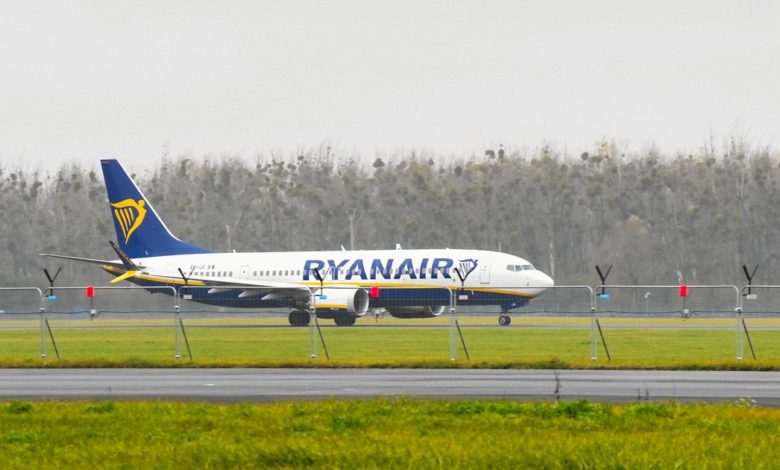
Is it possible to indicate the main culprits? The list of the ten airline most affecting the climate in 2024 opens Ryanairwhich broadcast 16.2 million tons of CO2 – by 9 percent more than in 2023. She took second place Lufthansa (10 million tons of CO2, increase by 6 % in terms of year on year). They trampled her on the heels British Airways (8.9 million tons of CO2, increase by 3 % year -on -year).
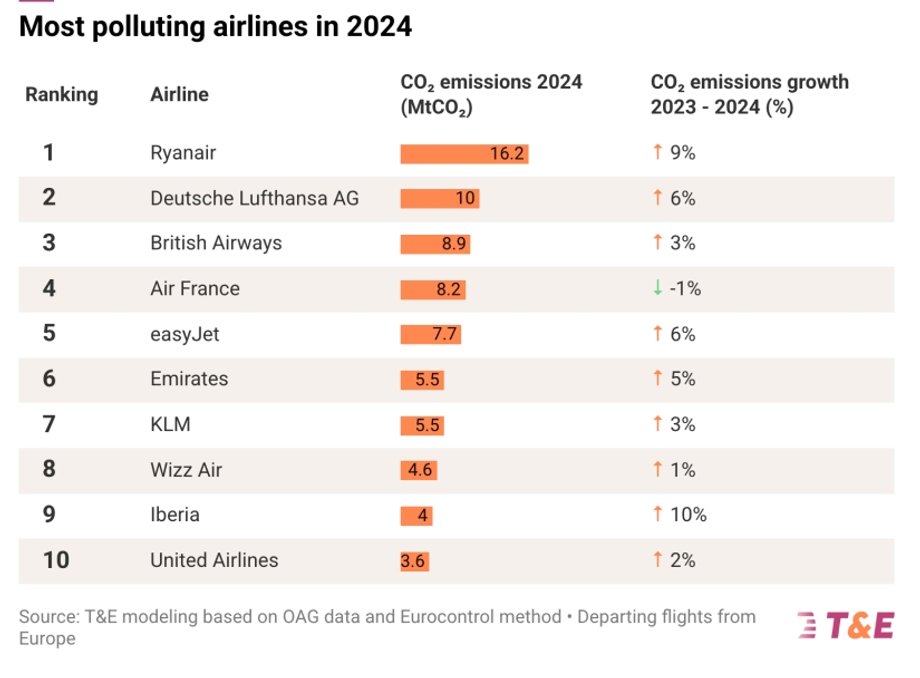
In the years 2023-2024, only one of the 10 most emission airlines in Europe reduced its impact on the climate
Ryanair's leaders' broadcasts were 1.3 times higher than in 2019, and the overall coal trace of 10 record holders was 74.3 million tons of CO2 – 40 percent all emissions from all flights starting in Europe.
What about flights outside Europe?
Of course, they turned out to be especially emission Long -distance flightsof which the first place was taken by the route from London to New York responsible for over 1.4 million tons of CO2. A significant impact on the atmosphere was also showed by sky travels from the capital of Great Britain to Dubai, Singapore or Los Angeles, but from Amsterdam or Frankfurt to Shanghai.
Meanwhile, intercontinental connections are not covered by the ETS emission allowance trade system, which is valid only in the European Economic Area (EU, Iceland, Norway and Liechtenstein) together with Great Britain and Switzerland (both countries have their own ETS systems).
Read also: Changes in the ETS are coming. Free permissions will be issued conditionally
Focusing exclusively on internal flights and the omission of further distances according to Transport & Environment results in the exclusion of 70 percent from the system. CO2 air emissions. The game also goes on Free assignmentswhich air carriers still use (in 2024 their withdrawal only began, which will last until 2026).
As T&C argues, possible aviation income lost by European and British emission allowance trading systems due to the exclusion of a significant part of flights and free allocations, are OK. EUR 7.5 billion. For comparison, last year, emissions from flights in both ETS amounted to EUR 3.2 billion.
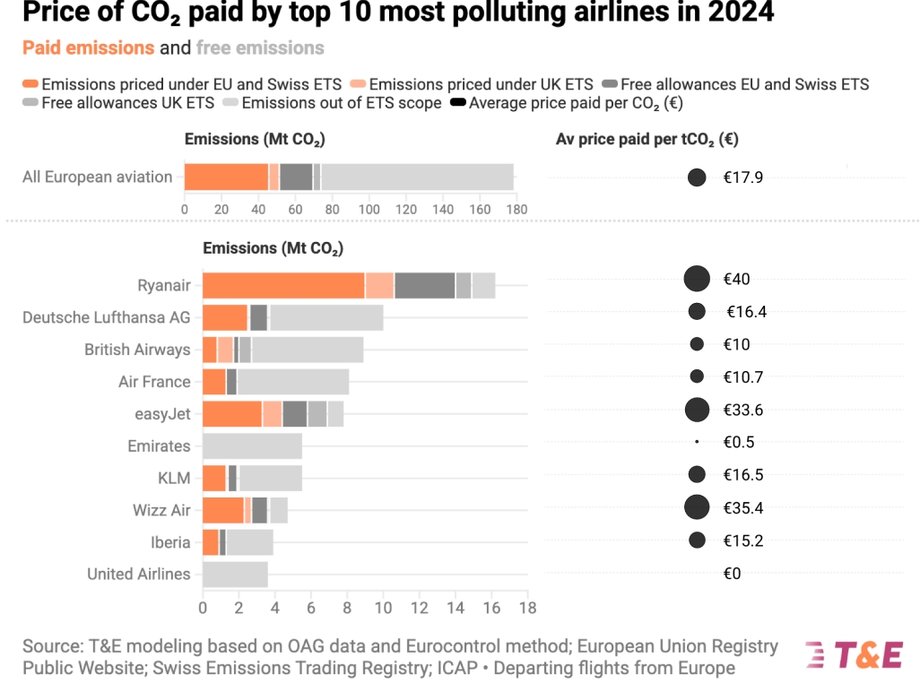
Extending the scope of the ETS system would significantly increase the income from the sale of emissions
Ineffective offset
An opportunity for the postulated extension of the ETS ETS system with intercontinental flights will come at revision planned for next year. What about other methods of limiting the impact of aircraft on the climate?
Global mechanism for compensation and reducing emissions Corsiaadopted in 2018 by the International Civil Aviation Organization, in the assessment & E it is simply ineffective, and unlike the ETS, it does not bring income that can be invested in a green transformation of aviation (including the development of sustainable fuels or hydrogen technologies or industry electrification).
As the representative of T&D responsible for air transport, Krisztina Hencz, relying on Corsia is “economically wrong”, and the solution, consisting mainly in the so -called offset emissions (compensation for e.g. planting forests) does not work financially or atmospheric.
– The extension of the ETS ETS system will bring the greatest positive effect for European economies, while maintaining the greatest environmental benefits The activist said.
Will we have balanced fuels?
Further reforms that supporters of the climate effects of aviation would like to include taking into account other types of impact outside carbon dioxide emissions, such as condensing streaks (from the beginning of 2025, the Union monitors so -called “Effects outside CO2“in the case of internal European flights).
T& e wants too taxation of traditional aviation fuel – Kerozyna, which would happen on the occasion of the registration of the Directive on energy taxation planned by the European Commission.
Read also: The industry that Covid-19 has almost “killed” returns to profits. Fuel prices are the problem
– next year's review of EU CO2 emissions markets is a chance to fix the gap in current regulations and ensure that the airlines will pay The actual cost of your pollution – said Hencz cited by T & E.
Hopes for Green Aviation Transformation They are stuck in the already mentioned balanced fuels, hydrogen or electrification; The promotion of all these technologies is assumed by the EU regulation Refueleu aviationadopted in the autumn of 2023. Last year's report of the Joint Research Center (JRC) operating at the European Commission, however, shows that all these solutions are far from readiness to be implemented on a larger scale; In 2024, balanced fuels were to satisfy only 0.53 percent. airline demand.
Innovative methods, of course, need to be developed, but JRC experts also suggest promoting alternatives to flying, such as railway connections. An example is to shine France, in which domestic flights were banned where it is possible to get efficiently by train.