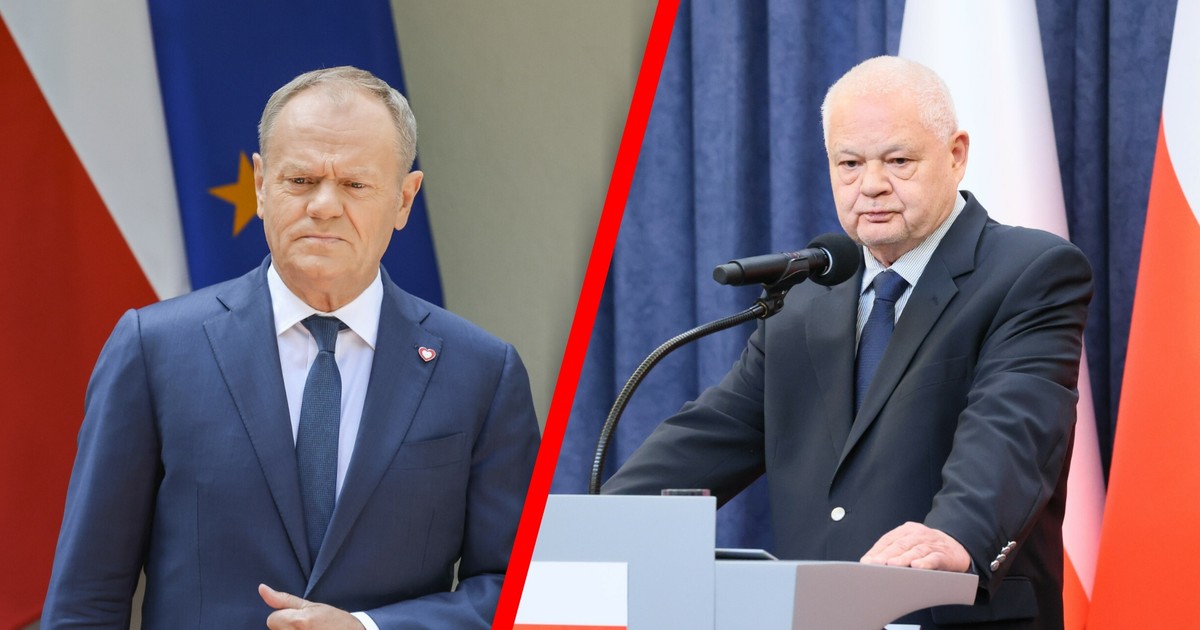
In the premiere episode of the Business Insider podcast Business and Money Bartek Godusławski warns that a seemingly personal conflict may have consequences for the entire economic system.
— Today we have a quite dangerous situation. When you read articles about the dispute over the NBP, it may seem that it is just a political quarrel about positions. But this is of enormous importance. The National Bank of Poland is a fundamental institution for a free market economy and protects the value of money. The legislator apparently never anticipated that politicians in Poland would not be able to reach an agreement on such a basic issue as the functioning of the central bank, says Bartek Godusławski.
Countersignature as a political weapon
The direct axis of the conflict became four nominations to the NBP management board. Adam Glapiński asked the president to appoint Marta Kightley, Ludwik Kotecki, Przemysław Litwiniuk and Marcin Zarzecki. The president sent the documents to the prime minister, but Donald Tusk refused to countersign. As a result, all nominations were returned to the Chancellery of the President. Kightley and Kotecki were to take up their positions immediately, and Litwiniuk and Zarzecki in the following months – from November 2026 and January 2027, respectively.
Godusławski points out that the Prime Minister did not have the political comfort of selecting individual names from the list. The mechanism required a decision for the entire package.
— Prime Minister Donald Tusk received four names of management board members whose appointment was requested by Adam Glapiński. The president sent the documents to the prime minister for a countersignature. They should go back to the president and the president should appoint them. But the Prime Minister sent them back. In this situation, Adam Glapiński is torn between the president and the prime minister because he needs the good will of both. He tried to woo her, but as happens with sitting astride a barricade, he hurt himself. Today, he doesn't have the board members he wanted, says a Business Insider journalist.
SAFE 0%, i.e. a turning point
According to the podcast's interlocutors, the key moment was the joint game between the president and the president of the NBP around the concept of “Polish SAFE 0 percent”. The idea was to provide an alternative to the EU arms financing program, in which NBP gold reserves or profits resulting from the increase in their value would play an important role. President Karol Nawrocki and Adam Glapiński presented this idea as a national, cheaper alternative to the EU instrument, while critics pointed to serious legal and constitutional doubts related to financing the state's needs by the central bank.
In Godusławski's opinion, this move eliminated any chances for a compromise with the government.
— In my opinion, Adam Glapiński knew when he went to the conference with the president that he was losing everything at that moment. After something like this, any deal with the government that was previously within reach, this entire puzzle of four names for the NBP management board, was no longer available to the Prime Minister to sign. SAFE, which was supposed to be a great success for the government, became one of the options thanks to President Glapiński's will. The president gained a lot from this politically because he said: I have an alternative. Of course, she is a bit out of touch, but she spoiled the government's celebration of the program, under which huge amounts of money were negotiated for defense, says Godusławski.
Will the NBP share the fate of the Constitutional Tribunal?
In the interview, Grzegorz Kowalczyk asks a question that resonates particularly strongly in Polish politics: can the NBP share the fate of the Constitutional Tribunal, an institution involved in a long-term dispute over the legality, composition and recognition of decisions?
— This description is almost identical. We do not know whether the partial management board will be able to make decisions, whether these decisions will be recognized, whether it will still be a management board at all, or whether it will only be a group of people who will talk casually in the office at Świętokrzyska Street. Are we facing such a scenario? Here, from an economic perspective, the game is even more serious, emphasizes Grzegorz Kowalczyk.
Godusławski replies that in the case of NBP, the stakes are unique, because the management board is not an ornament of the central bank, but its most important executive body.
— The Management Board of the National Bank of Poland is the most important body of the bank, not the president. Of course, the president is the face of the institution and represents it externally, but he does not have the same causative power as the management board. In many matters she must have his consent. The central bank is an institution that the world watches much more closely than many other state bodies. Therefore, some kind of agreement would be advisable. At this stage, however, I have the impression that politics plays a greater role, he says.
The shadow of the State Tribunal and the logic of elections
The conflict over the management board also involves the issue of Adam Glapiński's liability. The proceedings regarding the possibility of bringing the president of the NBP before the State Tribunal remain open in the Sejm. This makes the management dispute not just a technical problem of filling vacancies, but part of a broader political settlement.
Godusławski reminds that Glapiński has long been indicated by the ruling camp as one of the people to be held accountable.
— Adam Glapiński was on the list of people whom Donald Tusk, as the leader of the Civic Coalition, promised to hold accountable. There were even announcements that he would be removed from the National Bank of Poland. That's why I'm a pessimist today. I am afraid that in the logic of fighting for everything, i.e. the 2027 elections, we may see things that politicians would not have allowed themselves a few years ago, says a Business Insider journalist.
European Central Bank as the last arbiter?
However, an institution that could force people to come to their senses appears in the conversation: the European Central Bank. Not because he would defend Adam Glapiński personally, but because the principle of independence of central banks is crucial for the ECB. In the European Union, the central bank is supposed to safeguard price stability and the value of money, and political interference in its functioning is treated as a systemic threat.
— One short letter from the president of the European Central Bank would be enough. Christine Lagarde will not defend Adam Glapiński as a person. For her, the rules in force in the European Union regarding central banks as institutions guarding price stability, low inflation and the value of money are important. If the ECB allows politicians to remove governors or paralyze central banks, the independence of these institutions will be questioned, Godusławski points out.
He adds that the history of European central banks shows that in crisis situations, the reputation of the institution is sometimes more important than personal ambitions.
— We have had serious corruption scandals in the European Union related to central banks. Even when the prosecutor's office moved to secure documents, the European Central Bank intervened to defend the institution's independence. In Germany, when politicians put pressure on the central bank, its governors did not go to war with the politicians, but resigned, recognizing that for the good of the institution and to preserve its reputation, they had to give in, he says.
The full episode is available here and on streaming platforms:
Business and Money. Business Insider videocast
Are you wondering what changes in the economy, finances and business really mean to you? How do they translate into prices, investments and the household budget? In the Business and Money videocast, Bartek Godusławski and Grzegorz Kowalczyk from Business Insider Polska analyze the most important phenomena every week and show what they really mean for companies, Poles' wallets and your everyday decisions. Reliable, clear and practical. Stay up to date.
New episodes every Friday available on Onet Audio, on YouTube, Spotify and ApplePodcasts.
Bartek Godusławski, Grzegorz Kowalczyk, Business Insider journalists.