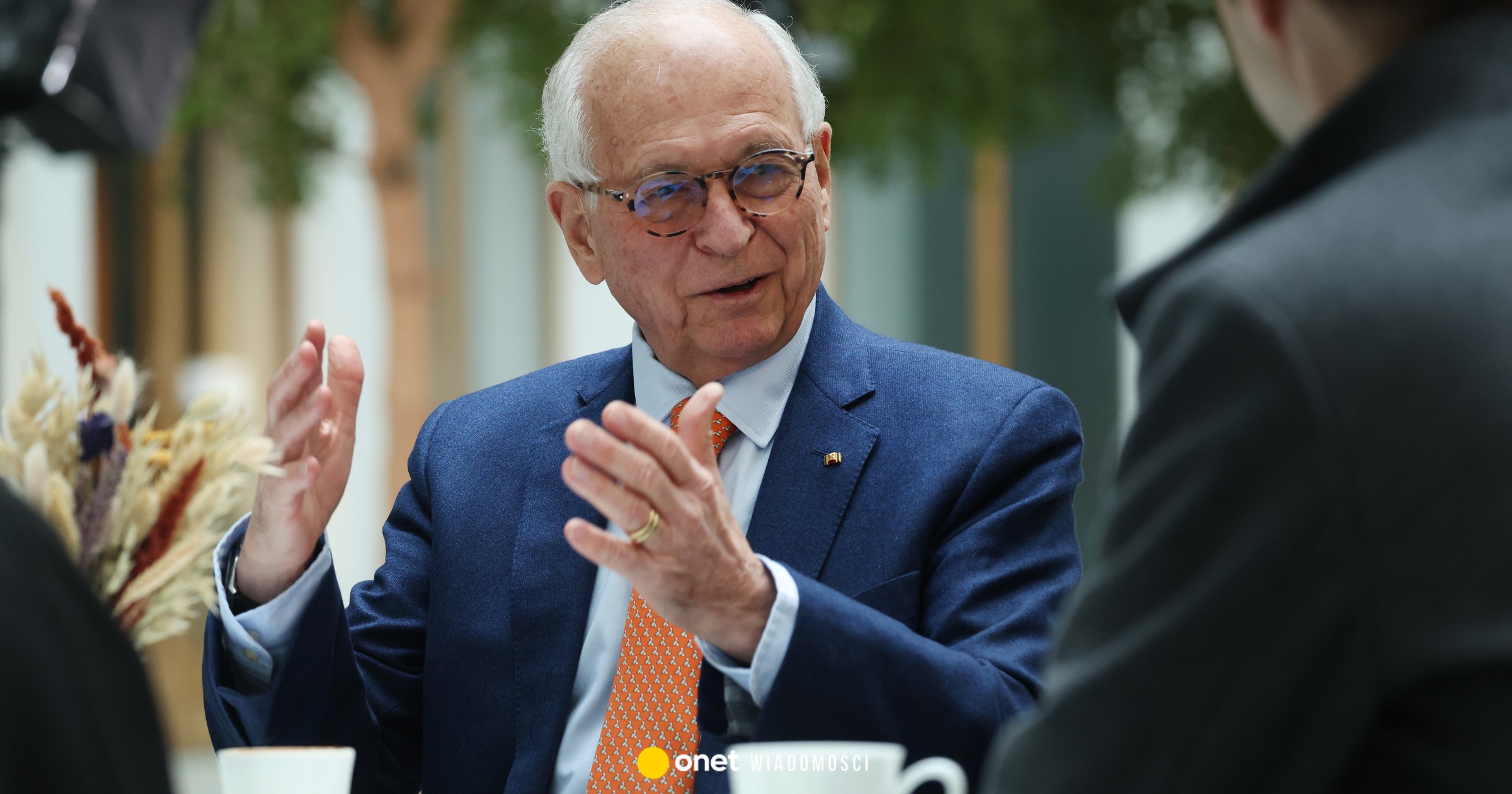
Wolfgang Ischinger – German lawyer and former diplomat, former German ambassador to the US and UK, chairman of the Munich Security Conference
The Pioneer: According to the Financial Times, EU foreign ministers want to discuss next week who could become the EU's special envoy for negotiations between Russia and Ukraine. This is something you called for publicly a few weeks ago. Why is now the right time?
Wolfgang Ischinger: The impetus for this is none other than Vladimir Putin himself, who tried to choose his own European negotiator. This is not an acceptable method for us. I would like to strongly emphasize once again that this step is long overdue.
The community of European states and its partners should not just hang around on the sidelines while the US tries time and time again with Ukraine and Russia to reach normal negotiations. However, I'm a bit concerned that this discussion is being conducted backwards rather than forwards.
There are two forms in diplomacy: one of them is the form of public diplomacy known to us today, i.e. publicly presenting and implementing one's activities. We see this every day with Donald Trump. However, there is another form that has somewhat fallen into oblivion: the so-called silent diplomacy.
The article continues below the video
Before we start naming names, I would first try quiet diplomacy and the so-called rear channel. Such a channel has played an important role in German foreign policy in recent decades, especially in relations with Russia. It wouldn't be a bad idea if we first, without making a public announcement, send someone to talks with Moscow to find out what the other side is ready for.
We cannot make or repeat the American mistake by offering ourselves as a neutral intermediary between Russia and Ukraine. We, Europeans, must take a stand as Europeans – and Ukraine is part of Europe, whose self-defense interests we represent. Therefore, our position would have to be slightly different than the one presented by Jared Kushner and Steve Witkoff over the last 12 months.
Friedrich Merz's proposal to grant Ukraine a special status as an EU partner – “associate membership”, as he put it – fits in this context. What exactly does Merz expect?
I believe that this proposal by the Federal Chancellor is right and comes at the right time. It shows that the European Union can no longer afford the luxury of dragging out accession negotiations for many years. There is a war going on, so candidates for membership cannot be postponed. This also applies to candidates from the Western Balkans, who have been waiting for concrete progress in the negotiations for over 20 years.
Since the door to NATO has failed to open, there is pressure to speed up the EU accession process. The Federal Chancellor has initiated a debate that I hope will ultimately lead to a gradual process in which not all requirements have to be met, but only some. For Ukraine, this could at best mean that it could benefit from the security alliance that the EU is creating before it actually becomes a member.
Would a special partnership with Ukraine, as Merz proposes, end the war?
We cannot set our expectations too high. It is more likely that a ceasefire will bring some peace first. I am skeptical as to whether all 27 EU Member States would agree to activate the protective function that the Treaty on European Union provides to its members and which is one of the elements proposed by Friedrich Merz in his proposal.
Nevertheless, I can only support this idea. Mario Draghi or former Finnish President Sauli Niinisto, whom I know personally, could be among the candidates to represent the EU. Niinisto, in particular, maintained tolerable relations with Putin for many years.
Is access to Vladimir Putin necessary in this case?
I think this access would be important. However, there are better and proven formats in contacts with Russia, for example the contact group, with which I had very positive experiences in the 1990s. At that time, the future Russian Minister of Foreign Affairs, Igor Ivanov, personally participated in it, thanks to which we managed to end the bloody war in Bosnia.
What would an end to the war look like that was negotiated solely between a representative of Europe and Russia? What about the US, Turkey? For this reason, it is an ideal tool – as long as all stakeholders are considered.
So would a contact group have the advantage that all interested parties participate in it, not just individual representatives?
Yes, group members make decisions together, so no action is taken alone. In some circumstances, you negotiate separately but make decisions as a team.
You have known many of these players for decades. How often does your phone ring now?
Like all of us, I am very worried and I talk to many people; I was recently in Washington. Europe must take up its responsibility, not only with regard to the war in Ukraine, but also with regard to the Strait of Hormuz, the Gaza Strip, Lebanon and the Middle East in general. We cannot allow ourselves to be pushed to the margins because this does not correspond to the global political ambitions of European citizens. I think this is absolutely possible.
I’m Ashley Davis as an editor, I’m committed to upholding the highest standards of integrity and accuracy in every piece we publish. My work is driven by curiosity, a passion for truth, and a belief that journalism plays a crucial role in shaping public discourse. I strive to tell stories that not only inform but also inspire action and conversation.