How the European car industry came to struggle for survival. Chinese electric cars rule the roost in Europe, with cheap and high-performance models

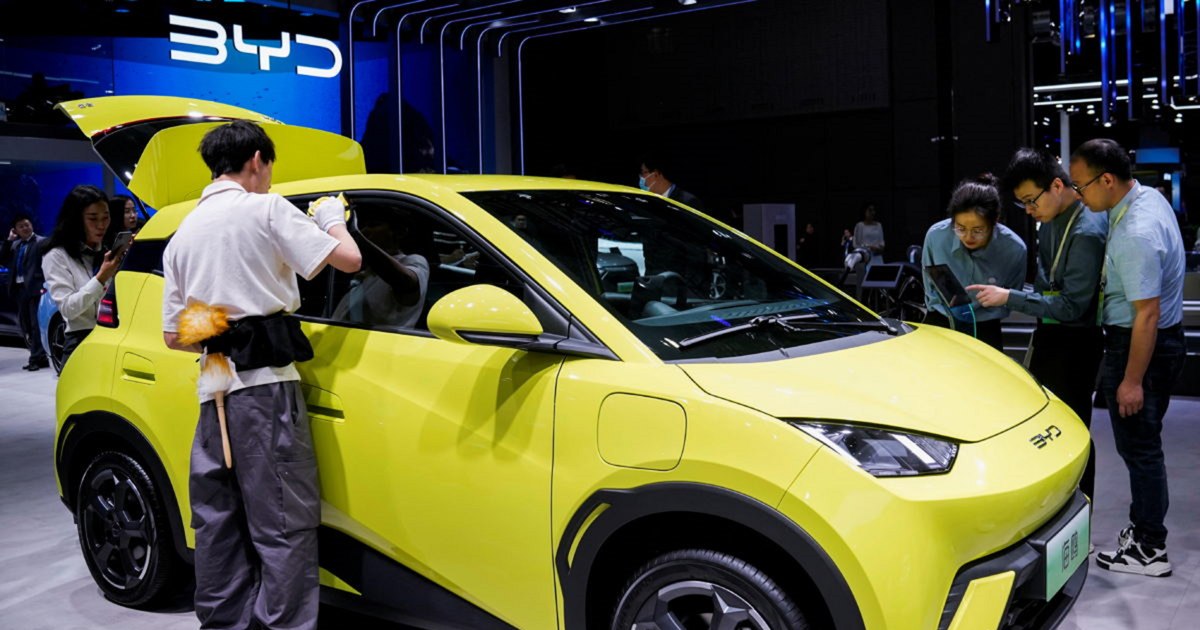
Chinese electric cars are starting to dominate the European car market. Against the backdrop of overproduction, Chinese companies have invaded the Old Continent with affordable, high-tech and attractively designed models. In this context, the European car industry is fighting for survival.
Chinese electric cars invade the European market PHOTO pbs.org
In the last decade, the Chinese car industry has experienced spectacular development, especially in the electric car sector. The number of companies grew rapidly, technologies became increasingly advanced and competitive, and production reached enormous levels. Basically, Chinese manufacturers have invaded the European car market, turning China into the largest exporter of cars in the world, writes the Financial Times.
Chinese companies offer a wide range of electric vehicles and try to meet all the demands of consumers in the Old Continent. Moreover, the massive production of electric cars was well calibrated in relation to the trends related to sustainable living and environmental protection, promoted including through the legislation of many European states.
Initially, Chinese manufacturers went for imitation, but later they started to develop more and more technological and competitive models. In addition, they offer electric cars at lower prices than established brands from Europe, Japan or the United States.
Moreover, many European companies make extensive use of Chinese factories as production and export bases. There they find skilled labor, experience and technology, but at much lower production costs. In short, the Chinese industry has come to play a pivotal role in the global electric car market.
From copying to industrial dominance
In the early 1970s, Dongfeng imported American trucks to learn how to build military vehicles. Today, the same Chinese group produces electric models for global markets alongside Stellantis. The transformation symbolizes the new order in the automotive industry: China is no longer just the workshop of the world, but the global center of innovation and production of electric cars.
Amid the costly transition to electric vehicles, major Western manufacturers — Volkswagen, BMW, Nissan or Hyundai — are increasingly using Chinese factories as export bases for Europe, the Middle East and Asia.
Exports explode
China has already become the largest car exporter in the world. In just a few years, exports have grown from under a million cars in 2020 to over 7 million last year. The pace continues to accelerate: in the first four months of 2026, foreign deliveries climbed 61%.
The phenomenon is fueled by the huge overcapacity of Chinese industry. While the domestic market absorbed about 24 million cars last year, the total production capacity is estimated at nearly 50 million vehicles.
Electric cars from China PHOTO shutterstock
In addition, the price war and shrinking margins are pushing Chinese manufacturers to overseas markets, where cars can be sold at higher prices and with bigger profits.
Europe, the new battlefield
The United States has virtually shut down the market for Chinese automobiles with tariffs of up to 100 percent. But Europe remains a strategic target, despite its own trade tariffs.
The results are already visible. Chinese exports to Europe have grown strongly, and brands such as BYD, MG, Omoda or Jaecoo are rapidly gaining ground. Chery's Jaecoo 7 has become the UK's best-selling new car in a month, just 14 months after its launch.
Small electric cars, problems or solutions for traffic in cities: “You get afraid of running out of battery”
At the same time, Western manufacturers are exporting more and more models produced in China. Nissan wants to reach 300,000 vehicles exported annually by 2030, including to Europe. Tesla makes a large portion of the Model 3s sold on the mainland in Shanghai.
China sets the technology standard
Industry specialists are increasingly admitting that China's advantage no longer lies only in low costs, but mostly in technology. Chinese electric vehicles are developed faster, use cheaper batteries and more advanced software. “We must accept that China sets the pace of innovation,” said Robert Cisek, head of Volkswagen China, reports the Financial Times.
According to the “International Energy Agency”, the production of an electric SUV in China costs at least 30% less than in developed economies. Volkswagen even claims it can produce an electric vehicle in China at half the cost in other regions. More and more Western companies are adopting the “in China, for China, to the world” strategy — developing cars in China and then exporting them to global markets.
The addiction that worries Europe
But China's rise is causing panic in European capitals. EU leaders fear that the European car industry risks losing not only production but also technological know-how.
Analysts warn that automotive engineering, research and supply chains could become increasingly concentrated in China. In many cases, European manufacturers end up using Chinese technologies even for models produced in Europe. At the same time, European factories are operating well below capacity. Some groups are trying to solve the problem by partnering with Chinese manufacturers. Stellantis wants to manufacture Dongfeng models in France, and Opel will produce an electric SUV in Spain using Leapmotor technology.
The trap of cars brought from Germany: 9 out of 10 vehicles have hidden problems according to the latest data from the car market
“Made in Europe” and a fight for survival
The European Commission is trying to limit dependence on China through new industrial rules. The “Made in Europe” plan would condition access to subsidies on the use of components produced in the EU.
Brussels is also considering restrictions on Chinese technology built into cars, amid concerns about cyber security and data control.
However, European authorities are in a delicate position: a complete break with Chinese technology could seriously affect even the European car industry, which is increasingly dependent on batteries, software and components developed in China. In just a few decades, China has gone from the status of a pupil of Western industry to a global leader in electric mobility. For European and American builders, the dilemma is increasingly clear: either collaborate with the Chinese industrial ecosystem or risk losing the technological race. And for Europe, the stake is no longer just economic competitiveness, but the survival of one of the continent's most important industries.