Summit in Brussels. These could be decisive days for Europe and Ukraine

Kiev's financial needs for the next two years amount to at least EUR 134 billion (PLN 564 billion). Part of this amount is to be covered by the International Monetary Fund (IMF). However, this will only be possible if the IMF aid program is supported by additional billions. But where to get this money?
Cash subsidies from Brussels are intended for Ukraine crucial to its survival. Washington withdrew funding support for Kiev's war effort after President Donald Trump took office almost a year ago.
The head of the European People's Party (EPP), Manfred Weber, said that in the face of the approaching winter it is necessary send a signal to Ukraine that we are on its side.
But will it work? Europeans have been arguing over financing conditions since September.
The stakes are high not only for Kiev, but also for the European Union. If Ukraine cannot be kept afloat thanks to European funds, this may further fuel criticism from various circles about a “weak Europe” and “chaos in Brussels”. Moreover, from the point of view of the American administration, it may be even more so weaken the position of Europeans in talks on a possible ceasefire.
From the point of view of European governments, the decision on further financing of Ukraine must be made during the Christmas summit. The President of the European Council, Antonio Costa, announced that he would not end the meeting until the result was presented. Several financing proposals are being considered in Brussels.
From the point of view of the European Commission and most member states, the most promising proposal is that Europe should partially use the assets of the Russian central bank, frozen since 2022, amounting to EUR 210 billion (PLN 884 billion). For legal reasons, the German government had long been adamantly opposed to the idea, but in September it suddenly changed its mind. Chancellor Friedrich Merz even led the movement in favor of this initiative. The largest part of the assets, approximately EUR 185 billion (PLN 779 billion), is held by the Belgian financial institution Euroclear in Brussels.
Plan for Ukraine
The idea is that the EU wants to use the frozen funds against the will of Moscow — which will likely make already difficult ceasefire talks much more difficult — without expropriating Russia, which would violate the principle of the so-called state immunity.
A few months ago, the European Commission developed a construction with a mysterious name, controversial in terms of international and political law. “reparations loan”. Put simply, the point is that the European Commission actually wants to confiscate EUR 90 billion (PLN 379 billion) of the approximately EUR 185 billion (PLN 779 billion) stored in Euroclear and transfer this money to Ukraine in the form of an interest-free loan.
This step would several political advantages.
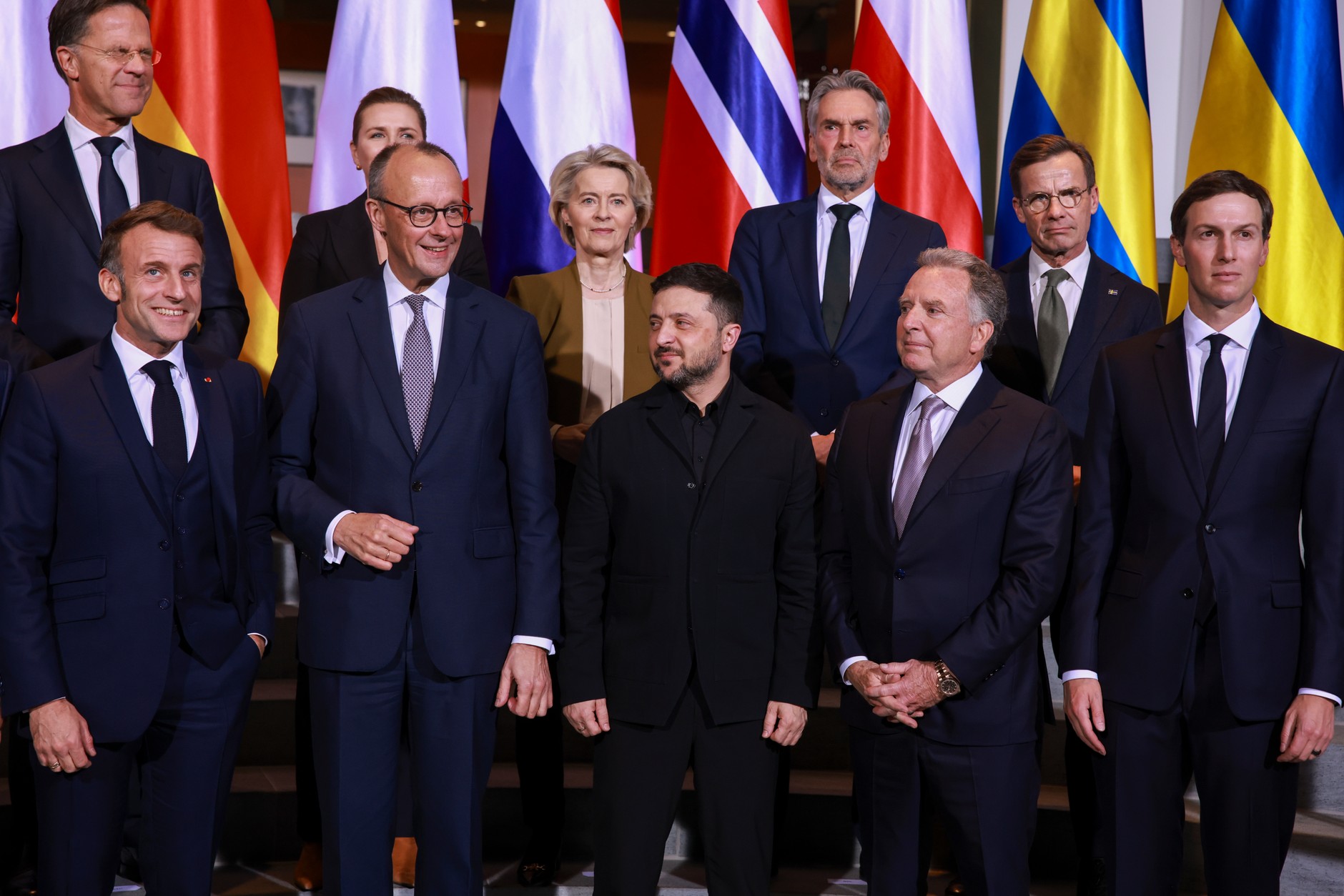
Volodymyr Zelensky with leaders in Berlin, December 15, 2025.Clemens Bilan/Getty Images
First, the money would be available quickly.
Secondly, it would meet the demands of a significant part of European public opinion that Moscow be punished for the war in Ukraine.
Third: a reparations loan would create the impression in public opinion that EU countries can miraculously support Ukraine financially without burdening their own budgets.
Fourthly, joint debt (Eurobonds) to finance Ukraine, highly controversial in Germany, is excluded.
Fifth: by permanently freezing Russian central bank funds last Friday and by planning a reparations loan, Europeans are preventing Americans and Russia from accessing these funds, as envisaged in Trump's 28-point plan.
Belgium's opposition
For months the Belgian government opposes the idea. This already led to a scandal during the EU summit in October. However, it was assumed in Brussels that Belgium would back down. However, this did not happen.
Now Merz and company want to make an impact pressure on Belgian Prime Minister Bart De Wever and bring some sense to him – even if the negotiations last until Sunday.
De Wever fears that Moscow may pursue claims compensation claims for the confiscated billions from the Belgian financial institution Euroclear. So that in such a case only Belgium is not burdened, De Wever demands appropriate safeguards from Europeans.
And indeed: last Friday, the Russian central bank filed a lawsuit against Euroclear in a court in Moscow, estimating its claims at approximately EUR 195 billion (PLN 821 billion).
However, the European Commission wants to legally ensure that claims awarded to Moscow by a third-country arbitration court cannot be enforced in the European Union. In any case, it should be expected that Moscow will now take retaliatory measures against the European capital remaining in Russia, and in particular against investors from Belgium.
An increasingly difficult discussion
Theoretically, most EU countries could outvote Belgium on a reparations loan decision. However, this would be an affront to one of the founding states of the EU. None of the leaders want this. Additionally, several countries, such as Hungary, the Czech Republic and Slovakia, also oppose the planned financing of Ukraine, but for different reasons.
Hesitations also appear in Italy. Italian Prime Minister Giorgia Meloni is under pressure from her coalition on this issue. The High Representative of the Union for Foreign Affairs and Security Policy Kaja Kallas said on Monday that the discussion on the use of Russian assets frozen in Europe is becoming “increasingly difficult”.
The European Commission recently tried to solve Belgium's dilemma by promising, as it put it, a “three-tier defense.” This was supposed to lead to a situation in which “there will be no scenario” in which Euroclear will not recover the money. EU countries would provide warranty to cover any potential liabilities of Euroclear.
De Wever does not believe that EU countries will ultimately be ready to take such a step. He demands written guarantees, which the heads of government are unable to provide in this form.
Preparations for the summit in BrusselsMICHAEL NGUYEN/Getty Images
Peace negotiations in the background
Several countries have already signaled that they do not want to join in. Italy is uncertain and even in France it is unclear whether President Emmanuel Macron will be able to force reparations loan guarantees through the National Assembly. This could lead to the so-called blocking minority, which would require at least four member states representing 35 percent. EU population.
As a result, the entire loan plan would fail. This would be the worst-case scenario, but Brussels does not rule it out. In principle, the rule applies: the fewer countries participating in the program, the higher the amount of responsibility of the remaining countries – especially Germany, which would have to cover at least a quarter of the loan amount anyway.
Ultimately, however, according to Brussels' plan, member states would have to cover EUR 90 billion (PLN 379 billion) only if, after the end of the war, Moscow paid reparations to Kiev for the effects of the war in at least the same amount. In Brussels this is considered out of the question.
However, Russian leader Vladimir Putin may thwart Brussels' plans. His condition in possible negotiations on a ceasefire or peace in Ukraine could be that without the immediate return of confiscated funds from the Russian central bank, Moscow will not make any concessions during the talks. Of course, this could be very costly for EU countries.