This strange gadget never entered mass production. Only eleven pieces were made, and in 1926 it disappeared from the radar. Today, in the times of TikTok, notifications every few seconds and a generation that self-diagnoses ADHD after 15-second videos, it is worth returning to it. Are concentration problems really new? Could mechanical insulation help in 2026? And how does modern science deal with what Gernsback fought with wood, oxygen and a narrow viewfinder?
Hugo Gernsback was born in 1884 in Luxembourg and emigrated to the United States as a young man. He was not only an inventor (he has about 80 patents), but also a publisher of popular science magazines and a true pioneer of science fiction. He founded the first magazine devoted to this genre, “Amazing Stories”.
- Read also: I'm afraid I'll stop reading soon. Neuroscientist: It's a profit and loss statement
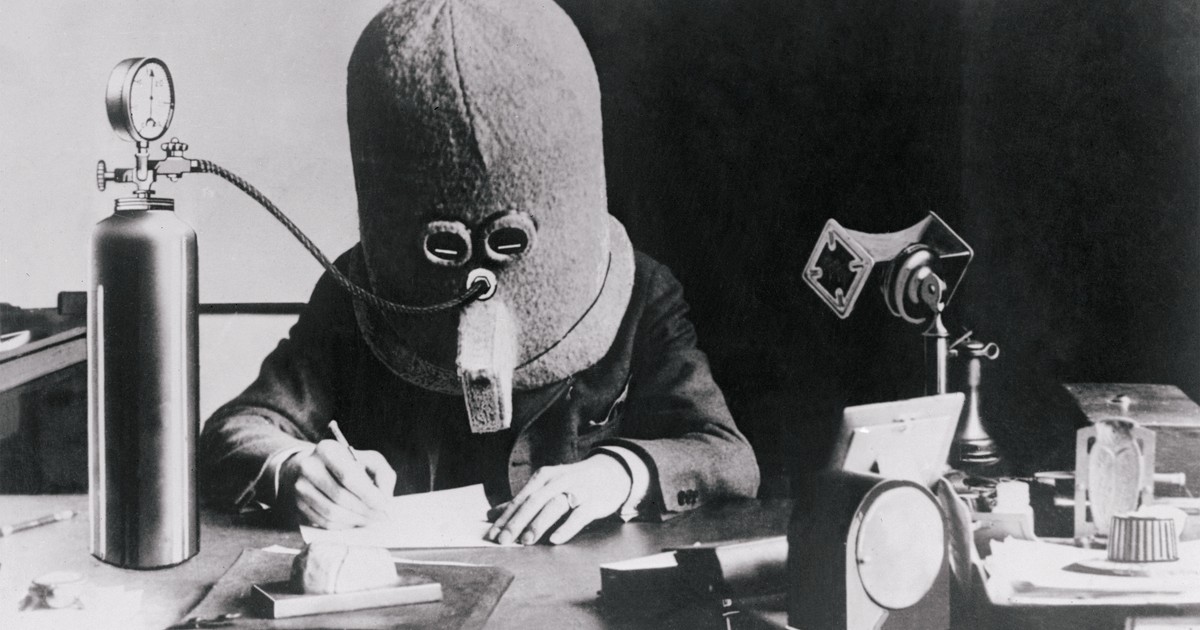
In July 1925, on the cover of another of his magazines – “Science and Invention” – he presented a helmet called “Isolator”. It was supposed to be a revolutionary solution to a problem he knew perfectly well: “long, deep, concentrated thinking is one of the most difficult things a person must achieve.”
Gernsback watched as even in a seemingly quiet room, the mind sought to escape. A telephone ringing, noise from the street, a fly on the wall or a pattern on the wallpaper. He believed that in the era of urbanization, radio and the first telephones, mechanical isolation could become the future of intellectual work of writers, scientists and students.
How did “Isolator” work?
The first prototype was simple but effective in its austerity. The helmet was made of wood, lined with cork and felt inside and out, and painted black to eliminate any visual stimuli. A special partition was installed in front of the mouth, which allowed breathing but muffled sounds. In place of the eyes, two pieces of glass were placed, creating a narrow slit so that the user could only see what was directly in front of him on the desk, usually just two lines of text.
Helmet “Insulator” (1925)
|
Bettmann / Contributor / Getty Images
Gernsback claimed that the helmet blocks 90-95 percent. sounds from the surroundings. However, it quickly turned out that after several minutes in complete silence and limited ventilation, a person begins to feel drowsy due to oxygen deficiency and the accumulation of carbon dioxide. So the inventor added an external oxygen cylinder that had to be replaced about every half hour.
The effect was radical: the user became a real “island of concentration”, cut off from the world, focused only on the task.
Who is this isolation for?
In the 1920s, distractions were a real problem – increasing urbanization, traffic noise, ringing telephones and the increasingly popular radio disrupted mental work. Gernsback saw “The Isolator” as a tool for those who complained about a lack of focus: writers, inventors, students.
- Read also: Addicted to noise
Unfortunately, despite the creator's enthusiasm, the invention did not catch on. Only eleven pieces were produced. The helmet was heavy, grotesque in appearance and simply impractical. Drowsiness after a dozen or so minutes, the need to replace the oxygen cylinder and a claustrophobic feeling meant that few people wanted to use it on a daily basis. Interestingly, too much isolation could paradoxically make it difficult to concentrate. There was also the aesthetics: it looked like a prop from a horror movie, not an elegant work tool. As a result, it disappeared already in 1926, although Gernsback patented it and called it “a great investment”.
Does this mean that problems with concentration were already a huge problem? Yes, but on a completely different scale than today. People have complained about distractions for centuries – medieval monks wrote about fighting “mind wandering.” In the 1920s, new technologies and the hustle and bustle of the city actually made it difficult to concentrate.
ADHD had also been described earlier (the first clinical records date back to the early 20th century), but it was not a mass phenomenon. Historical research shows that distractions have always accompanied humanity, their intensity and source have simply changed.
Would a similar invention have a chance in the era of the “TikTok generation”?
The TikTok generation and older really struggle with attention deficit. Short, dynamic videos train the brain to quickly switch attention, and algorithms keep us in a dopamine loop. Research from 2024-2025 indicates that excessive use of short-form videos correlates with shorter attention span, decreased self-control, and an increase in ADHD self-diagnoses. On TikTok, more than half of the most popular videos about ADHD contain inaccuracies or are misleading, which paradoxically increases awareness, but also pathologizes normal concentration fluctuations.
- Read also: What happens to your brain when you don't use your smartphone? Surprising results
A modern version of “The Isolator” could make sense, but not in a wooden, claustrophobic form. However, we can imagine advanced headphones with active sound suppression, combined with VR glasses that limit the field of view, and applications with a deep immersion mode. People are already buying sensory cabins and noise-cancelling helmets.
There is a demand for insulation, but it must be comfortable, discreet and aesthetic. The extreme helmet with an oxygen tank is unlikely to return.
How does modern science deal with attention deficit?
Fortunately, we no longer have to put on wooden helmets. Science offers a multi-pronged, evidence-based approach.

Diagnosing ADHD in children today is crucial
|
Studio Romantic / Shutterstock
In people diagnosed with ADHD, the most effective are stimulating drugs (methylphenidate, amphetamines), which work in 70-80 percent of cases. patients, helping to “normalize” brain functioning. Cognitive-behavioral therapy (CBT), mental training and lifestyle changes include regular sleep, physical activity and a diet rich in omega-3.
For “ordinary” attention deficit caused by technology, conscious management of stimuli is recommended: website blocking applications, the Pomodoro technique, “do not disturb” mode on the phone and regular “digital detox”.
Instead of wearing a helmet, turn off notifications
Gernsback's Isolator was visionary, but premature and too radical. Today we have much better tools and we do not have to cut ourselves off from the world completely. You just need to manage it consciously. The problem of distraction is not new, but the technology that makes it worse also gives us the tools to solve it.
- Read also: The results of research into the intelligence of Generation Z have horrified researchers. “It hasn't been this bad since the end of World War II”
Maybe instead of putting on a wooden helmet from 1925, you can just… turn off notifications and give yourself a chance to deep focus? Sometimes the simplest solutions are the most effective.