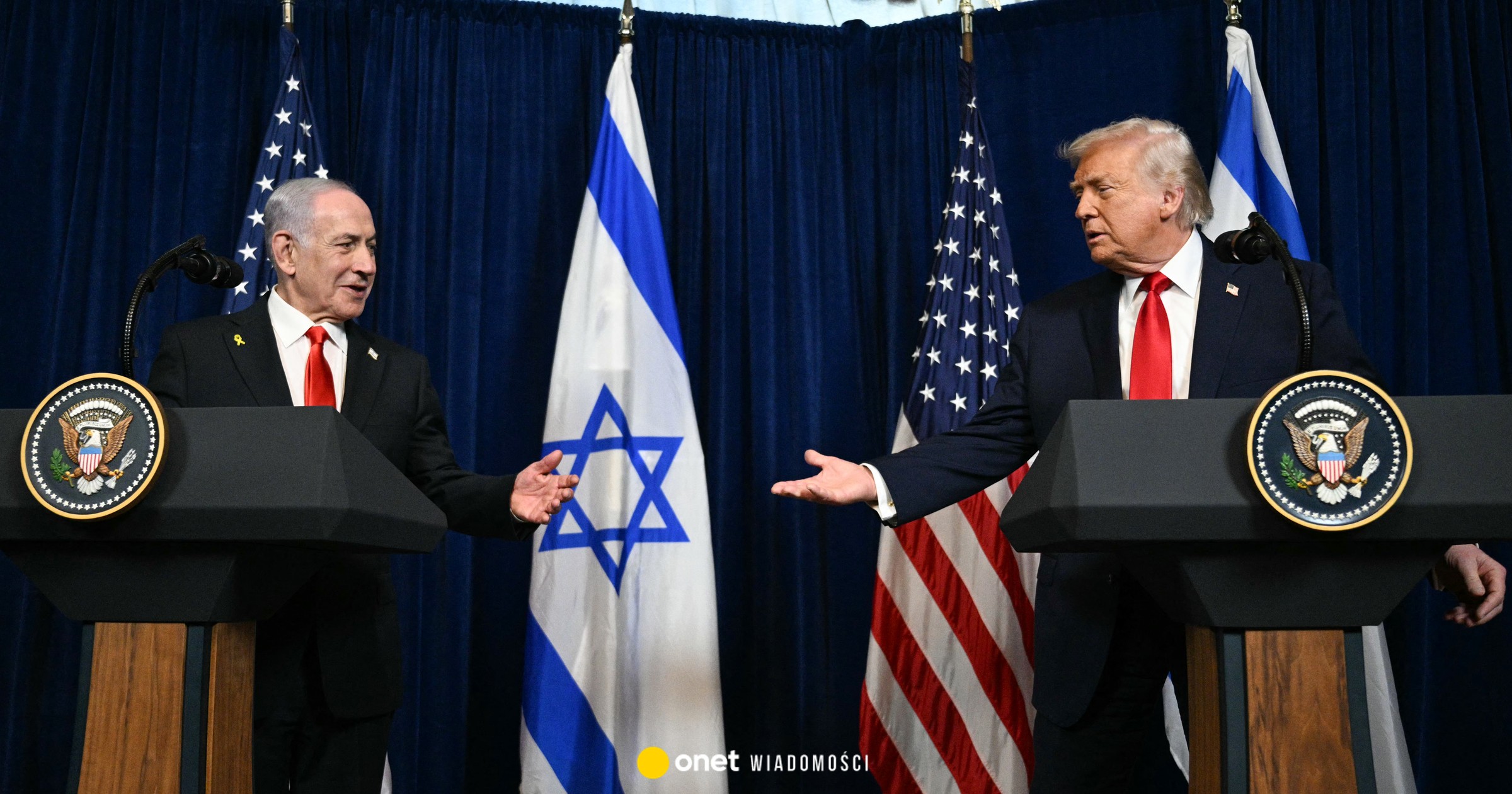
Is this the end of their friendship? There was supposed to be a heated argument between Donald Trump and Binyamin Netanyahu on Tuesday. According to the American media Israel's prime minister was “furious beyond words”. The reason was different visions of ending the war with Iran.
Trump wants to end military operations as quickly as possible – military operations consume huge amounts of money and ammunition, and the blocked Strait of Hormuz is driving up global energy prices. Netanyahu, in turn, insists on waging war until the complete overthrow of the regime in Tehran. Paradoxically, it is the ayatollahs who now hold the fate of the American-Israeli friendship in their hands.
“Best friend”? It's a thing of the past
Trump and Netanyahu have been drinking each other's asses off for years. During his first term, Trump moved the US embassy to Jerusalem and recognized the Golan Heights as Israeli territory. In the current term, they jointly planned actions regarding the Gaza Strip and on February 28 announced a joint military operation against Iran.
After Trump's second inauguration in early 2025, Netanyahu continued to flatter him: “You are the best friend Israel has ever had in the White House.”
The article continues below the video
Those times are in the past. Currently, as reported by Axios and the Wall Street Journal, the situation is very tense. During Tuesday's telephone conversation, both politicians argued about a possible agreement with Iran. Netanyahu warned that the ayatollahs in Tehran could not be trusted — they will never honor the agreement to halt the nuclear program or refrain from attacks in the region.
Trump did not care about this warning and clearly declared that he intended to reach an agreement regardless. This was said to have so enraged Netanyahu that, according to the American media, his “hair stood on end.”
Rebellion in MAGA ranks
By pursuing an uncompromising policy, the Israeli government increasingly risks losing support in the US. Already in February, the renowned Gallup center reported that for the first time since the beginning of cyclical research in 2001, the attitude of Americans had changed: currently 41 percent rather sympathizes with the Palestinians, and only 36 percent with Israel. A year earlier, the proportions were 46 to 33 percent. in favor of Israel.
Even within Trump's inner circle, within the MAGA (“Make America Great Again”) movement, there is growing resistance. Even though evangelical Christians — traditionally pro-Israel — continue to support an alliance with Israel, the nationalist-isolationist wing, strongly opposed to foreign wars, is rapidly gaining ground. It is to this group that Trump owes his victory. He was elected because he promised he would no longer wage “endless wars.” For them, it's all about “America First” – they don't want to spend money or lose their lives in conflicts far from home.
Even the movement's former media darlings distance themselves from the war. Famous presenters such as Tucker Carlson and Megyn Kelly, as well as conspiracy theorists Alex Jones and Candace Owens, sharply criticized the attack on Iran. Trump responded to these voices with his customary disdain: “They're not MAGA supporters, they're losers.”
It all depends on the ayatollahs
The U.S. alliance with Israel now faces a serious test. If the ayatollahs remain adamant and reject Trump's demands to stop the nuclear program and open the Strait of Hormuz, Washington and Jerusalem will continue joint military operations.
Binyamin Netanyahu, Prime Minister of Israel, and Donald Trump, President of the United States, at the Mar-a-Lago residence. Palm Beach, December 29, 2025JIM WATSON / AFP
However, things will get really interesting if Iran accepts Trump's proposal. Then the American president will make an announcement immediately ending the war – much to the chagrin of Netanyahu, who may continue his attacks on his own. This would be a historic crisis in bilateral relations.
Nevertheless, a split between the US and Israel seems unlikely. Relations in the fields of intelligence, security and economy are too close. Israel still remains Washington's most important partner in the Middle East. A period of growing tensions and sharp conflicts of interest is more likely.
But the real danger lurks elsewhere — in American domestic politics. The more war fatigue grows and the more influence the isolationist wing of the Republican Party gains, the more conditional the hitherto unconditional U.S. support for Israel may become.
I’m Ashley Davis as an editor, I’m committed to upholding the highest standards of integrity and accuracy in every piece we publish. My work is driven by curiosity, a passion for truth, and a belief that journalism plays a crucial role in shaping public discourse. I strive to tell stories that not only inform but also inspire action and conversation.