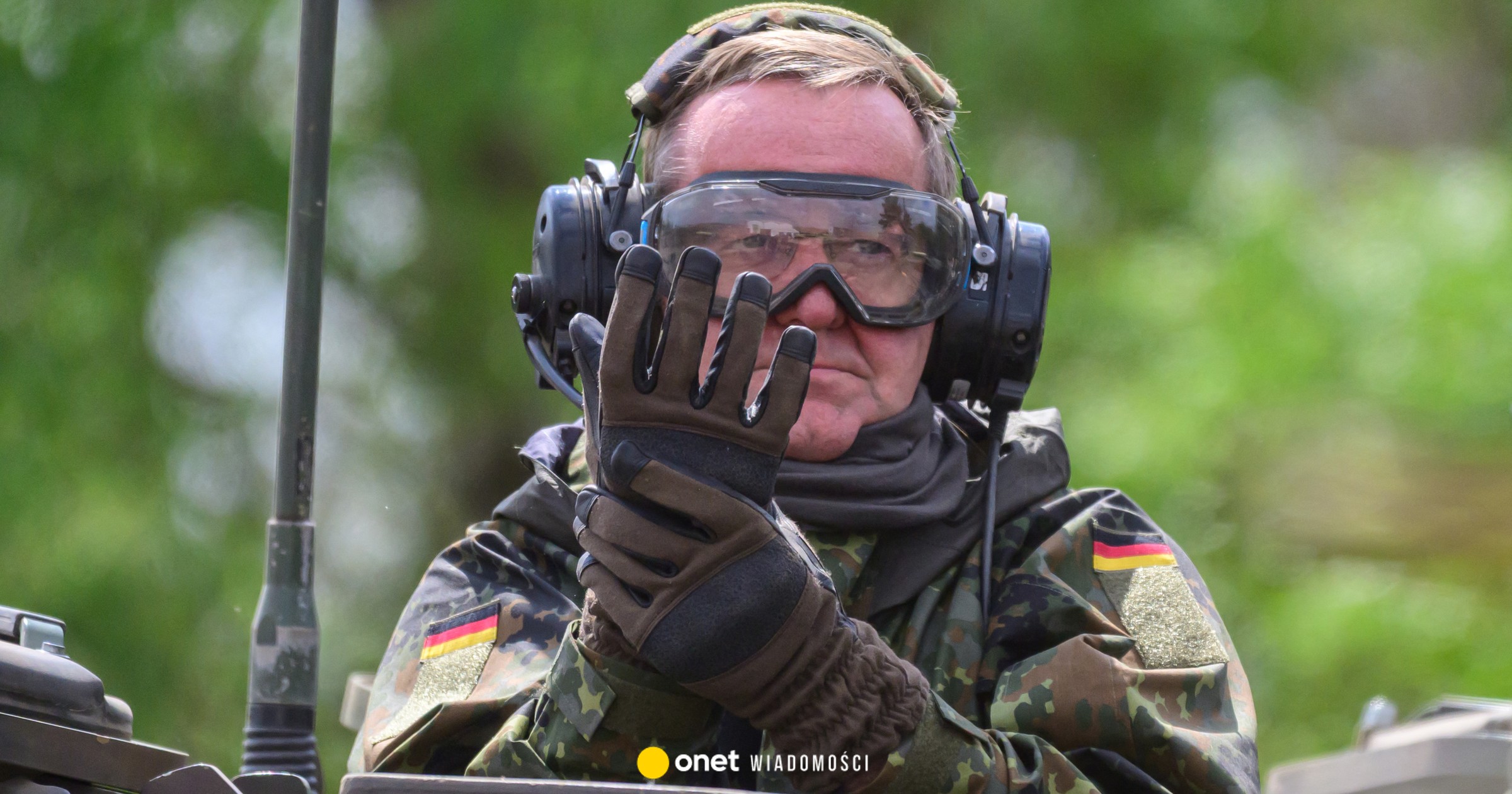
Defense Minister Boris Pistorius is tackling one of the Bundeswehr's biggest, long-standing problems: supplies. More precisely, it deals with the Federal Office for Equipment, Information Technology and Technical Support of the Bundeswehr – in short BAAINBw. It is one of the largest German agencies, based in Koblenz, employing almost 13,000. employees. For years, it has been a symbol of what is too slow, too complicated and too bureaucratic in the Bundeswehr.
Now this bureaucratic colossus is to be rebuilt: Pistorius presented 12 points to the Bundestag's defense committee, a reform program that is intended to transform this sluggish apparatus into a modern procurement organization. Moving away from classic office structures towards flexible teams. Moving away from the administrative mode towards greater pace.
The pressure behind this is enormous. The debt-financed “special fund” worth EUR 100 billion (PLN 424,683 million) is practically budgeted, and at the same time regular defense spending continues to grow rapidly. Zeitenwende (German: turning point) creates financial freedom, but this is where the problem has been for years: the state cannot spend these funds fast enough.
[Te działania to] a promise kept: already at the Bundeswehr conference in November, Pistorius commissioned his Secretary of State, Jens Ploetner, to present a reform plan by May. And unlike other major projects of the ministry – military strategy, reserve concept or capability profile – this time the plan actually appeared on time.
The essence of the reform is the complete reorganization of BAAINBw. So far, the agency has operated in a classic way, within departments and departments – slowly, hierarchically, often based on competences, not projects. In the future, it is to become a parent organization. The new structure is based on the military dimensions: land, air, sea, cyberspace and information space, and space – that is, it is a mirror image of the Bundeswehr itself.
— So much has been purchased in recent years [sprzętu wojskowego]like never before, Pistorius said. The problem is that the structures “were not really designed for it.”
The goal of the reform is smaller, more flexible teams that can make decisions faster. Instead of one procedure for everything, in the future there will be a distinction between fast track (fast track) for quick purchases available on the market, innovation (innovation) for new technologies and complex for multi-billion projects.
“Multinational and primarily European-oriented”
This sounds technocratic, but it has crucial political significance. Because The fundamental problem of the Bundeswehr has long been not only about money, but about the speed of the system. For decades, the public procurement process has been focused on spending control. Now suddenly he has to organize reinforcements.
The reform is to be sufficiently deep. Supply chain control, market surveillance and price verification are to be significantly expanded. It is the issue of prices that worries the ministry. Together as defense spending increases, so does the fear of a sharp increase in costs in the arms industry. “Throughout the public procurement process, we want to ensure that investments are used responsibly and therefore cost-wise,” Pistorius said.
Plus there is a second problem: staff. Despite almost 13 thousand employees in the Federal Office, hundreds of positions remain unfilled. Highly qualified IT or defense industry experts have rarely come to Koblenz (where BAAINBw is headquartered) until now. In the future, the office will expand its activities throughout the country – also to become more attractive thanks to new locations. A maritime and space division is established in Bremen – close to the maritime industry and space cluster. Dresden will be developed in terms of cybersecurity and IT.
Brussels will also receive a small representation in the future. “Our orders must be international and, above all, European,” Pistorius said. The new facility is intended to help in getting closer to EU and NATO institutions and in earlier co-creating European arms projects. Officially, it is about better cooperation with the EU and NATO. In reality, however, this office also aims to send a signal: Germany wants to think about arms procurement in a more European way.
The article continues below the video
This would be a departure from the current course. To this day, European countries, despite all their political declarations, purchase supplies primarily at the national level – expensively, in small batches and often duplicating purchases.
But despite all the rhetoric of reform, the real challenge remains enormous: The agency must rebuild itself while pursuing projects worth billions. Pistorius himself talks about “open heart” surgery.
However, this does not mean that the office will be automatically enlarged. Although the Ministry excludes job cuts, the apparatus is not simply expected to become larger, but to function more efficiently – this is a difficult balancing act for an office that has been struggling with staff shortages for years.
Specific implementation steps are to be determined by June 30, after which the reform will begin gradually. The Ministry deliberately does not provide a specific completion date. The reconstruction is too extensive – and the pressure in the meantime is too great.
I’m Ashley Davis as an editor, I’m committed to upholding the highest standards of integrity and accuracy in every piece we publish. My work is driven by curiosity, a passion for truth, and a belief that journalism plays a crucial role in shaping public discourse. I strive to tell stories that not only inform but also inspire action and conversation.