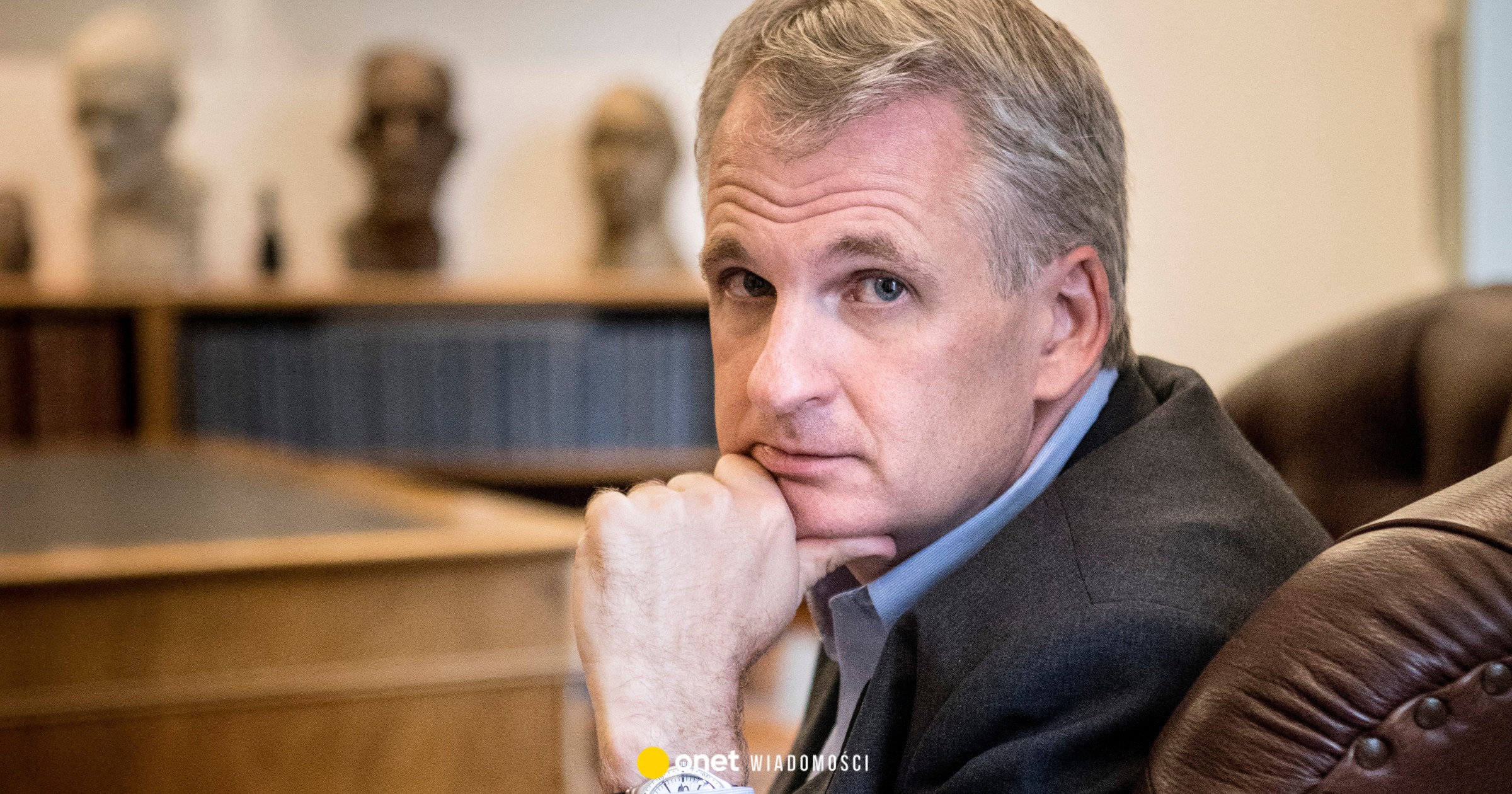
Timothy Snyder worked at Yale University until 2025 and is currently a professor at the University of Toronto. He left the US in opposition to Trump's policies. He is the author of many books, including: “Bloodlands. Europe between Hitler and Stalin” and “About tyranny. 20 lessons from the 20th century.” He regularly publishes in leading newspapers around the world, especially in The New York Review of Books.
Magdalena Fajtova: When the United States and Israel attacked Iran, we were discussing it in the editorial office and one of my colleagues said something that initially shocked me: that it was possible that World War III had just begun. Are we actually at the beginning of World War III?
I don't think so. World War III has already been “declared” many times. I think the lines of conflict are not exactly the same as on the battlefields. The real lines of conflict in the world are different: humans against the digital world and the ultra-rich against everyone else.
These are the real dividing lines. And I'm not saying that wars aren't important, but even these conflicts can be understood in this context. A Russian invasion of Ukraine simply couldn't happen without a man with hundreds of billions of dollars and some imagination.
The same applies to the war in Iran. We would not have attacked Iran if the Americans had not given power to a billionaire who does not even have as much imagination as Putin.
For example, during World War I, the Habsburgs made the mistake of attacking Serbia, but it is not that kind of mistake. They were wrong about some things, but not as wrong as Trump or even Putin is. So there is a certain level of stupidity that I believe is only possible through massive accumulation of wealth.
This stupidity means that wars are being fought and those who started them don't even know how to continue them. The United States is at war with Iran. We don't know why. We don't know what purpose this is for. We don't know how this could ever end – and neither does the US president. But I don't think this is part of some broader global conflict.
The article continues below the video
In my opinion, it is rather a consequence of what happens when wealth is allowed to concentrate and when one is disconnected from reality.
Another thing is that many people do not understand what war really is. They think it's like a movie or a video game, but it's not. What does Donald Trump know about war? It's not that he doesn't know anything – he knows even less than nothing. He thinks he knows things, but he doesn't. For example, he thought the war would be easy and the other side was stupid.
But this [prowadzenie wojny] it's not easy, and the other side is usually not stupid.
So the concentration of wealth and the loss of touch with basic historical realities – these are the things that lead to wars.
This war [z Iranem] makes the United States much less powerful than it otherwise would be. I don't think changing the world order means a global war of all against all. Rather, the United States artificially weakens its power with its own policies and thus indirectly enables the development of its rivals.
“That's the crux of the problem”
Inequality, or more precisely the huge gap between a small group of people who are unimaginably wealthy and the rest of society, should be – as you say – the main conflict on which we should focus. At the same time, however, in many cases, the most vulnerable people, who do not have access to good education and struggle with difficult living conditions, often choose leaders who are responsible for their situation and do not intend to solve it. How to explain this?
When you can't see a way forward, you may reach for something that looks like a shortcut. And this is what is often offered. Donald Trump is a good example. It tells people, look, the system is broken, which is largely true, the rules don't actually work. And look at me, I succeeded by breaking the rules. The idea that the rules don't apply — and that the system is broken — may work for a few oligarchs after all. As soon as we say that the rule of law does not apply, everyone will act on their own.
This may work, but certainly not for everyone. Trump's political magic is that he says: look, in this situation everyone can do whatever they want and everything will be fine. Except it won't be okay, or rather it will be a nightmare. And the heart of the problem is that people are losing the ability to see the future because they are losing social mobility. So it doesn't surprise me that people vote this way. Moreover, as humans we have a general tendency to view other groups as the culprit for our problems. It's quite human to see other groups as “the other ones.”
And creating conditions in which we vote consciously takes work. We should learn to see the world this way – with empathy. The common task is to create conditions in which people can say: my choice now makes sense, it really makes a difference. And no: my choice is just a symbol of something I feel inside, but which is unattainable. So it's not just that individuals do stupid things – we all do stupid things. It's about creating structures, not only choices and institutions, but also an environment in which people can see the future.
Where can we find hope in this situation? Are there examples of this coming true?
Yes, it happens all the time. We cannot do this without feeling that a good or meaningful future awaits us. And we won't have this feeling if we don't build and strengthen institutions – no matter how big they are. It is worth creating them even at the local level. I see hope in this.
In his book “On tyranny. 20 lessons from the 20th century.” from 2017, you listed situations from which we should draw conclusions in times of strengthening authoritarian forces in democracies. You have already mentioned some of them – for example, that we should support good causes and causes, talk to others, point out what is wrong, look for violations of rules, or defend institutions. However, we should also avoid paramilitary groups or one-party rule, reject symbolism of oppression of certain groups of people, and the like. You wrote about the United States, but we are also seeing the return of the extreme right and authoritarianism in Europe. So clearly we haven't learned much from these 20 lessons. Which of them have we ignored the most?
I stick to the American context because I believe that the situation is different in different places, but in my opinion the first of these 20 points: “do not give up in advance”, is the most important. In the US there was and still is a huge sense of preconceived obedience.
Much of Trump's power has literally been willingly handed over to him, often by people who, if only he had resisted a little, would have won. This group includes large corporations and universities. I think I was right to put this first, because if you don't fall into preconceived obedience and maintain your own awareness of what is valuable, you have a chance to deal with other things as well. However, if you start subordinating yourself, you will develop the habit of normalizing what is happening around you.
And once you start to submit from above, it is very easy to stick to it. Then you start to see those who don't as weird, unattractive, unsympathetic – and ultimately as enemies.
The role of social media in this process is clearly absolutely crucial today. And not only in the context of discussions and challenges or how we confront people who see the world differently than we do. It's also about how we shape our own view of the world – algorithms show us what we want to see, a point of view that suits us. In a way it radicalizes us – what should people do to be immune to this effect?
I don't think this is the worst effect of social networking. But I will talk more about them because they also have other bad effects. They tend to narrow down the number of topics we consider. It's not just that you're around people you agree with, but that you're shown the same topics over and over again. And then you don't even realize that other people not only have different opinions about your questions, but that they deal with completely different things.
And then when you meet such people and they are dealing with other things, it seems very strange and you don't understand how they can be interested in such a thing at all, because “your people” are not interested in it. Another problem is that social media makes us believe that we are right about everything, thus making it harder for us to listen. There are things that people in my social bubble think are necessarily bad.
That they just have to be bad. And sometimes it turns out that they are actually bad. But you get used to the fact that if you hear it over and over again, it must be true. And it's not bad just because it confuses us in politics, as you say. Overall, it makes us worse thinkers.
There is no doubt about it. But how can we get out of this trap?
First, physically: if possible, don't have your phone with you all the time. At least sometimes. For example, try not to reach for your phone until you have done some physical activity. Don't touch your phone until you read a book. Try to postpone the moment you pick up the phone. Do something else first. This gives a great effect. I also think we shouldn't have phones in schools. You asked about COVID several times. In my opinion, COVID has proven this.
One of the worst things was that we sat children in front of screens – and the research is very clear on this: they learned nothing. Everything was in vain. If we instead told every family that their child should read one book by Karl Capek a year [red. czeski pisarz]it would be better than all remote learning combined. So we know this is basically nonsense, and we know that phones in schools hinder learning.
At the university level, we know that everyone cheats with AI. We have to accept that and say, okay, we're going to create physical spaces where people can be with people, because that's how people really learn, remember what they've learned, and learn to deal with different views.
I’m Ashley Davis as an editor, I’m committed to upholding the highest standards of integrity and accuracy in every piece we publish. My work is driven by curiosity, a passion for truth, and a belief that journalism plays a crucial role in shaping public discourse. I strive to tell stories that not only inform but also inspire action and conversation.