Transalpina and Transfăgărășanul come out from under the mud. When the most spectacular roads in Romania could be reopened

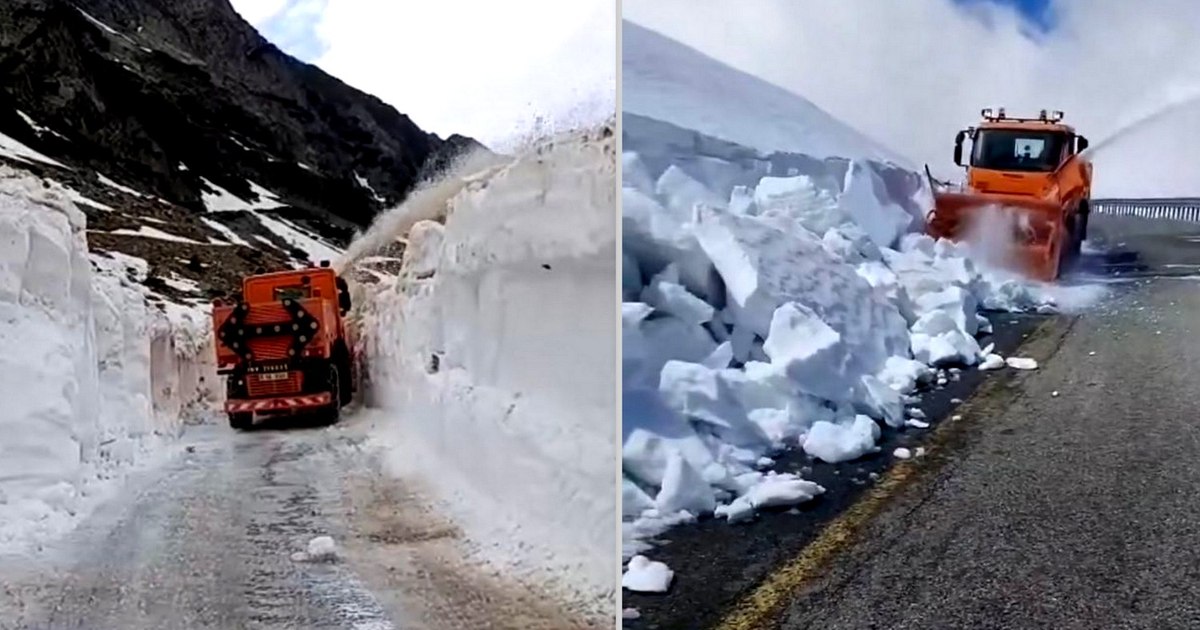
Snow removal machines have appeared in recent days on Transalpina and Transfăgărășan, the most spectacular alpine roads in Romania, to prepare their reopening. Images capturing the work to clear the slush-covered roadway have sparked controversy.
Transfăgărășan and Transalpina. Photo DRDP Brașov and DRDP Craiova.
Transalpina (DN67C) and Transfăgărășanul (DN 7C), two of the most spectacular mountain roads in Romania, are covered with snow in the alpine areas for more than half the year, and preparations for their reopening are difficult.
The images recently published by the Regional Directorates of Roads and Bridges (DRDP) Brașov and Craiova show the “struggle” of the snow removal machines with more than two meters of slush, which make it impossible to cross these segments with cars.
In addition, in recent days it has continued to snow at altitudes above 2,000 meters, and the risk of avalanches and rock slides in some parts remains high.
Snow removal on Transalpina and Transfăgărășan
While the regional directions of roads and bridges show how they mobilized to remove the Trojans, some Romanians noticed that the snow removal started too early.
“The end of the world is coming! Snow in May in the mountains, at 2,000 m!”wrote a Romanian, to the images published by DRDP Craiova with the works on the road.
“Will it be able to drive soon or are you just consuming diesel for nothing?”, asked another netizen.
“If we don't use diesel, it won't be possible to drive very soon”, responded DRDP Craiova.
The images of the works on Transfăgărășan generated similar reactions. Some Romanians were excited in anticipation of the reopening of the road route, others were amazed by the thickness of the snow layer that covered some places on DN 7C, and other Romanians complained about the waste of resources.
“You're consuming fuel for nothing! July 1st had to be met so much of it would melt from outside temperatures,” complained a netizen.
DRDP Brașov representatives reminded him that, regardless of the date on which it will be possible to open the segment between Bâlea Cascada and the Bâlea Lac area, the snow removal usually starts in May. Also, they added, the impressive amount of snow and weather conditions during this period could cause the road to be reopened towards the end of June or from July 1.
In 2025, Transfăgărășanul and Transalpina were reopened to traffic from June 6. After the snow was removed, on National Road 67C (Transalpina), drivers were able to drive on the road sector between Rânca, Gorj county, and Curpăt, Alba county, which includes the Urdele Pass, the highest road point in Romania, located at over 2,100 meters above sea level.
Since then, on the road that runs through the ridges of Făgăraş, tourists have been able to drive up to the Bâlea-Capra Tunnel, at 2,042 meters above sea level, one of the most spectacular points of Transfăgărășan. The roads could be used for just over four months, until October 20, 2025, when traffic was officially closed, but as early as September, in the alpine areas, temporary restrictions were imposed due to the risks caused by snow and ice.
In 2026, the chances of these mountain roads being reopened in early June are extremely slim.
Transfăgărășan, built with soldiers, inaugurated by Nicolae Ceaușescu
Transfăgărășanul, the mountain road that connects Argeș and Sibiu counties, was built in just four years, with the considerable efforts of thousands of people, most of them military – cheap and accessible labor, frequently used by the communist regime in projects of public interest.
Transfăgărășanul, Romania's extreme construction site. “People dismantled the bulldozer and carried it on their arms. Avalanches took us up”
“The difficulty was not only that of the design and layout conditions, but, perhaps to an even greater extent, that we had to look for ingenious solutions that would avoid the great difficulties of building and then operating the future road, to avoid as much as possible the areas of large avalanches or to design systems to prevent and stop avalanches or defend against them”, recalled, in 1986, the engineer Theodor Guțu, involved in the initial project.
The segment between the Vidraru dam, from Argeș, and the Sibiu town of Cârțișoara, with a length of approximately 90 kilometers, was built between 1970 and 1974. Its paving was completed in 1977, and work on widening the tunnel continued in the following years.
The road crosses the Făgăraș Mountains through the Bâlea caldera, climbing to an altitude of 2,042 meters, near Bâlea Lake. It was inaugurated in September 1974 by Nicolae Ceaușescu and is considered one of the most complex road infrastructure works carried out before 1990, due to the difficult relief.
The mountain road starts from the town of Cârtisoara, the last one before the route enters the alpine area of the Făgăraș Mountains. From Cârtisoara, travelers climb to the Bâlea Waterfall and the Bâlea caldera, reaching over 2,000 meters, in the Bâlea lake area. After crossing the Bâlea-Capra mountain tunnel, the route descends towards Argeșului Valley, past Vidraru Lake and Poenari Citadel, to the famous Curtea de Argeș monastery.
Built between 1972 and 1974, the Bâlea-Capra Tunnel, in the vicinity of the Bâlea glacial lake, was the touchstone for the workers on the Transfăgărășan construction site. It was designed with the help of mountaineers specialized in topometric measurements and was dug in extreme conditions, on the mountain road at an altitude of over 2,000 meters. Half a century after its construction, the Bâlea-Capra Tunnel remained the longest road tunnel in Romania, but it will be surpassed by the tunnels under construction on highway segments.
Transalpina, built with pioneers, inaugurated by King Carol the Second
The Transalpina, the road that cuts the ridges of the Parâng Mountains at over 2,000 meters above sea level, is almost 150 kilometers long and crosses the Carpathians. It was inaugurated in the summer of 1935 by King Charles II, being then called “King's Road”.
Transapuseana, the mountain road that makes Transfăgărășanul and Transalpina forgotten in winter
Then, King Carol the Second and his son, Mihai I of Romania, were among the distinguished guests who traveled on the Transalpina by car, from Săliște, near Sebeș, to Novaci, in Gorj.
“This road, which is of great importance from an economic and military point of view, connects the north of Oltenia with the south of Transylvania and the Mureș valley, crossing the Sebeș and Lotr Mountains, climbing to a height of 2,200 meters. It is 130 kilometers long and cost only three million lei, given that it was built with the help of pioneers”the “World of Villages” publication showed in 1935.
National Road 67C, also known as Transalpina, connects the towns of Novaci, Gorj County, and Sebeș, Alba County. The most attractive area it crosses starts from Valea Lotrului, climbing in serpentines towards the Rânca mountain resort.
After leaving the conifer forests behind, the route crosses the alpine meadows from which travelers can enjoy the wide panorama of the Parâng, Lotrului, Cindrel and Șureanu Mountains, with peaks over 2,000 meters high and numerous landforms shaped by glaciation. The glacial lakes of Parâng remain hidden from view; instead, the archaic sheepfolds, established in remote clearings, surrounded by forests, and the most modern ones, close to the road and transformed into stopping places, welcome their guests in a picturesque atmosphere.
For decades, it was considered one of the most dangerous roads in Romania. The route eventually became an attraction for adventurers, but locals warned the few car travelers to turn off the road because of the steep slopes, difficult curves bordered by cliffs and sharp rocks in the roadway. The dangers on the road that reaches an altitude of 2,145 meters in Pasul Urdele have been lessened with the modernization works since the 2000s, but the route in the alpine area, Obârsia Lotrului – Rânca, remains open only during the summer and still needs modernization works.