Corporatist by day, farmer in his spare time. How Ionuț turned a passion into a flower business

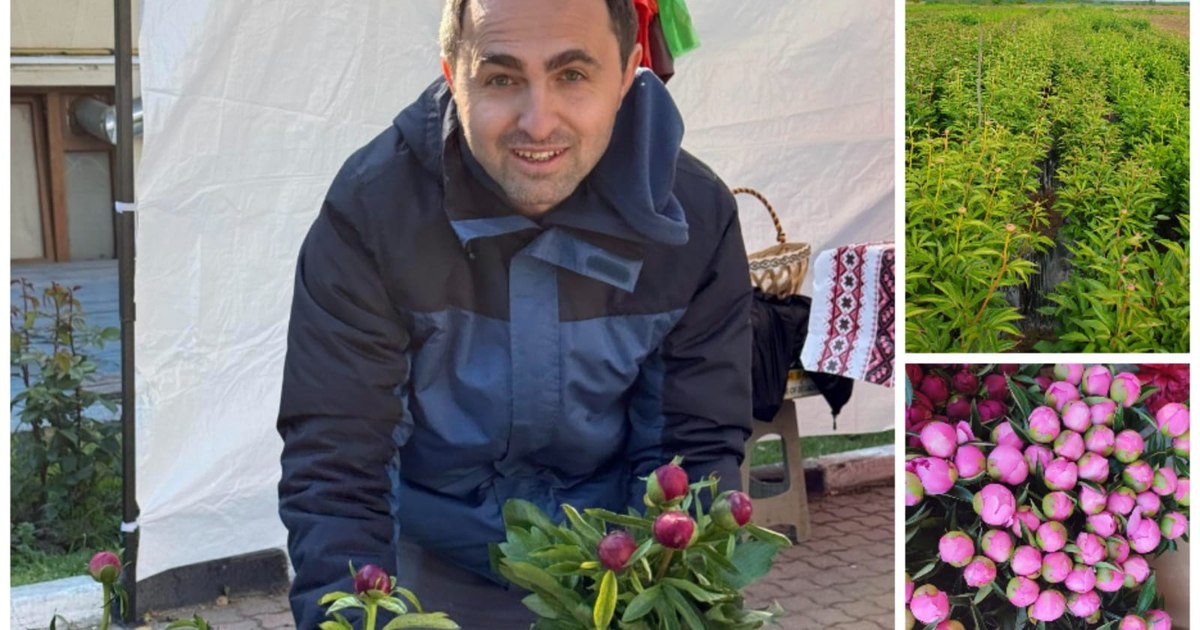
Ionuț Stanciu is 38 years old, works in a corporation in the Capital, and several times a week he goes to the farm in Olt, where he grows flowers on thousands of square meters. “I plant test all the time.”
Graduated in Electronics, employed in a corporation in Bucharest, Ionuț Stanciu (38 years old) says that his basic profession is actually agriculture, because “I worked since I was a small child”. For 8 years, he has been developing, according to the corporate program, a family business in the field of horticulture, and the peonies he harvests every spring from the farm in Pleșoiu, Olt, have conquered the hearts of consumers.
Ionuț Sranciu established the peony plantation eight years ago PHOTO: collage/Ion Păunel
The passion for flowers comes from the family, especially relatives on the father's side having an inclination towards this field. However, things settled down even more clearly after the marriage, the wife's parents growing flowers on a large area, in Giurgiu County. The young man took from everyone's experience and thus started the adventure that today involves the whole family.
“Test” planted peonies
The first flowers from the “Sim Flowers” farm were peonies and daffodils in 2018. “I always test plant. I plant 50-100 of each variety and see how they develop, which one is the most sought after, which one sells best in the market, what our customers have asked for, and then we expand”the young man explained.
The test result indicated that the peony could be the winning flower, and eight years later the peonies from the farm in Pleșoiu are still appreciated. At that time, Romanian peonies were available on the market in Bucharest, available in several colors. He ordered peonies in Holland, in a wide color palette. He recouped his investment after about four years, in the first three managing to get only a few bouquets for the housemates.
“In the fourth year we slowly began to harvest, recouping part of the investment, and only in the fifth year did we turn a profit. We weren't in a hurry, that's right. Having a job, an alternative, was pleasure. I wanted it to be something lasting, not overnight. A peony should last 10-15 years, maybe even longer.” added Ionuț Stanciu. Today he has the opportunity to expand the peony plantation, which currently covers 3,000 square meters, using those planted eight years ago.
In the four “plus” years, the money earned went to the development of the farm. They bought new varieties every year, invested to have their own water supply, bought a transport machine when the old one failed, etc.
Everything is spent from own funds, because the flower sector does not benefit from support. Only recently has the possibility appeared for flower producers to access a support measure, through DR-18 “Investments in floriculture, medicinal and aromatic plants”, a program launched in consultation with AFIR, but for which the project submission session has not opened. According to the official announcements, the measure would benefit from a financing of 5 million euros, with a maximum support of 100,000 euros/project (with a co-financing of 15% or 35%, depending on the size of the farm). This means, Ionuț Stanciu points out, very little considering the fact that there are approximately 10,000 farmers who grow flowers.
“At the moment it is insufficient, but it is a start. However, we should be happy, see the positive side as well”, the farmer shows himself confidently.
Labor and sales – general issues in horticulture
And because it's about agriculture, Ionuț Stanciu also points out that the lack of labor tends to become one of the main problems. He works as a family, with his wife and parents, the 3,000 sqm cultivated with flowers, and during the intense periods the work overwhelms him. “It's hard for us to find people to help us. And they're also a little reluctant, when it comes to flowers. Everyone thinks that the flower is something demanding, velvety, it has to be handled carefully. And they are afraid to come and help. And even if they help, they help with the limited things, say, I cut, the wife ties, and someone carries the flowers from the garden to the place where the wife ties them (n. ed. – for transport)“, explains the farmer.
Peonies ready for sale PHOTO: Ionuț Stanciu archive
The challenges don't stop at the workforce. Unpacking is another matter. Flowers are sold, there is a market, instead everything takes place with a huge consumption of time, an important resource that could be reserved for production.
“If we could only produce, take to a warehouse, preferably a central, regional warehouse, because here is also the problem with distance, it would help a lot. To take my peonies to Bucharest, I have to travel at least 400 kilometers every day. It would be ideal if everything we produce goes to a regional warehouse and then customers come to that warehouse and stock up. It is clear that it would be easier for us. I, for example, arrive at the Pucheni fair at 7.00 – 8.00 in the evening and leave at 7.00 – 8.00 in the morning. I have to stay awake for 12 hours, sell and drive another 400 kilometers. It's very tiring during this period”, said the farmer.
The individualism of those active in the field is also a barrier. It is clear, claims Ionuț Stanciu, that the solution lies in association. Even if a repository is successfully built, diversity will be needed. “We will have to have regional producers from all categories. Because this is the problem I have encountered most often here. I produce peonies and there are people, florists, even flower stores, who want to buy because they are close and I harvest them today and I can deliver them in two hours, so it is a guarantee of freshness, but I only produce peonies. And then people told me most of the time: yes, we come, we buy peonies, but we still have to let's go to Bucharest to buy roses, chrysanthemums. The sector is somehow underdeveloped, and there is no organization. We are at the beginning, let's say.”the young man summarizes the list of things still to be solved in the flower sector.
The story of the man from Olt with orange and olive plantations in Greece: “I went to work. At first I crossed the border illegally”
Mathiola conquers with its strong smell PHOTO: Ionuț Stanciu archive
The flowers of Romanian producers, on the other hand, are appreciated by customers. They come directly from the field or greenhouse, they don't stay in warehouses for days, therefore they last longer for the buyer. In addition, the offer is starting to diversify. Growers also grow lishiantus, and lion's mouth, and delphinium.
“Sit seems that they are starting to diversify, but I think it is the area near Bucharest that cultivates massively. In the country, I think there are very few plantations that cultivate a wide variety of flowers, whether they are cut or potted flowers”, emphasizes Ionuț Stanciu.
Peonies and mathiola have arrived in the flying market in Slatina PHOTO: Alina Mitran
On the other hand, if there was a storage solution, even for a few days, producers would no longer experience huge losses when the market fails to absorb large quantities or when prices drop so much that farmers no longer cover their costs. Storage would mean losing, of course, freshness, but saving production.
Finding a solution for processing is equally imperative. Ionuț Stanciu says that he has studied the idea of obtaining essential oil from the peony, but the process is heavy, long, and the amount extracted is very small, therefore another option must be found. For minimal processing, of any type, new investments will be needed, which opens another discussion.
Mathiola and lishiantus catch up
The peony season is almost over, so the deliveries of mathiola, a less popular flower in our country, have started from Ionuț Stanciu's farm. Those who had the opportunity to smell it fell in love and now ask for it. After the mathiola will follow the lishiantus, also a flower in particular demand in florists.
Surprisingly, the disappointment came from the tulips. He also brought tulip bulbs from Holland, cultivated them, obtained beautiful flowers, but the selling price was below the cost of production.
Mathiola and lishiantus are cultivated in a protected space, on an area of 400-500 square meters, alongside the vegetables that the parents, old producers of vegetables for the market, did not give up. They are still studying the possibility of increasing the area of protected space considering that flowers are a sensitive product to environmental conditions.
An environmental activist calls for the modification of the GEO for saving green spaces, promoted by Diana Buzoianu: “The approach is wrong”
Many of the “secrets” he possesses today he learned by testing. He collaborated with those from whom he bought the bulbs, but also with the specialists of the phytosanitary stores with whom he already collaborates for the cultivation of vegetables in a protected space. “It was a surprise for them too when we went with Lishiantus, with Mathiola, with the peony and discovered together what works and what doesn't work”, says the farmer.
Lishiantus is an increasingly sought-after flower PHOTO: Ionuț Stanciu archive
An option to expand its market would be supermarket chains. For that it will be necessary to give up selling only on the basis of the manufacturer's card and to switch to a form of legal organization.
Together with the members of the Muntenia Flower Growers Association, they are also thinking about a cooperative, because the needs of all members are great and the solutions are easier to find together.
They need solutions including in the long term. For now, peony production is outdoors, but the weather, which becomes more challenging from year to year, forces them to adapt. It was an idea to develop a system of photovoltaic panels, which would have worked as a protection for the crop and a source of energy to heat the solariums where they grow flowers. However, he found out that the investment through DR 18, the measure that all flower producers are looking forward to, does not allow them to be prosumers.
We also talk about how profitable the activity is, beyond the passion. Although the peony culture once established lasts 10-15 years, there are also annual costs for it. Drip tape, weed wrap, pesticides, insecticides, fertilizers of many kinds all cost money. Sometimes the earnings figures look good, but they never measure the unpaid work that four family members do. “Plus the problem faced by the in-laws. With me, being a smaller area, the disappointment with the tulips was small. In the case of the in-laws, the investment was much larger, they secured gas heating and a small mistake they made during heating destroyed their tulips for which they had paid 20,000 lei just for the bulbs. At first glance, it seems simple, but every small mistake costs a lot.” Ionuț Stanciu also said.