The highway in the middle of the ocean that costs 200 million euros per kilometer. The sci-fi project built by France on a volcanic island

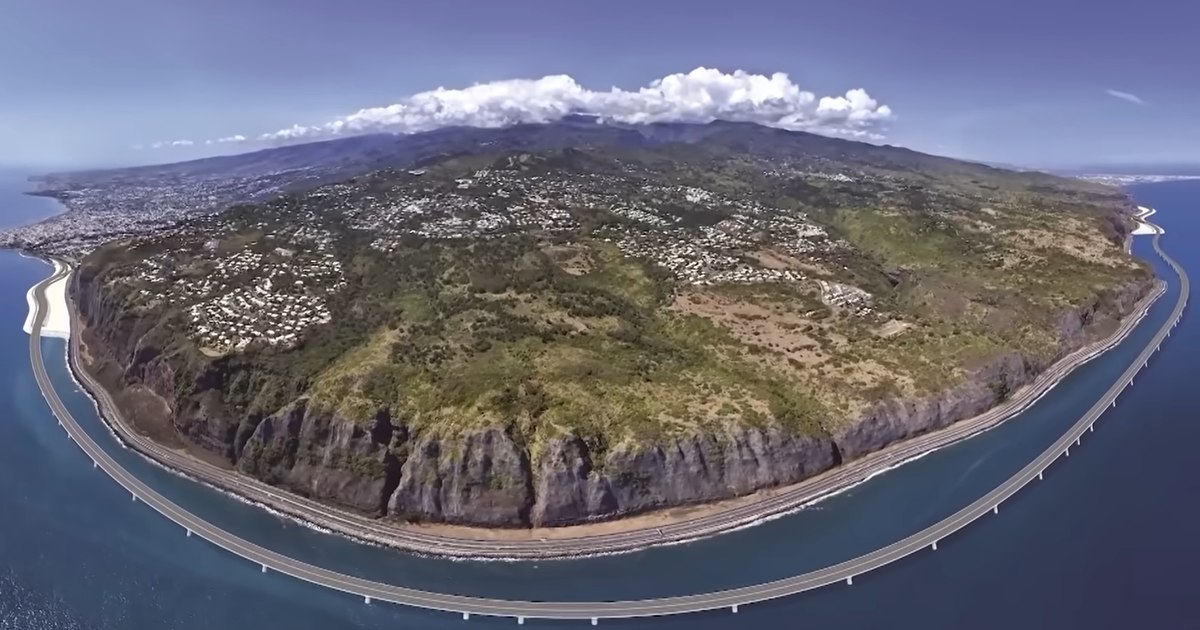
On an island lost in the middle of the Indian Ocean, where volcanic mountains crash directly into the sea and cyclones hit with waves of up to 20 meters, France has built one of the most expensive and spectacular roads in the world. The “Nouvelle Route du Littoral” is not just a highway: it is a structure suspended over the ocean, designed to withstand nature in its most violent form and to link, at all costs, the capital of the island of Réunion with its main port. With a cost reaching around 200 million euros per kilometer, the project has become a symbol of extreme engineering — and of man's struggle with an unforgiving terrain.
Nouvelle Route du Littoral. Photo capture Youtube
There are many spectacular roads and highways in the world, built in such difficult conditions that their costs reach levels hard to imagine. Usually, the most expensive projects are tunnels, either those dug under large Asian metropolises, such as in Japan, or those excavated through extremely hard mountain massifs, where every meter of drilling becomes an engineering challenge. But when we talk about surface roads, one of the most expensive projects in the world is being built by France in the middle of the Indian Ocean: “Nouvelle Route du Littoral”, the highway suspended above the ocean that costs about 200 million euros for each kilometer.
The new coastal road is located on the island of Réunion, a French overseas territory located in East Africa, between Madagascar and Mauritius. Although it is over 9,000 km from Paris, the island is part of France and the European Union, using the euro currency and having the same administrative status as the mainland French regions.
Download video from Youtube
Réunion is a relatively small island, approximately 63 km long and 45 km wide, but it has a population of over 900,000 inhabitants, which makes it one of the most densely populated islands in the Indian Ocean, according to piataauto.md. Its relief, however, is extremely difficult. The island is of volcanic origin, and almost its entire interior is occupied by steep mountains, deep valleys and spectacular cliffs.
The island, formed on two huge volcanoes
In the center of the island there are two huge volcanoes. The first is Piton des Neiges, an extinct volcano that reaches 3,070 meters above sea level and dominates the geography of the island. The second is Piton de la Fournaise, one of the most active volcanoes in the world, with an altitude of 2,631 meters. It erupts periodically, and the resulting lava fields constantly shape the southern relief of the island. It is precisely this volcanic origin that makes the island's northern coastline consist of steep basalt walls that plunge directly into the ocean.
The capital of the island is Saint-Denis, located in the north, and the main commercial port is located in the area of Le Port, near the town of La Possession. Between these two points is the most important road connection of the entire island, used daily by approximately 70,000–80,000 vehicles. The problem is that the old coastal road had been built exactly between the volcanic mountain and the ocean, in an extremely narrow and dangerous corridor.
On one side were vertical rock walls, prone to massive rockfalls and landslides. On the other side is the Indian Ocean, one of the most violent tropical sea regions in the world. During cyclones, waves can exceed 15–20 meters in height, and winds frequently reach over 200 km/h. At such moments, the waves hit the road directly, flooding it completely and making traffic impossible.
Over the years, many people have lost their lives on this route due to rock falls. In some periods, the road was closed for days, and the capital of the island remained virtually isolated from the commercial port and the rest of the economic infrastructure.
Spectacular development on Transilvania Highway, Nădăşelu-Zimbor lot. “These people are from another movie!” VIDEO
Huge viaduct, 5.4 km long
For this reason, the French authorities decided to build a new highway completely separated from the coast. The project was officially approved in 2011 and work began in 2013–2014. The engineering idea was extremely ambitious: the new route was to be built directly in the ocean, at a sufficient distance from the coast to avoid both falling rocks and the direct impact of waves.
The new highway has a total length of approximately 12.5 km and is made up of a combination of maritime viaducts and artificial dikes. The central element of the project is a huge 5.4 km long viaduct actually built over the ocean. This is today the longest viaduct in France.
Download video from Youtube
The construction of the viaduct was one of the most difficult European engineering achievements in recent decades. The ocean floor near the island is extremely steep, as it represents the underwater continuation of the volcanic relief. Practically, the slopes of the mountain continue under water, which means that the pillars could not be anchored in a flat ground, but in an irregular geological structure, formed by very hard volcanic rocks.
Each foundation required complex underwater drilling and excavation operations, closer to the technologies used in offshore wind turbines than to those used in classic bridges. The piers were anchored at great depths and specially designed to withstand simultaneously:
- extreme ocean waves;
- tropical cyclones;
- strong sea currents;
- salt corrosion;
- moderate seismic activity.
In total, the viaduct is supported by dozens of massive reinforced concrete pillars, some of which are over 50 meters high. The superstructure includes huge prefabricated beams, transported and installed by sea with special equipment.
Spectacular “Miracle” on the Transilvania Highway, prepared by a German-Austrian association VIDEO
The construction price doubled due to technical difficulties
Initially, the project had an estimated budget of 1.6 billion euros, which already meant more than 130 million euros per kilometer — a huge amount for a highway. But technical difficulties, redesigns, logistical problems and rising material costs pushed the bill much higher.
Currently, the total estimated cost exceeds 2.5 billion euros, which raises the price to approximately 200 million euros for each kilometer of road. This makes the Nouvelle Route du Littoral one of the most expensive surface roads ever built.
The project is not yet fully completed. The main viaduct was gradually inaugurated between 2020 and 2022 and is already passable in both directions. Other segments of the highway have also been opened, but the remaining portions continue to be redesigned and built.
Initially, part of the route was to be carried out on protected coastal dykes. But the ocean conditions proved so difficult that the authorities decided in 2025 that several sections would also be transformed into maritime viaducts, which led to further cost increases. Final work is expected to continue until around 2030.
Even so, the project is considered an impressive engineering achievement. France sees this highway as a demonstration of technological capacity in an extremely hostile natural environment. And the images of the viaduct suspended above the Indian Ocean, among huge waves and steep volcanic rocks, went around the world, turning the “Nouvelle Route du Littoral” into one of the most spectacular infrastructure projects ever built.