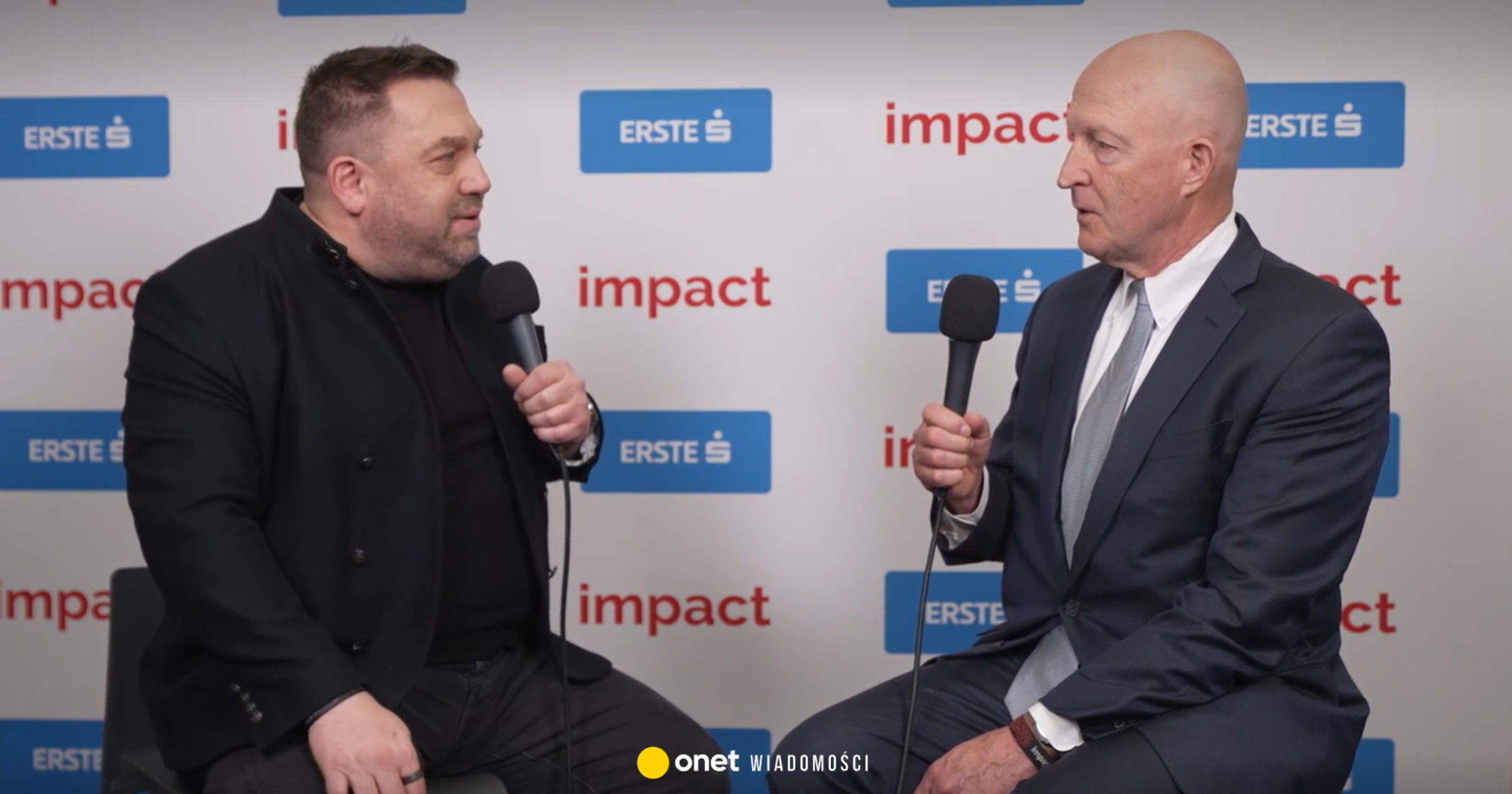
Bartosz Węglarczyk: Thank you very much for accepting the invitation. Let's start with the information from the last hours. American media – “Stars and Stripes” and “Army Times” – reported that the Pentagon was to withdraw 4,000. soldiers of the 1st Cavalry Division who were on their way to Poland. How should we interpret such reports? What does this mean for Poland?
Ian Brzezinski*: I hope this is not true, but unfortunately there may be a grain of truth in it, as the administration has signaled its desire to reduce the military presence in Europe. If that happened, the key question is: will someone replace them? Will there be another unit? Or will allies fill this gap?
However, if not, it would be a serious mistake. This could mean a reduction of up to 40%. American forces in Poland. This is a disastrous signal not only for Poland, but also for Ukraine and the entire region. And worst of all, it's a signal that would embolden Putin.
You are a Republican and know the realities of US politics well. How to understand inconsistent signals from Washington? On the one hand, President Trump praises Poland, on the other hand, the Pentagon talks about restrictions and focus on Asia. Is Europe still important to the US?
Yes – very much so. And not just for me, but for most Americans.
Indeed, there are reasons for concern. We saw the withdrawal of troops from Germany, Patriots from Poland and brigades from Romania. This undermines trust in the US and harms our interests.
But it must be made clear: Trump's views are not representative of the entire American establishment. In Congress, 70-90 percent politicians – including Republicans – support NATO, the presence of troops in Poland and support for Ukraine.
What about public opinion? Do Americans share this perspective?
Yes. About 70 percent Americans consider NATO important and want to maintain or increase its involvement. Interestingly, even among MAGA voters:
- 84 percent believes that foreign policy should be based on values,
- 71 percent supports the defense of a NATO ally in the event of an attack,
- 56 percent wants a greater US military presence in Central and Eastern Europe.
This shows that America remains committed to Europe in the long term.
But when we hear Donald Trump criticizing NATO and speaking more warmly about Kim Jong Un than about European leaders – is NATO's Article 5 still a guarantee of security?
Trump is clearly frustrated with Europe, and that frustration may be growing. I expect more difficult transatlantic relations in the coming years.
But in the long run, I'm calm. Outside the narrow circle around Trump, there is a strong consensus in the US: Europe is of great importance to us – economically, militarily and in terms of value. 60 percent American foreign investment is here.
Ian Brzezinski in Oslo during the security conference, 2024.PAP/NTB / PAP
Jens Stoltenberg claims that in 2018 NATO was on the verge of collapse. Can we be sure Trump won't try again?
Predicting his decisions is risky. But considering the social and political mood in the US, such a step would be very unfavorable for him.
Trump's support dropped to about 30 percent and over 60 percent. Americans consider his policy towards Iran to be wrong. Causing another crisis – like leaving NATO – would be political suicide.
Let's move on to Asia. Can the conflict over Taiwan cause the US to turn away from Europe?
This is a serious risk. China seeks to show that it is an equal superpower to the US – something like “G2” that runs the world.
If this message sticks, especially in China, it will be a success for Xi Jinping. And the more China feels strong, the more difficult Taiwan's situation becomes.
Finally, Russia and Ukraine. Do Putin's words about the end of the war have any meaning?
NO. Putin doesn't want peace – he wants Ukraine. The proof is the subsequent attacks, hundreds of drones and rockets hitting Kiev.
What should the West's strategy look like?
First, this war must be won – and the West does not yet have a coherent strategy.
This is absurd, given the advantage: NATO and the US have much greater resources than Russia. Both economic and military.
What to do:
- increase military aid to Ukraine,
- strengthen NATO's presence on the eastern flank,
- hit Russia with sanctions,
- conduct an information offensive against Russian society,
- accelerate Ukraine's path to NATO and the EU.
Only this will force Putin to negotiate.
Is this the dominant view in the Republican Party?
To a large extent yes, but not entirely. If the US president communicated this clearly, he would have broad, bipartisan support.
But we must remember: Trump's vision of the world is not the vision of all of America. This is just part of the political scene.
Thank you for the interview.
Thank you, I'm very pleased.
***
*Ian Brzezinski — expert with over 20 years of experience in US national security matters. He is a researcher at the Center for Strategy and Security. Scowcroft, a member of the Atlantic Council and head of the Brzezinski Group.
In 2001-2005, he served as deputy assistant secretary of defense for European and NATO policy. He was responsible for the expansion of the Alliance, the creation of the NATO Response Force and support for operations in the Balkans, Afghanistan and Iraq. He worked on Capitol Hill for seven years, including: as an assistant to Senator Bill Roth, a specialist in the Senate Foreign Affairs Committee and coordinator of the NATO Observation Group.
He served as a volunteer in Ukraine (1993-1994). He also worked at the Department of Defense, the National Security Council and as a director at Booz Allen Hamilton. He was awarded the Medal of the Department of Defense, the Order of Merit of the Republic of Poland in the officer class, as well as decorations from Lithuania, Latvia and Romania.
He is the elder son of Zbigniew Brzeziński, national security adviser to US President Jimmy Carter.