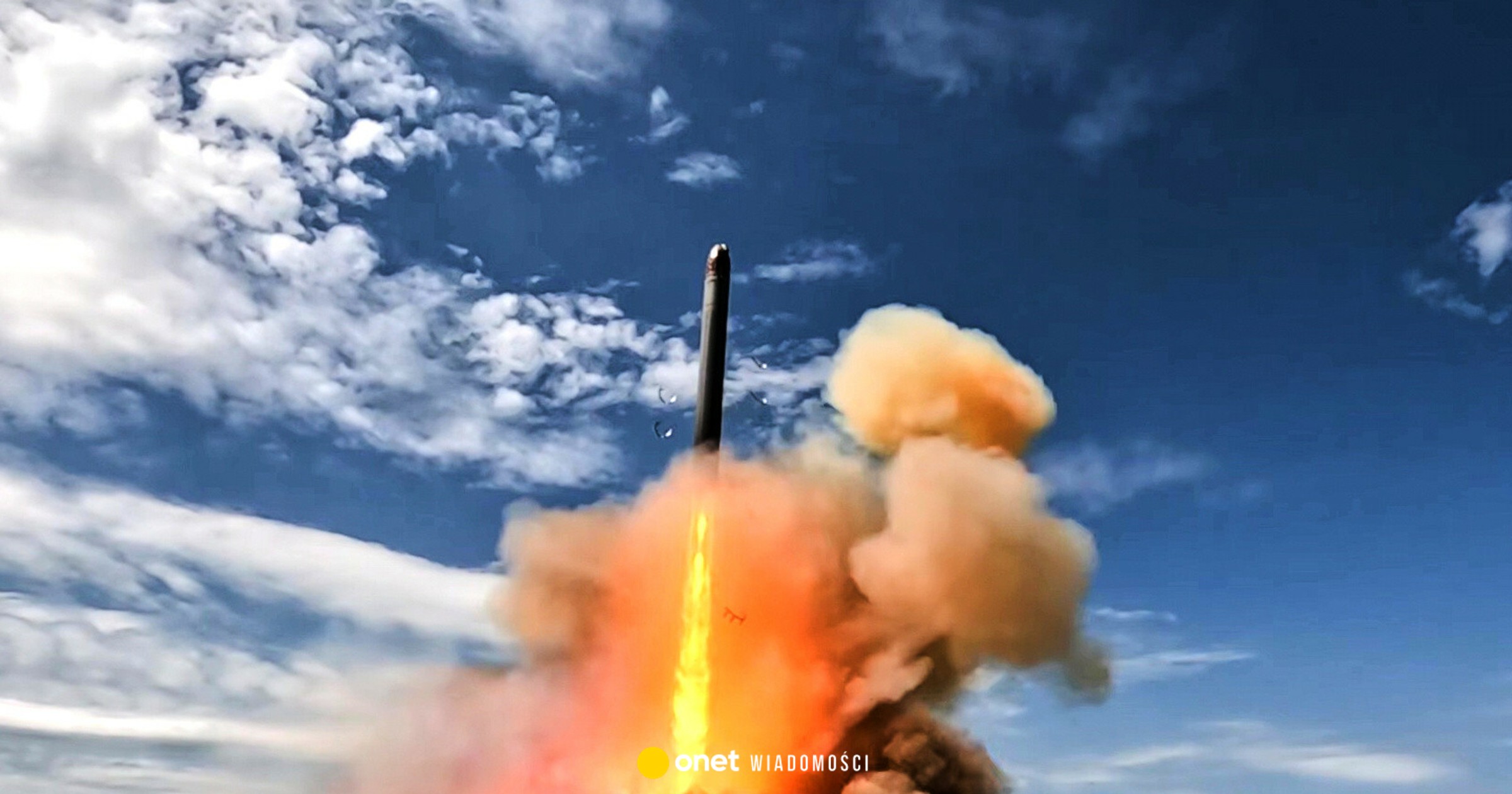
The great celebrations accompanying the test launch of the Sarmat intercontinental ballistic missile, which Russia – according to Vladimir Putin – will introduce into combat service before the end of this year, were ignored by Western countries.
Putin named this missile “the most powerful in the world”claiming that it is capable of striking at a distance of up to 35,000. km.
Security Council Deputy Chairman Dmitry Medvedev “congratulated” the launch on “Western friends,” and Russian state television continuously showed the missile on the news for more than a day.
Still neither Donald Trump, nor European leaders, nor representatives of governments or defense ministries of Western countries bothered to comment on it.
Putin himself spoke twice about nuclear weapons in 24 hours: on May 12, he announced that the complexes would be ready for combat, and on May 13, he announced plans to continue the modernization of strategic forces. On May 13, Kremlin spokesman Dmitry Peskov said that Russia had warned the West about the Sarmat missile launch and called it “an important event for the country.”
State Duma Chairman Vyacheslav Volodin stated that the rocket “has no equal”, and deputy Dmitry Kravchenko announced a “significant change” to the entire balance of nuclear forces in the world.
Yet despite all the PR efforts, Western officials remained silent on the almost constant stream of messages coming from Russia.
Breakthrough or not?
Russia has been working on the Sarmat missile for about 15 years. The main goal is to replace obsolete Soviet Voyevoda missiles that have been in service since the late 1980s, notes Etienne Marcus, a researcher at the French Fund for Strategic Research (FRS).
These missiles, each carrying five to 10 warheads, were operated in Ukraine and became impossible to maintain after the annexation of Crimea.
The article continues below the video
— While the Sarmat is regularly portrayed as a weapon capable of destroying a country like France, in reality it is by no means a strategic breakthrough. (…) Sarmat only allows Russia retain a fleet of heavy intercontinental ballistic missileswhich, for example, enables the destruction of American missile bases or ensuring a high level of destruction in the enemy camp in the event of neutralization of part of the Russian arsenal as a result of a surprise attack, explains Marcus.
According to data from the Stockholm International Peace Research Institute (SIPRI), Russia currently has 36 Voevoda (Satan in the NATO classification) missiles remaining in its armed forces.
Russia's nuclear forces
Since the early 2020s, Russia has carried out at least six tests of the Sarmat missile (including one unconfirmed), and four of them ended in failure (in September 2024, in November 2025, in February and in October 2023), notes Paweł Podwig, senior researcher at the UN Institute for Disarmament Research.
Before the last test, only one successful launch was known – in April 2022. – Is it possible to put the rocket into service after two successful launches? Probably not, notes Podwig. — On the other hand, these missiles are supposed to lie in silos without moving for decades. And they can definitely do that.
According to SIPRI data, Russia's strategic nuclear forces count in total 333 ground-based missiles. These are mainly Jars complexes (206 pieces), including mobile ones, each of which can carry four warheads with a power of 250 kilotons. Russia also has 78 Topol missiles with one warhead of 800 kilotons, Voevods and 12 Avangard complexes. Moreover, according to SIPRI data, the Russian Federation has 192 ballistic missiles launched from submarines (Sinewa and Bulava).
I’m Ashley Davis as an editor, I’m committed to upholding the highest standards of integrity and accuracy in every piece we publish. My work is driven by curiosity, a passion for truth, and a belief that journalism plays a crucial role in shaping public discourse. I strive to tell stories that not only inform but also inspire action and conversation.