The warriors who set fire to the civilized world and their mysteries. Who were the pirates and looters with bronze plates that changed history forever

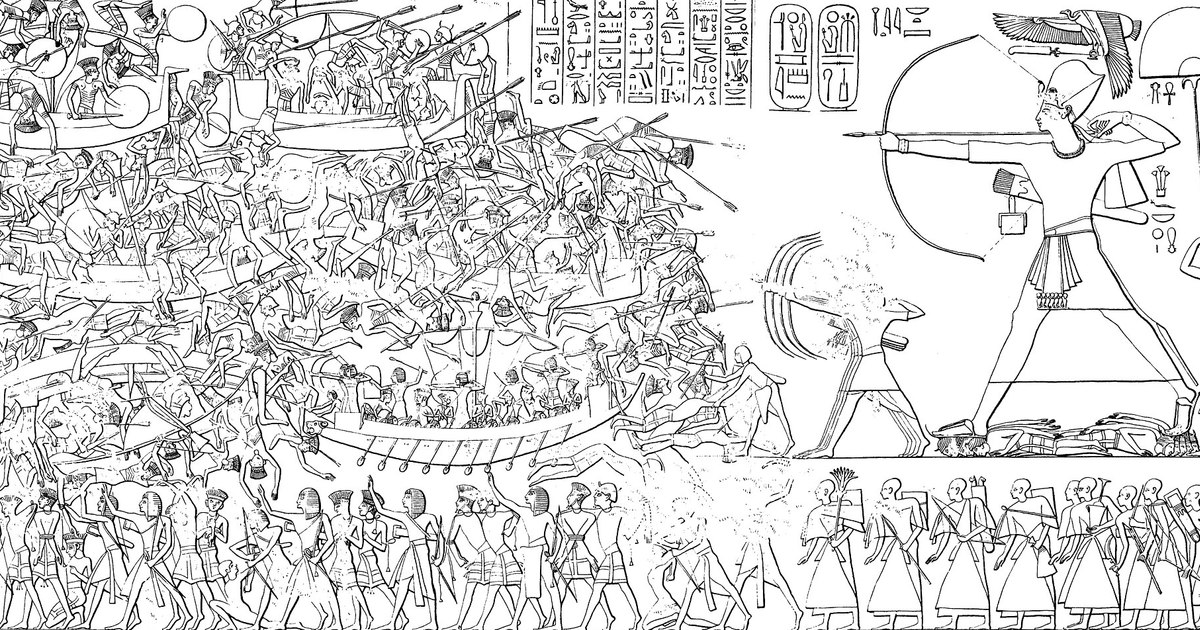
Among the most significant events in human history is the emergence of the “Sea Peoples” in the 12th century BC. They were fiercely warlike tribes of mysterious origins that changed human history. They were pirates, colonizers, mercenaries and a great mystery of history.
Battle between the Egyptians and the Sea Peoples PHOTO wikipedia
In the twelfth century BC, the great civilizations of the Bronze Age, and generally the first great known empires of history, were collapsing one by one. The “Fertile Crescent”, a historical arc-shaped region of the Near East, considered the “cradle of civilization”, where agriculture appeared and the first great cities developed, where writing appeared, but also the most important technological innovations of the time, had become a place of destruction and blood. The kingdoms and city-states of Mesopotamia (modern-day Iraq), the Levant (Syria, Lebanon, Israel, Palestine, Jordan) and Ancient Egypt were facing massive internal problems as well as extremely brutal invasions by mysterious warriors.
Tribes of men clad in bronze armor were savagely attacking the shores of the Mediterranean. They were pirates, mercenaries, people in search of booty and riches. They would simply disembark from their long boats with the heads of fantastic animals and ravage the shores. Specialists called them the “sea peoples” because they came and attacked from the sea, and consider them partly responsible for the collapse of the great civilizations of the Bronze Age, but also of the palace civilization. Their attacks changed human history forever. From the Mycenaean palaces of Greece to the Hittite imperial courts of Anatolia, no great power remained untouched by this wave of destruction that preceded the birth of the classical world.
A mystery of the ancient world, discovered on the walls of temples
We found out about these peoples of the sea relatively recently. More precisely, 150 years ago. Emmanuel de Rougé, curator at the Louvre, in his 1855 work, “Note on hieroglyphic texts”, first introduced this term of sea peoples. The historical narrative comes mainly from seven ancient Egyptian sources, and although in these inscriptions the name “of the sea” does not appear in connection with all these peoples, the term “Sea Peoples” is commonly used in modern publications to refer to the nine peoples described by the pharaohs in the Egyptian chronicles. At the same time, mentions of these mysterious warriors also appear in Phoenician texts from the eastern shores of the Mediterranean, corresponding to today's Lebanon, Syria and Palestine.
One of the most famous testimonies of the time comes from the diplomatic correspondence of the city-state of Ugarit, a thriving commercial center on the coast of present-day Syria. King Ammurapi, finding himself in a desperate situation, wrote a warning to the king of Alashia (present-day Cyprus) that became the symbol of the vulnerability of that era. The ruler of Ugarit wrote that enemy ships had already arrived, burned the cities and ravaged the country. He pointed out that his own army and chariots were far away in the country of Hatti, and his fleet was stationed in Lycia, leaving the kingdom defenseless against seaborne invaders. This letter, found in a tablet furnace where it had been left during the final destruction of the city, represented the last cry of a civilization collapsing after two millennia under the blows of mysterious warriors from the sea.
But, returning to the Egyptians, it is from them that we have most of the sources regarding the “sea peoples” and their devastating attacks. Pharaoh Ramses III, considered the last great monarch of the New Kingdom, left to posterity, on the walls of his temple at Medinet Habu, a graphic and dramatic description of the battles fought against these “strangers from the middle of the sea”. The hieroglyphic texts speak of a coalition of groups such as the Peleset, Tjekker, Shekelesh, Denyen, and Weshesh advancing not just as a conquering army but as a whole population on the move. Like an invasion of proportions.
The Medinet Habu Inscriptions provide a bleak perspective on the collapse of Egypt's neighbors, noting that no country could withstand their weapons, beginning with Hatti, Kode, Carchemish, and Arzawa, all of which were destroyed at a single blow. In the second year of Ramses II's reign, Egyptian inscriptions state, there was an attack by the “Sherdens” (one of the Nine Sea Peoples) on the Nile Delta. The attack was repulsed by Ramses, who captured some of the pirates. The event is recorded on Stela II from Tanis. An inscription of Ramesses II on the stele of Tanis, which recorded the raid of the Sherden raiders and their subsequent capture, speaks of the continued threat they posed to Egypt's Mediterranean coasts. “The insufferable Sherden, whom none ever knew how to combat, came sailing boldly in their warships from the midst of the sea, none being able to withstand them”the inscriptions show.
“Among the most significant events in human history is the emergence of the Sea Peoples in the 12th century BC. During this era, palace culture collapsed, causing comparative economic hardship throughout the Mycenaean world; the Hittite kingdom disappeared overnight, and a number of city-states in the Syro-Palestinian region were destroyed or depopulated. The Egyptian Empire (New Kingdom) also went into decline in this moment. The political vacuum created by the collapse of empires allowed small states such as Israel and Damascus to emerge and play significant roles in the region's trade and politics. The precise role these divergent groups played in these events has become a matter of debate.”Mark Anthony Phelps stated in “Sea People” for EBSCO.
A killer confederation, the special forces of yesteryear
Modern historiography, beginning with pioneers Emmanuel de Rougé and Gaston Maspero in the 19th century, has attempted to identify the origins of these groups. Today, academic consensus tends to see the “Sea Peoples” as a mixed population, originating from the Aegean basin, western Anatolia, and Mediterranean islands such as Sardinia or Sicily. For example, the Peleset group is almost unanimously identified with the Philistines of the biblical accounts (apparently Mycenaean in origin), who later settled on the coast of Palestine.
Who really were the mysterious Philistines, the most implacable enemies of the Jews. What the specialists say
Many other populations of the nine described by the Egyptian inscriptions are unknown to this day, for example the Weshesh. Others, such as Lukka or Peleset, which I have already mentioned, have been identified. Most, however, are Aegean tribes, coming from diverse areas such as Sicily, Sardinia, Crete, southern Italy, Cyprus and western Anatolia (today's Turkey). They usually acted together, which shows that these populations nevertheless established common bases from which to launch these attacks.
Representation of a warrior from among the peoples of the sea PHOTO wikipedia
“The Sea Peoples were not a monolithic group, but a collection of predators from various locations. In surviving texts, these groups are occasionally referred to as marauders or mercenaries. In some Egyptian texts, scholars have assigned them the following geographical or ethnic names (not all associations are accepted by all modern scholars): Tjekker and Sherdani (Sardinia), Lukka (Lycia, in Anatolia), Shklsh (Shekelesh), and Trsh (Teresh; Tyrsenoi, who Herodotus claimed migrated from Lydia, Anatolia, to Etruria, Italy), Eqwsh (Ekwesh; Achaean) and Sikila (Sicily), Danuna (either Cilicia in Anatolia or mainland Greece), Wshsh and Peleshet (Philistines, whom the Hebrew Bible states came from Crete; some scholars claim an Anatolian origin)”states Mark Anthony Phelps in the same paper.
As depicted by Egyptian bas-reliefs and inscriptions, the Sea Peoples consisted of brutal, well-versed warriors, experienced in battle, with well-bound and hardened physiques. People tanned by the sea winds and with their hair dyed red. These warriors were distinguished by their distinctive helmets, which often featured a “feathered” or horned design, frequently having a vertical peak and a circular band at the base. In terms of body protection, depictions show them wearing corset or plate armor similar to that of the Philistines, or in some cases just simple tunics and bare chests similar to kilts. For defense, they used large round shields, a distinctive feature that set them apart from other military forces of the time.
Egypt amazes the world: the first tomb of a pharaoh discovered after a century, since Tutankhamun
The weaponry of the Sea Peoples was advanced, consisting of long, straight, double-edged swords designed for both cutting and thrusting. These weapons suggest technological links with the Aegean or European regions. Distinguished was the Sherden sword, this being a long and narrow weapon of about 95 centimeters. In addition to these, they used swords with horn-shaped guards. In addition to swords, their arsenal included sturdy spears. A crucial aspect debated by historians is the possibility that these groups used the first iron weapons, which made them truly dominate the battlefields. This technological innovation would have given them a decisive advantage over opponents equipped with bronze weapons, which were more brittle or difficult to maintain in long campaigns.
An interesting observation made by the specialists is that, unlike the Egyptians, who relied heavily on archers, the Sea Peoples are not depicted using bows in battle. Their tactics seem to have been focused on direct, brutal confrontation based on heavy infantry and naval mobility.
A new vision, but the mystery remains
New historical studies indicate that the view of the “sea peoples” should be nuanced. And this in the conditions in which certain explanations have been found regarding this large-scale invasion. It is assumed that the peoples of the sea are, in fact, a symptom of a deeper systemic collapse. Prolonged drought, famine, earthquakes and the collapse of international trade routes could have turned previously peaceful populations into armed refugees, forced to seek new homelands at the cost of destroying their old ones.
Other specialists come to contradict this view, especially from the perspective of the fact that it is not about people who came in migratory waves, with women and children, but well-armed men, grouped in fast and destructive contingents. People well trained and used to war. In any case, even today, 150 years after their discovery, the “sea peoples” remain a great mystery to mankind.