Norilsk Nickel and scientists from a Russian institute will create an AI platform for designing new materials based on precious metals

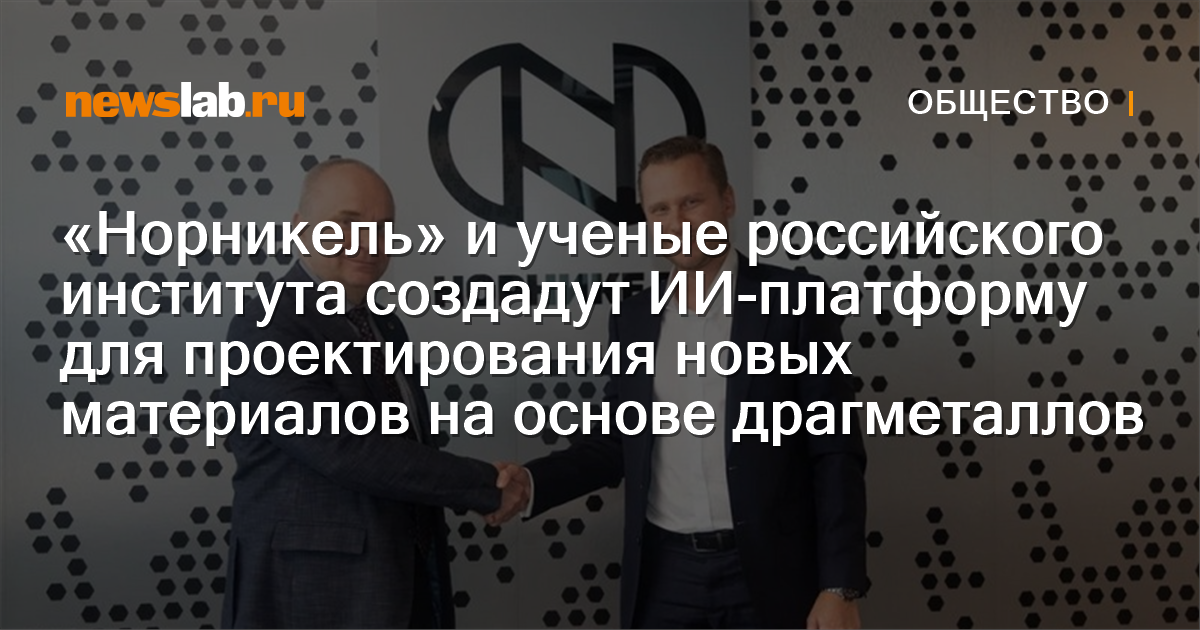
Norilsk Nickel and the Institute of General and Inorganic Chemistry named after. N. S. Kurnakov of the Russian Academy of Sciences (IGNKh RAS) will join forces to develop artificial intelligence that will design new materials based on precious metals for specific industrial tasks.
The Institute of Inorganic Chemistry and Chemistry of the Russian Academy of Sciences, one of Russia's leading centers for the synthesis and study of new inorganic substances and materials, has accumulated tens of thousands of measurement results over decades: the composition of materials, their structure, physicochemical, mechanical and functional properties. The institute will provide this array of real experimental data, which previously existed separately in reports and archives, to Norilsk Nickel for training AI algorithms. At the first stage, it is planned to collect at least a thousand unique compounds with measured characteristics.
Norilsk Nickel, in turn, brings to the partnership competencies in the field of artificial intelligence and a deep understanding of the microstructure of different classes of palladium-based materials. As explained in the company's statement, the agreement with the Institute of General Economy of the Russian Academy of Sciences will allow us to move to the next step: generating new materials by training digital materials science algorithms on an array of real experimental data.
The task of the platform will be to design new palladium-containing materials under the required conditions of specific technological processes.
One of the practical requests that the platform is designed to serve is the search for an alternative to gold in microelectronics. The global microelectronics industry consumes about 250 tons of gold annually: it is used in coatings of printed circuit board pads, connecting wires and tracks. Gold is well suited for these tasks – it is absolutely corrosion-resistant, electrically conductive, and ductile. But the entire industry is consistently moving towards cheaper technologies, and here palladium is an ideal candidate for a replacement: it is three times cheaper than gold and almost twice as light.
The trend towards miniaturization and the desire to reduce the thickness of coatings by a factor of two already demonstrates the inability of existing materials to provide target properties at ultra-small thicknesses and dictates the need to search for next-generation materials.
Norilsk Nickel, together with industrial partners, is already developing microelectronics in two areas: new palladium-based finishing coatings for contact pads of printed circuit boards and palladium-containing conductive coatings for the electronics of the future. In such systems, palladium forms a stable protective and contact layer that resists corrosion and degradation, ensuring a reliable electrical connection throughout the product's life cycle.
Each class of device, from high-density server boards to electronics operating in extremely difficult conditions, requires not only a unique composition of palladium-containing coating, but also its own application technology. This, as the company emphasizes, is what the AI platform will do: generate optimal materials for given technical process parameters – be it a board for a server AI processor, an electric vehicle power module, or an industrial sensor chip.
For Norilsk Nickel, this project is part of a large technological bet. The company is investing about $100 million in the development of palladium technologies until 2030 and has already opened the world's first specialized laboratory for the study of palladium-based materials in the Lomonosov cluster in Moscow.
Norilsk Nickel is the first company in Russia that has begun to systematically create a detailed dataset in digital materials science together with academic institutions. IOGKh RAS will take on the role of a hub for systematizing data: it is planned to connect other Russian institutes and universities with accumulated experimental bases for different classes of materials to the project.
At the first stage, the platform will work with crystalline inorganic materials – alloys and chemical compounds. The coverage will then expand to metal-organic frameworks, two-dimensional materials and amorphous systems. This opens the way to the creation of a new generation of materials: 2D catalysts, high-entropy and amorphous alloys, functional coatings and high-precision sensors. The project horizon is two years.
“Russia is the largest palladium producer in the world. Expanding the industrial applications of this metal is a direct path to increased orders for the metal and sustainable income for the country’s mining and metallurgical industry. New sales markets include jobs in science, the utilization of Russian high-tech industries, and strengthening the country’s position in the supply chains of critical materials,” commented Dmitry Izotov, director of the Norilsk Nickel Center for Palladium Technologies.
“Scientists at the Institute of General and Inorganic Chemistry have been successfully creating a knowledge base about the properties and structure of substances and materials of various classes, including those based on noble metals, for quite a long time. We are pleased to join forces with a business customer to solve the key problem of modern digital materials science – generating the composition and structure of new materials that, with the maximum degree of reliability, will have a given set of properties,” explained the director of the Institute of General Economy of the Russian Academy of Sciences, academician Vladimir Ivanov.
In a broader, global context, as summarized in the press service of Norilsk Nickel, the ability to design materials using artificial intelligence is becoming one of the key technological competencies of the 21st century. The first country or company to build a reliable path from a specification to a new material gains an advantage in the production of the next generation of chips, power plants and industrial catalysts. Norilsk Nickel, together with Russian academic science, is taking exactly this step.