I remember buying fresh fruit from an old lady at a crowded market in Wuhu. It didn't have a terminal and didn't accept cards. She simply showed a printed QR code tied to the stroller. Scan, enter the amount, confirm with biometrics – and the transaction is completed in a few seconds. A few meters away, a duck head seller was doing the same. In a supermarket, all you had to do was scan the code at the checkout, and in the metro or taxi – the same. Cash has become a relic, and traditional payment cards – something seen mainly among tourists.
The history of Alipay dates back to 2004, when Alibaba, then still a young e-commerce platform under Jack Ma, was struggling with the basic problem of the Chinese internet – lack of trust. Buyers were afraid that the seller would not send the goods, and sellers were afraid that they would not receive the money. The solution was an escrow system: the buyer's money was blocked until delivery was confirmed. This simple tool built a foundation of trust and fueled the explosion of online commerce.
Even a small meat stall in China has QR codes for payment
|
Bartłomiej Sieja / Business Insider
Over time, Alipay has expanded far beyond e-commerce. In 2014, it was spun off into a separate company – Ant Financial, today known as Ant Group. The app has evolved into a true super app. You don't just pay – you can invest money in Yu'e Bao (one of the largest money funds in the world), take out loans, buy insurance, pay bills, order food or a taxi, and even split the bill with friends or… watch short videos. Today, Alipay has over a billion users and, together with WeChat Pay, controls over 90%. mobile payment market in China.
The simple magic of QR codes
The way it works today impresses with its simplicity and low entry threshold. In a store or market, the seller displays his QR code – static or dynamic. The customer opens the application, scans the code with the phone's camera, enters the amount (or it is already automatically loaded) and in some cases confirms the payment with a PIN or fingerprint. The money is immediately transferred to the seller's account.
- Read also: BLIK wants to conquer Europe and break the iPhone monopoly. “If we go public, we will be a unicorn. At least double”
On the street, every fruit seller, street food seller or snack stand has a QR code printed on it – on a table, on a T-shirt, sometimes even on a cardboard box. You don't need an expensive payment terminal or even a smartphone. Only the customer must have it.
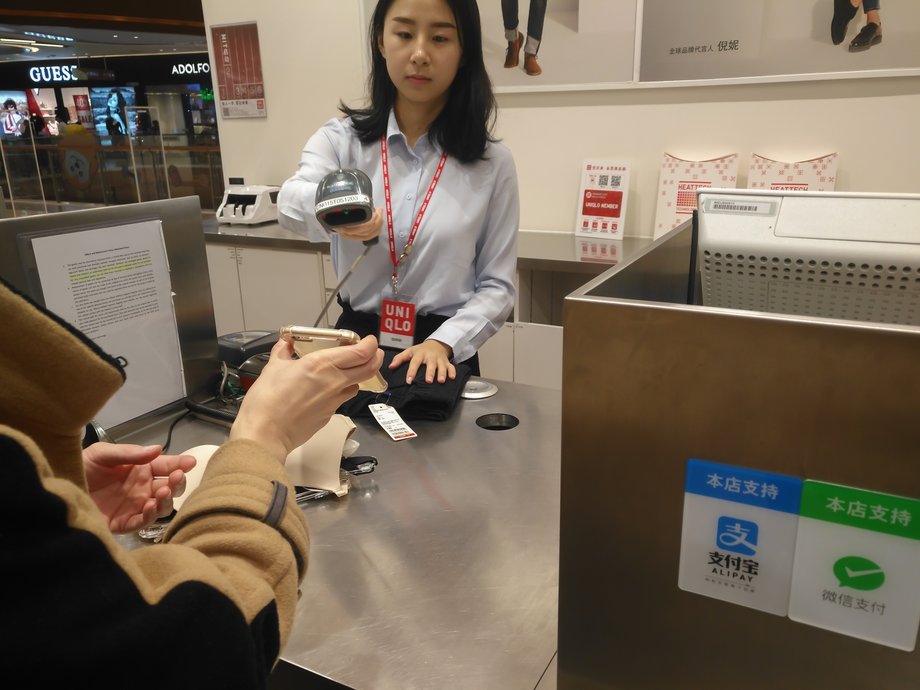
AliPay payment is extremely simple. We show the code generated in the application and… paid
|
Freer/Shutterstock
However, if the seller has a terminal, the whole thing works even faster, because without entering the amounts charged by the cash register. Then the customer shows his QR code and the seller scans it. The entire system is based on QR codes, which are cheap, do not require advanced equipment and work great even with weaker internet or even offline. However, China has such a developed mobile infrastructure that delays are practically non-existent. In 2026, cash is marginal – many young Chinese rarely carry it at all. Alipay also introduced “Tap to Pay” (Alipay Tap!) based on NFC, but this is still an exception. QR codes dominate.
Polish reality – we prefer to wave our phone
Traveling through China, the contrast with Poland is striking. Here, Poles love contactless payments – by phone via Google Pay or Apple Pay, by watch, or most often simply by card. BLIK performs excellently in e-commerce and mobile transfers, and in 2025 it processed almost 3 billion transactions worth over PLN 441 billion. It is growing in stationary stores, especially in the form of contactless (already almost half of POS transactions), but the general preference is towards a quick “swipe” of a card or phone. Scanning QR codes is not as natural here as in China.
- Read also: He appeals to strawberry sellers: take a cardboard box, take a marker. He talks about making people happy
BLIK would have the potential to go further towards the Chinese model. If the operator (Polish Payment Standard) strongly focused on universal QR codes accepted everywhere – from small shops to stalls – and integrated them deeply with banking applications, we could get closer to Asian convenience. However, this would require investment in the education of small sellers, incentives for them and the creation of one truly super application. The problem is that Poles are very accustomed to the convenience of contactless communication. Changing habits would not be easy, especially since we already have a dense network of payment terminals, which China has largely simply “leaped over”.
Our substitute for Chinese QR codes is phone transfers. More and more often, at various marketplaces, you can pay cashless by phone transfers. Drawback? Someone knows our number. In this case, the QR code allows you to remain anonymous.
Admiration for scale – unify payments in a country the size of a continent
However, what is most admirable is the scale of what has been achieved in China. A country the size of a continent, with huge differences between metropolises and the countryside, with hundreds of millions of elderly people and regions with different levels of technological development – and yet within a dozen or so years it has managed to unify daily payments around two applications. It's not just a technological success. It's a combination of mass smartphone adoption, favorable regulation, the powerful ecosystems of Alibaba and Tencent, and cultural openness to new solutions. For the average user, the difference between Alipay and WeChat Pay is small – you pay with your phone everywhere.
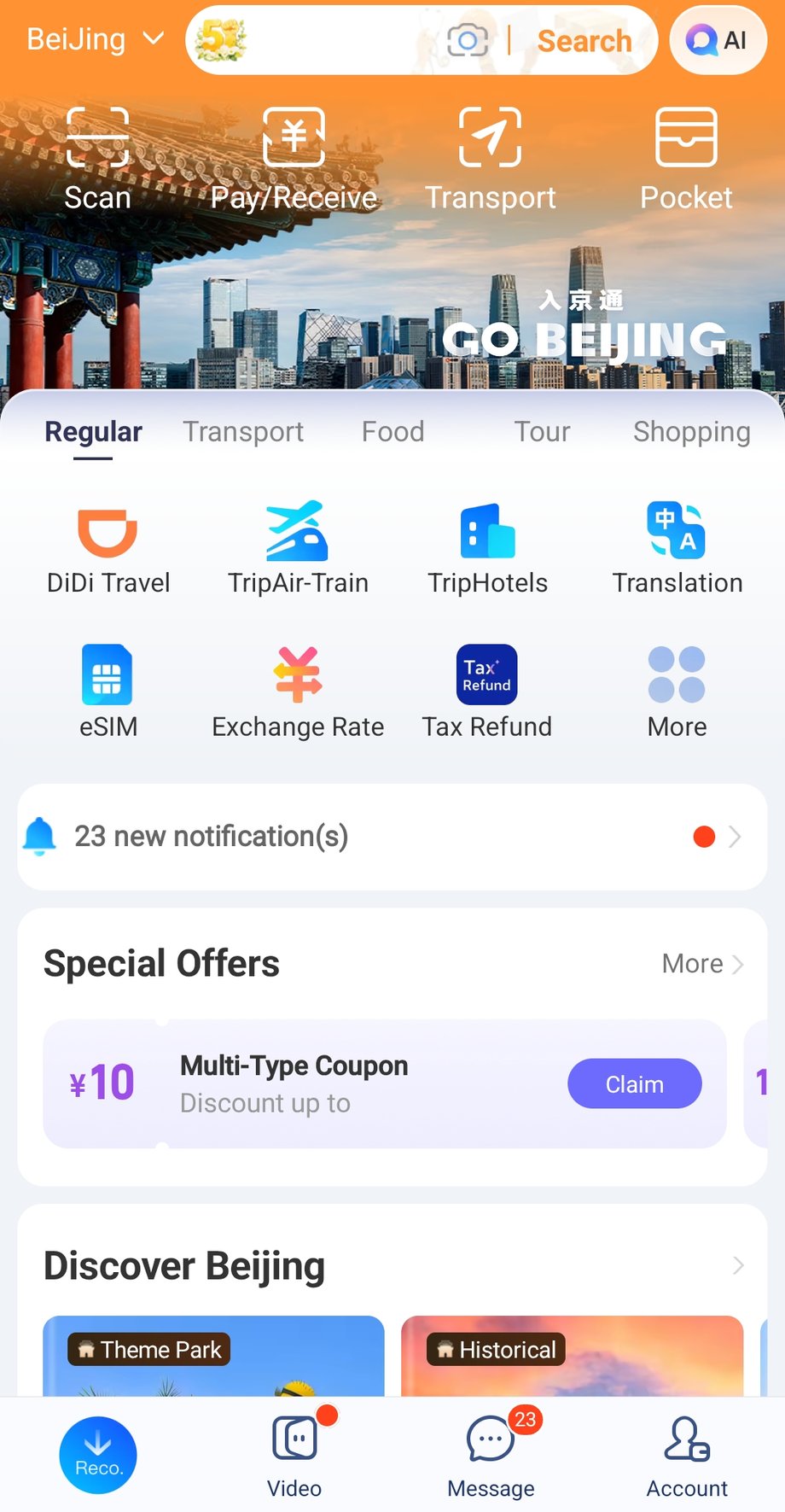
Today, AliPay offers many conveniences for tourists. This includes: translation, ticket purchase and tax refund for travelers
|
Bartłomiej Sieja / Business Insider
Of course, the system is not perfect. The concentration of huge amounts of data in the hands of private giants (and indirectly the state) raises questions about privacy. Older people and tourists sometimes feel excluded, although in 2026 facilities were introduced for foreign cards – they can be linked to Alipay without a Chinese bank account. Revolut and other virtual cards also work.
The effect is stunning: a country where cash has virtually disappeared from everyday circulation and one application has become the basic infrastructure of everyday life.
Do we want to go into this?
Traveling around China without cash changes your perspective. Alipay and WeChat Pay are not just payment tools – they are the entire social infrastructure that makes life possible in the dizzying pace of Chinese cities and in the provinces at the same time. In Poland, BLIK has a chance to become something more than a convenient way to make transfers or online shopping. But will Poles want to abandon their beloved contactless “swipe” in favor of universal QR code scanning? This is a question not only about technology, but about habits and payment culture.
One thing is certain: the Chinese have shown the world that in a country as large as theirs, they have managed to create a system in which one (or two) applications really rule everyday life – and they do it surprisingly effectively.