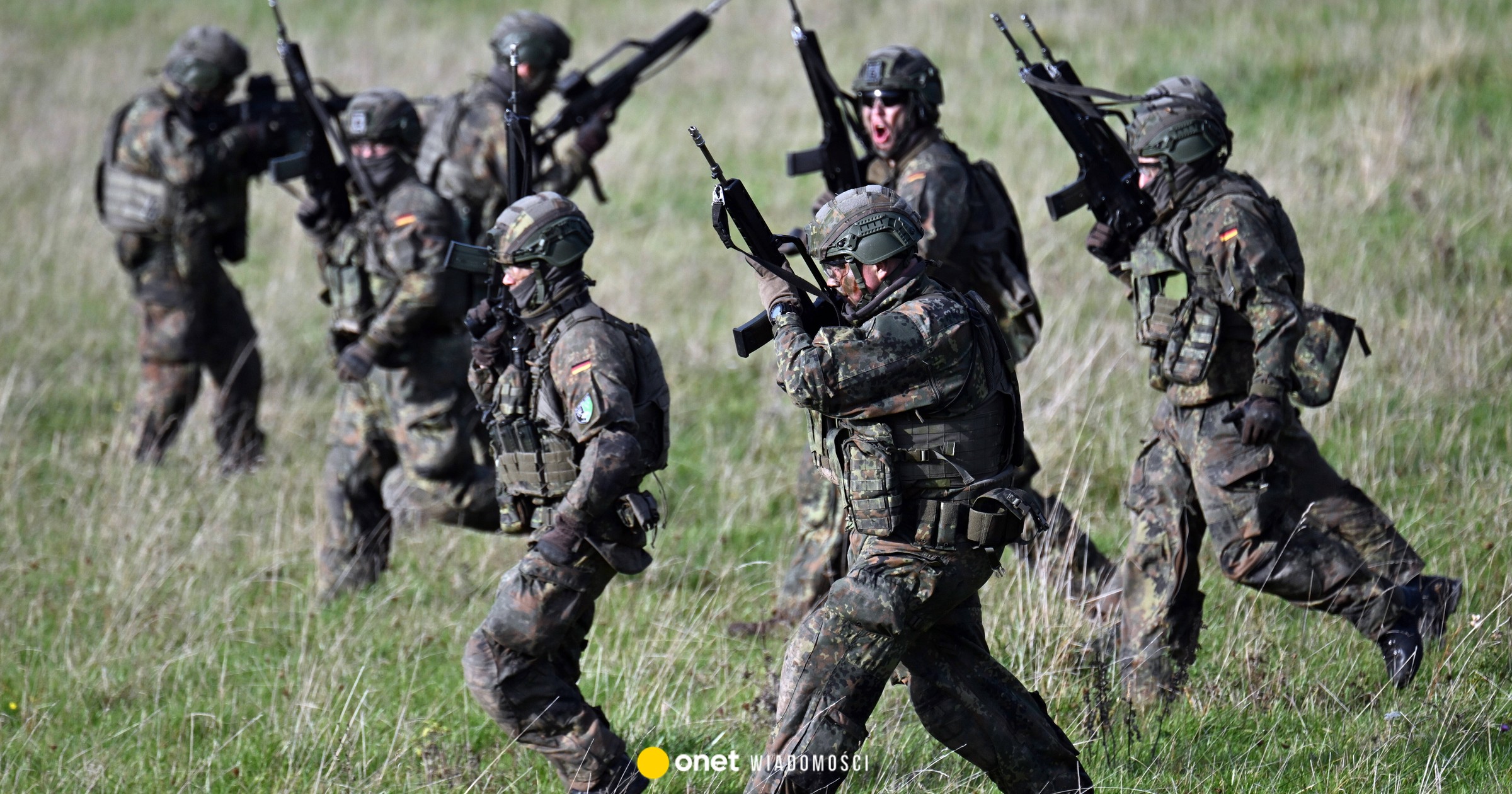
The German state wants to know again who could fight for it in an emergency. From 2026, all 18-year-old men will have to complete a questionnaire – a step that heralds return to compulsory military service. A detail that has so far received little attention is also to be registered: citizenship other than German.
This is not an “expression of distrust” towards people with dual citizenship, but necessary information for the Bundeswehr, as the German Ministry of Defense writes in the draft law. After all, anyone with two passports can be subject duties “that must be taken into account before entering service in the German armed forces”. This is not a marginal aspect, as shown by data from the Federal Statistical Office obtained by “Die Welt” journalists. This affects tens of thousands of young people.
The male part of the 2008 cohort is to be counted first. According to the statistical office, on the day of the last census, May 15, 2022, exactly 340,000 people lived in Germany. 859 men with German passports born in 2008. They are eligible for military registration and conscription. However, 56 thousand 693 of these men had at least one other citizenship than German – about one sixth.
According to experts, the approach to them is not yet decided – especially if they are citizens of countries that the German government considers posing a threat. There may be issues of loyalty and secrecy here.
This is particularly problematic in relation to Russia. According to the Federal Statistical Office it ranks fourth place among “second homelands”. 3,691 men born in 2008 hold both German and Russian passports. In this age group, Russia is ahead only of Turkey (14,463 dual citizenships), Poland (4,141 dual citizenships) and Italy (3,857 dual citizenships). Other significant countries include Serbia (1,888 cases), Morocco (1,640 cases) and Kazakhstan (1,620 cases).
Will they really be loyal to the German state? “Special constitutional test of loyalty”
In principle, those affected should be “fully fit for duty,” Hans-Peter Bartels, former defense commissioner, said in an interview with Die Welt in October. A “significant number” of repatriate children whose native language is Russian is already serving in the Bundeswehr. Many of them may have deliberately turned away from their country of origin. However, Bartels also warned that special precautions should be taken in the case of people with dual citizenship, such as those from Russia, Belarus or Iran.
First of all, it's about precautions for volunteers serving in the military. These will initially be used to cope with the increase in troop numbers. A spokeswoman for the Ministry of Defense explains that, according to the plan, people who are to be called up for military service for the first time on the basis of a voluntary commitment “would undergo a special constitutional test of loyalty before starting military service.”
“The authority responsible for conscription or conscription into the army decides whether a multinational person guarantees in defense of a libertarian democratic system within the meaning of the Basic Law“- writes the ministry.
In the event of reactivation of compulsory military conscription, the following principle would apply: “Regardless of dual citizenship, all Bundeswehr soldiers as 'citizens in uniform' are subject to a standard set of rights and obligations, which also includes loyalty to the Federal Republic of Germany.”

Bundeswehr soldiers and recruits during a ceremonial oath-taking ceremony on the occasion of the 70th anniversary of the Bundeswehr. Berlin, November 12, 2025BERND VON JUTRCZENKA/dpa / PAP
Soldiers have the obligation to “faithfully serve the Federal Republic of Germany and bravely defend the rights and freedom of the German people.” Anyone who breaches this obligation will face disciplinary action. Where loyalty is in doubt – for example due to security arrangements or possible influence attempts by other countries – access to security-sensitive areas may be denied.
The number of dual citizenships has increased. This is a legacy of Olaf Scholz's government
This is a sensitive issue: the legislative reform carried out by the previous coalition in March 2024. abolished the previous rule of avoiding multiple citizenship. It was politically desirable that migrants could have at least two nationalities. The number of people affected will therefore increase in the future. But experts recently warned that the risks involved have been underestimated.
The 2024 citizenship reform has greatly simplified broadcasting in particular German-Russian dual citizens, which is completely not in line with the times, as Matthias Friehe, professor at the EBS University of Business and Law in Oestrich-Winkel, told “Die Welt” a few weeks ago. — Anyone who is loyal to the libertarian and democratic system in Germany cannot be loyal to Putin's regime and vice versa.
Other legal experts also warn about the consequences of the reform. It is clear that “unrestricted acceptance of multiple citizenships will lead to a new bureaucracy because potential conflict situations may multiply“, says lawyer Ferdinand Weber from the University of Bremen and an expert on citizenship laws.
This concerns both threats to Germany's security and possible loyalty conflicts for people residing in their second home country. When it comes to security threats, Weber expects that “They will probably just lead to a lack of post-draft recruiting.”.
Conflicts may also arise from job duties in the second country of origin. People with dual German-Russian citizenship “must be aware that they are treated by the Russian authorities only as Russian citizens”, warns the German Foreign Ministry in the context of traveling to Russia. This also applies to a possible call-up to serve in the Russian armed forces. “The embassy cannot provide them with any consular protection because the Russian authorities treat them only as Russian citizens“.