Warsaw connects the world of semiconductors. TRUMPF and Polish innovation in the spotlight

What do Taiwanese TSMC, American Intel, Korean Samsung and Japanese Kioxia have in common? It turns out that among others Warsawbecause complex machines work in the factories of these semiconductor giants, where you can find elements and technological know-how also coming from Poland.
This is due to the fact that although we have several leading producers and manufacturers of semiconductors in the world, they fill their factories with machines from the same suppliers, who often have a very strong, and sometimes dominant, position in various fields.
Read also in BUSINESS INSIDER
The most famous such supplier is the Dutch company ASML, which creates machines for exposing silicon wafers, but the list also includes companies such as Tokyo Electron, Applied Materials, Lam Research and KLA. However, they do not build everything themselves, but are part of the global ecosystem.
Many of their machines feature TRUMPF systems and components. It creates, among others: high-power CO2 lasers for the most advanced ASML machines, but its solutions are also part of plasma systems used at many stages of chip wafer processing.
Warsaw in the machines of world giants
This is the point of contact between global chip giants and Warsaw and its surroundings. Annopol and Targówek in Warsaw, as well as Zielonka and Kobyłka near Warsaw are places where TRUMPF Electronics Polska has its branches.i.e. part of the German TRUMPF group.
This generators and power systems for the machines mentioned above are designed and then manufactured here. In practice, this means that currently virtually every advanced microprocessor and memory production line has machines and electronics that could be written “Designed and made in Warsaw”.
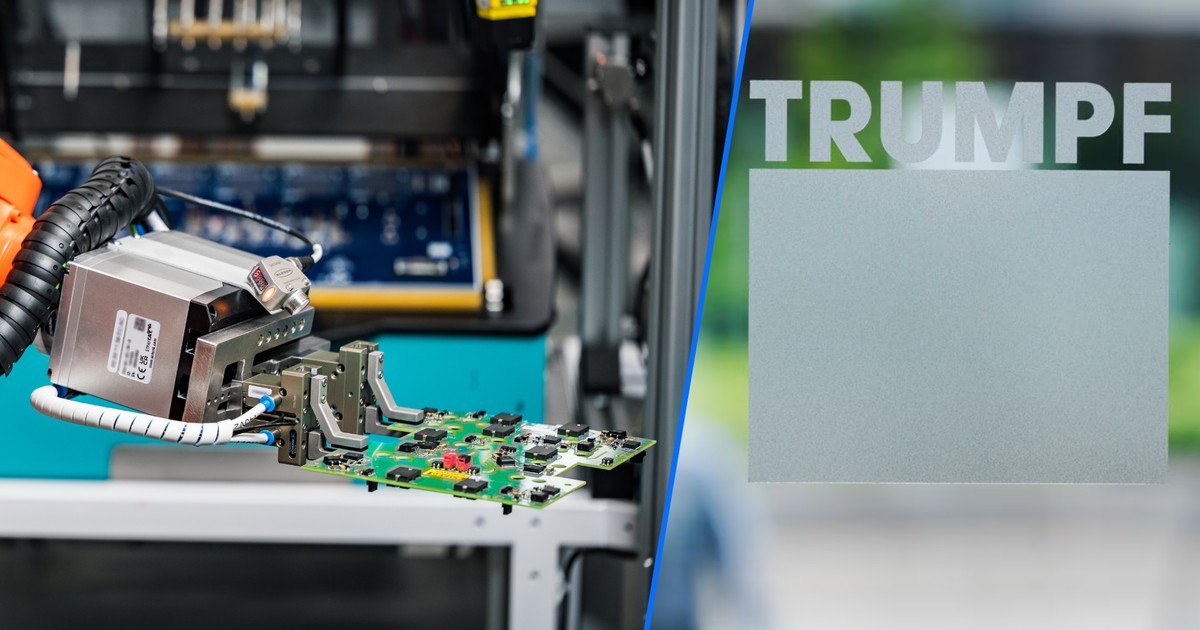
The TRUMPF factory in Annopol, Warsaw produces generator and power supply components, which are later used, among others, for machines used for the production of semiconductors.
Although the words “generator” and “power supply” do not excite the imagination as much as, for example, other elements of ASML lithography systems, we are still talking about advanced technology that requires unique know-how found in few places in the world. Designing systems of this type still eludes automation, and simulations are still unable to replace an experienced engineer with a unique instinct in this work.
The team of Dr. Paweł Ozimek – managing director of the Polish branch of TRUMPF Electronics and head of the company's R&D department – is particularly proud of its high voltage technology, which is used in etching devices used in the production of cutting-edge flash memories. The company claims that there is currently no market alternative for it, so without the work done in and around Warsaw, further development of semiconductor memory would be difficult.
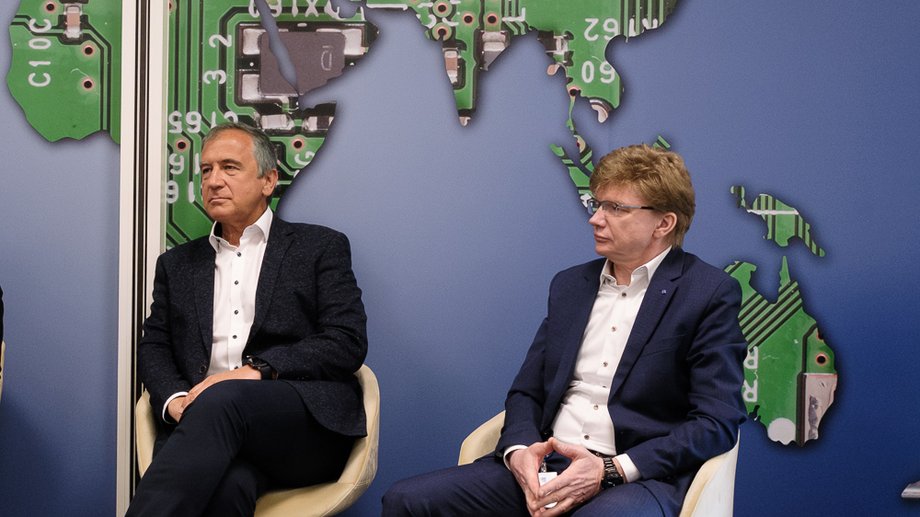
Dr. Rafał Bugyi, CEO of TRUMPF Electronics, and Dr. Paweł Ozimek, managing director of the Polish branch of TRUMPF Electronics
|
Mieszko Krzykowski / Onet
PLN 600 million for the Polish part of the puzzle
During our visit to the TRUMPF factory in Annopol, Warsaw, Berthold Schmidt, CTO of the TRUMPF group, revealed that over the last five years, the group has spent approximately PLN 600 million on the development of the electronics sector in Warsaw and the surrounding area. These investments included “expenditures on research and development, product lines and modern production facilities, including automation and robotization.” He also assured that the company invests heavily in people – and in practice it is immediately visible. What is noticeable in the corridors, offices and production halls is the low average age of employees, many of whom are in their 20s and 30s. The company also cooperates closely with the Faculty of Electrical Engineering of the Warsaw University of Technology.
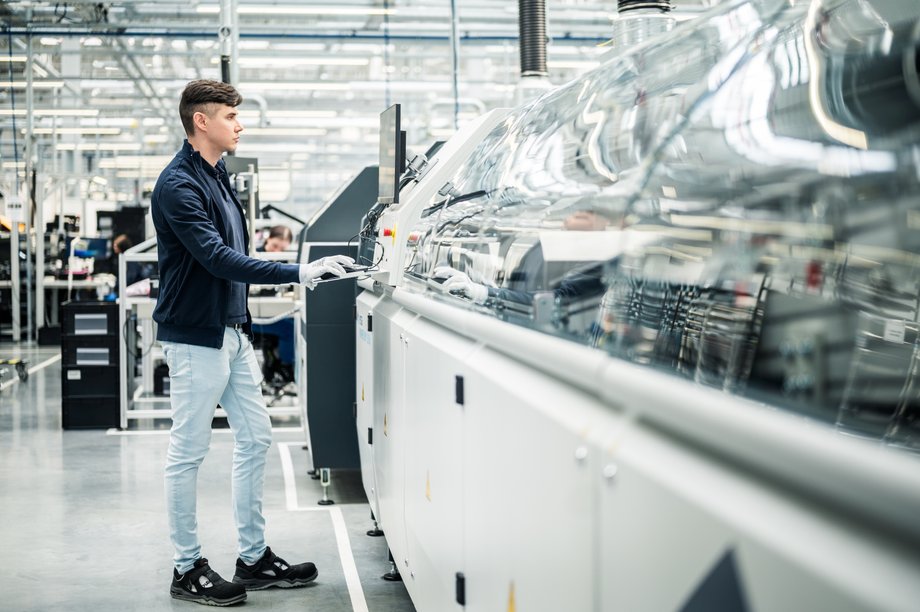
TRUMPF has a very modern and automated line in Warsaw for soldering passive components and chips to printed circuit boards. The elements leaving it must meet the requirements of some of the most demanding customers in the world
There are many indications that this is not the end of investing in this project. The world has turned into a construction site for semiconductor factories, and all makers of the machinery needed to produce chips are trying to keep up with record orders. And this also means greater demand for products manufactured in Polish TRUMPF factories, which are crucial for the global supply chain of integrated circuits. Therefore, according to Berthold Schmidt, “local centers such as Poland are not on the periphery, but constitute an integral part of the European industrial backbone in the field of semiconductors.”
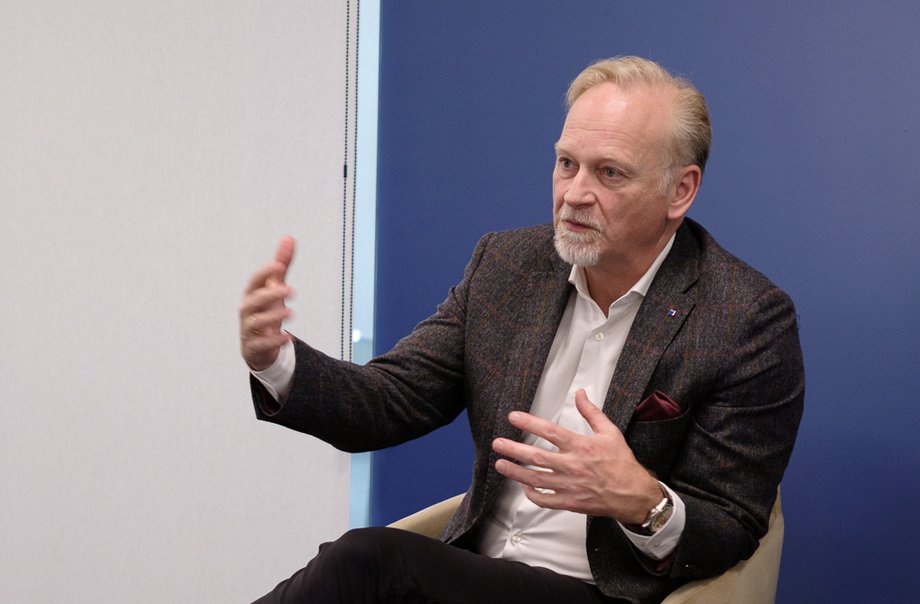
Dr. Berthold Schmidt, CTO TRUMPF SE
|
Mieszko Krzykowski / Onet
This development combined with the global tendency to shorten the supply chain is a huge opportunity to create a larger ecosystem in Poland. Of course, it is not about building a second TSMC on your own (the example of Japan currently shows how much it costs and what such an undertaking requires), but about a network of companies that do not necessarily make headlines, but solve very specific technological problems of the global industry. This is supported by the fact mentioned by Rafał Bugyi, CEO of TRUMPF Electronics
In this industry, you don't win just because you're big. You don't win only at cost, either. Cost is very important, but it is not a winning factor. Technology is the winning factor.
Read also: The only memory factory in Europe is located in Poland. There's a lot to admire
Europe's systemic problem
However, building a complete semiconductor ecosystem, including cutting-edge chip factories, would require much broader international cooperation. How to create it in Europe?
TRUMPF representatives answer this question quite clearly: what is needed is people, long-term investments and a specific, consistently implemented plan. Rafał Bugyi pointed out that Europe and Poland have an advantage that they often cannot fully convert into an industrial advantage.
— I believe we have the right people and the right level of education. Europe is very strong educationally. This is a potential that we are not fully exploiting in Europe, he says.
Berthold Schmidt, however, emphasized that semiconductors require a perspective measured not in years, but in decades. Building a wafer factory, implementing the technology, creating an entire business system around it and bringing it to stable operation takes – as he said – one or two decades. And this is where Europe has a problem. It has great points in the value chain, but often lacks a coherent, multi-year strategy that can survive political changes and economic cycles. For example, the European Union said it wanted to increase its share in the global semiconductor industry from approximately 10 to 20 percent, but – as Schmidt said – it is far from this goal.
The largest European technology companies express themselves similarly. In an open letter published in early May, the heads of ASML, Airbus, Ericsson, Mistral AI, Nokia, SAP and Siemens write that Europe is losing global competitiveness. Also, in their opinion, the problem of the continent is not the lack of innovation, but the inability to turn it into scale: by fragmented market, too complex and overlapping regulations, too slow implementation of new technologies and weaker conditions for the growth of European companies compared to subsidized competition from other parts of the world.
In short: there is a lot of talk about silicon sovereignty, but still relatively little is done.