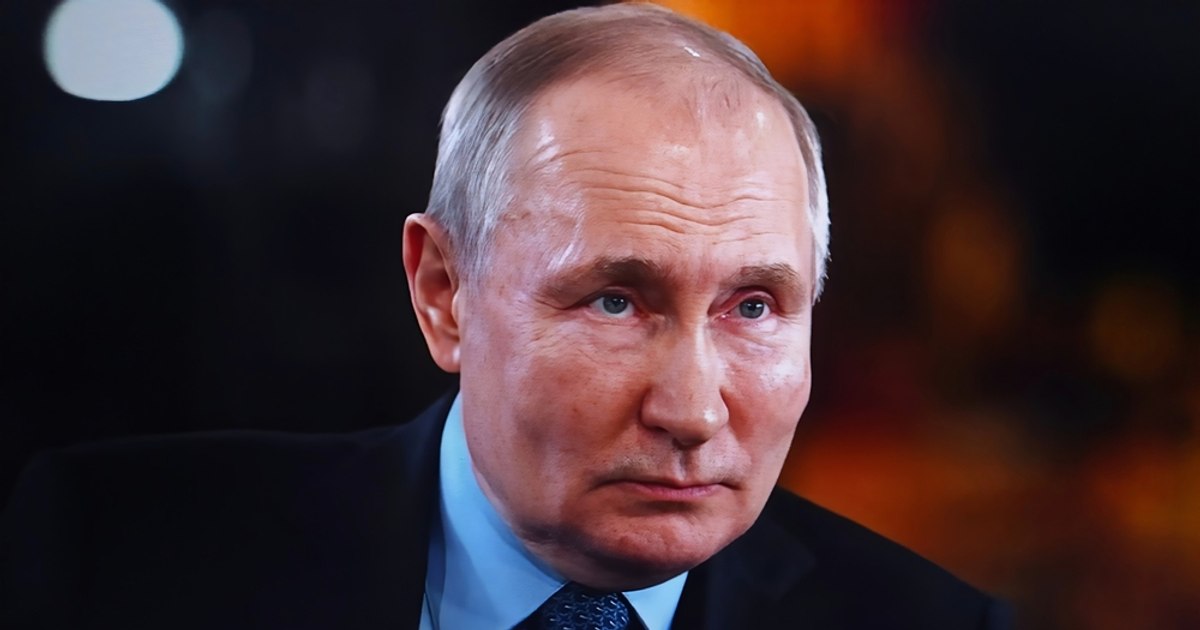
Rumors of coup plots are rife in Moscow, but the Russian president's problems are actually much bigger. Vladimir Putin managed to stay in power for 26 years because he was always a few steps ahead of his enemies. Now, however, Putin's room for maneuver is narrowing and the Kremlin leader may be weaker than we imagine, a Foreign Policy analysis shows.
SHUTTERSTOCK PHOTO
Russian President Vladimir Putin has a reputation for being extremely cautious about security risks, even avoiding the use of a mobile phone, aware of how easily they can be tracked. However, a document recently leaked from inside the Kremlin and reached the press through a European intelligence service shows a new level of suspicion surrounding the security of the Russian leader, which seems to have reached new heights, notes Foreign Affairs.
According to the document, access to Putin is allowed only after two security filters. His bodyguards have total control over his public appearance schedule, and travel to military targets has been all but eliminated. People working near it are no longer allowed to use mobile phones that can be connected to the Internet, only devices without Internet.
Moreover, surveillance systems would have been installed including in the homes of the domestic staff who serve the Russian leader: cooks, drivers or maids. They would have been forbidden even to use public transport. A telling detail is that Putin and his family no longer live in their usual residences, but in secret, highly secured locations, and the president's work is said to be conducted mainly from bunkers in southern Russia.
The authenticity of the document cannot be independently verified, and analysts admit the possibility of a disinformation operation aimed at causing tensions within the Kremlin. However, put into context, much of the information presented is perfectly plausible, revealing the pressures facing the Russian leader from several directions.
In recent months, authoritarian leaders in the crosshairs of the US have become increasingly vulnerable to intelligence operations and precision-launched attacks. In January, US forces were able to capture Venezuelan President Nicolás Maduro without loss of life. In late February, Israel removed Iranian Supreme Leader Ali Khamenei on the very first day of the war with Iran, along with several high-ranking Iranian officials.
Such operations rely on a sophisticated combination of human sources and electronic interception, tracking not only the communications of the targets, but also those close to them, guards or auxiliary personnel. In this context, authoritarian leaders have become much more vulnerable than in the past.
The former head of Ukraine's military intelligence service, Kirilo Budanov, now chief of staff to President Volodymyr Zelenskiy, is said to be an admirer of Israel's targeted assassination tactics. Under his direction, several Russian officers, politicians and propagandists were assassinated, including in Moscow.
In December, a car bomb attack in the Russian capital killed Lieutenant General Fanil Sarvarov. According to the leaked Kremlin document, the attack would have caused panic in Moscow's power circles and led to tense meetings between security service officials, who blamed each other for alleged breaches. These may be real or just imagined, but the warning signal cannot be ignored: amid repeated Russian attempts to remove Zelenskiy, Putin has good reason to believe that he too could be a target.
Vladimir Putin has many fears, but also real problems
It is possible that Putin fears internal enemies as much as Ukrainians – as evidenced by the rumors of a coup d'état running rampant in Moscow. But if so far Putin has managed to stay in power by outclassing his enemies, now his room for maneuver seems to be narrowing, notes Foreign Affairs.
One of the pressure factors is the military situation at the front, which seems to be deteriorating for Russia. The offensive prepared for this spring was thwarted before it even started. The Ukrainians claim that in March alone, the Russian military lost around 35,000 soldiers dead or seriously wounded, the fifth consecutive month in which losses outpaced recruitment.
More importantly, analysts say, the human sacrifices have not yielded the desired strategic gains. Michael Kofman, an expert from the Carnegie Endowment for International Peace, commented in this regard that not only is Ukraine “doing better than anticipated”, but “time is no longer on Russia's side”.
In some sectors of the front, Ukrainian forces even managed to push Russian troops back. Russian commanders seem bereft of ideas to change the dynamics of the war: simply sending new troops to the front no longer produces results.
Vladimir Putin has become a hostage to the “grandparents” myth. “Everyone now began to understand that the war was not going according to plan”
Instead, Ukraine continues to surprise with military innovation and creative new uses of technology. Almost daily new bold attacks inside Russian territory are announced. On April 25, Ukrainian drones struck a military airfield in the city of Chelyabinsk in the Ural Mountains, more than 1,700 kilometers from the Ukrainian border.
Ukrainian forces have devoted significant resources to destroying Russia's air defense systems, which are no longer able to simultaneously protect all strategic targets. At one point, the threat of Ukrainian attacks prompted the simultaneous closure of Moscow's four international airports.
The Ukrainians strike strategically deep into Russian territory
Analysts believe that the expansion of the range of Ukrainian attacks also influenced the Kremlin's decision to exclude military equipment from the May 9 Victory Day parade. In a gesture considered humiliating for Moscow, Putin would have asked US President Donald Trump to deter possible Ukrainian attacks during the ceremony.
However, the purpose of these strikes is not only psychological. The Ukrainians appear to be pursuing an ambitious goal with real impact: the destruction of essential components of the Russian economic and industrial infrastructure.
At the end of April, a long-range Ukrainian drone struck a refinery in Perm, targeting distillation columns needed to process oil. Unlike storage tanks, which are relatively easy to repair, such installations are much more difficult to replace.
The former commander of US forces in Europe, Ben Hodges, observed that Ukraine had developed “a theory of victory” based on the destruction of Russia's energy infrastructure to directly target Moscow's ability to sustain the war.
A Reuters analysis published in late March estimated that the Ukrainian attacks reduced Russia's oil export capacity by about 40 percent. At the same time, Russia's budget deficit has already exceeded its target for the full year, while oil and gas revenues have fallen by 45%.
The Ukrainian strategy is repeated in other industrial areas. The attacks target chemical plants, semiconductor manufacturing facilities and steel plants, hitting precisely the components critical to the functioning of Russia's military industry.
In contrast, Russia does not seem capable of generating similar consequences on Ukraine. Ukrainian military production is dispersed across numerous small production facilities in hard-to-identify locations, making it difficult to pick out effective targets. As a result, Moscow continues to hit energy infrastructure and civilian areas, tactics that observers say only strengthen the resistance of Ukrainian society.
The nest of spies in the heart of Moscow: what is Department 4, Putin's “hacker factory”.
The fact that the direction of the war is going in favor of Ukraine is also reflected in President Zelensky's speech to the United States. The Ukrainian leader recently said that Russia “played the Americans again”, a reference to Donald Trump's policy of allowing Russian oil exports.
That's not to say Ukraine doesn't still have its problems, including military personnel shortages and corruption scandals. Many Ukrainian men still avoid conscription.
However, Kiev's international position seems to be strengthening. The war in Iran has opened new diplomatic opportunities for Ukraine, which is trying to capitalize on its experience in combating drones to attract support from the Gulf monarchies.
At the same time, Russia is losing influence in Europe. The recent electoral defeat of Hungarian Prime Minister Viktor Orban deprived the Kremlin of one of its most important allies in the European Union. His departure enabled the unlocking of a European assistance package for Ukraine worth 106 billion dollars.
Externally, Moscow is also experiencing difficulties in Africa. Mali's military government, backed by Russia, is losing ground in the confrontation with Islamist rebels.
For Vladimir Putin, the loss of influence in Mali is not a direct threat. But a possible defeat in Ukraine, combined with economic stagnation, discontent among oligarchs and increasingly harsh restrictions on the Internet in Russia could become a real danger to the stability of the regime.
Signs of doubt are beginning to appear even among the most ardent supporters of the war. One of the pro-war bloggers recently commented that “little by little, the advantage is shifting to the side of the enemy,” who are succeeding in their counterattacks.