Wolves are circling a town in western Romania. “Dracula's pet. He was looking for his master”

A recent alert sent to the population, after the appearance of a wolf in the vicinity of Corvinilor Castle in Hunedoara, caused various reactions, from humor to anxiety. However, the case is not unique: after many years of “quietness”, wolves have returned to attention, recalling strange and tragic events.
Wolves appeared in the vicinity of the Corvinor Castle in Hunedoara PHOTO Archive
On the night of May 1, the Inspectorate for Emergency Situations Hunedoara sent an alert message to the local residents of Hunedoara, announcing the presence of a wolf right in the vicinity of Corvinilor Castle.
“The presence of a wolf has been reported in Hunedoara, Voinei street! Avoid the area, stay indoors! Keep your distance from the animal and do not try to take pictures with it or feed it. Without exposing yourself to danger, protect the animals in the household“, informs the Ro-Alert message.
Lupii, closer to Hunedoara
Some locals treated the message with humor, recalling the legends of Dracula and werewolves.
“This was Dracula's pet, he was looking for his master, hearing that he was in the dungeon here.” joked a local on Facebook.
“Werewolf, probably,” someone else added wryly.
Some locals complained that wolves recently attacked a sheepfold on Valea Zlaștiului, in the vicinity of the municipality, while other Hunedor residents claim that the area is frequented by jackals, not wolves. However, their approach to the city is a first, after many years when wolves were only observed deep in the forests of the Poiana Ruscă Mountains.
The wolf from Corvinir Castle. Image made with AI. Source: Hunedoara, Culture, History, Tourism
From the foot of the Corvinilor Castle in Hunedoara, the place where the Cerna and Zlaști rivers meet, the roads climb up the valleys of the two rivers to the villages of the Pădurenilor Land, a picturesque region in the Poiana Ruscă Mountains, occupied in the past by more than 40 villages, most of them affected in the last decades by depopulation and the aging of the population.
Forests cover areas of thousands of hectares around these settlements, and the presence of wolves often made the locals uneasy, even as the lyrics of local songs tried to give people courage.
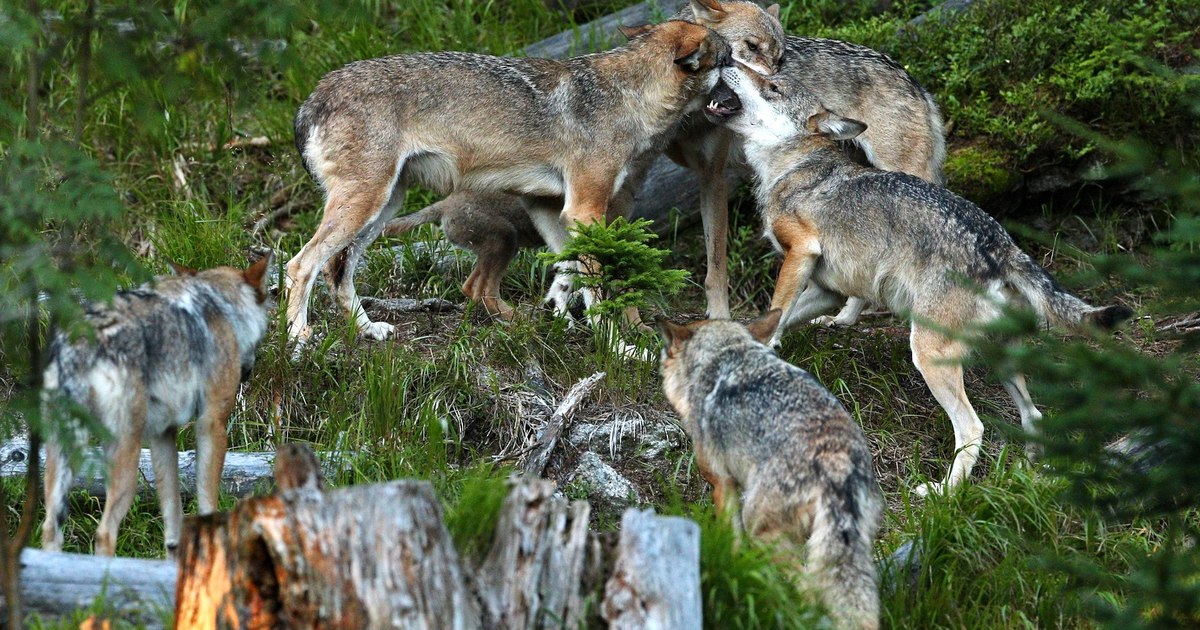
Pack of wolves, Vadu Dobrii. Photo Vadu Dobrii, dreamland. Facebook
“I was the chicken of the forest and wolves wouldn't eat me, wolves eat horses and oxen, they don't eat volunteers like us”was one of the popular songs in the forest villages, collected by the composer and ethnographer Béla Bartók, in 1913, from the villagers of Feregi.
Recently, a forester from the Ghelariu area reported that wolves were observed several times in the images of surveillance cameras located in the forest. In February, another local resident published images captured by surveillance cameras, with a pack of wolves passing by the outskirts of the village of Vadu Dobrii, on the then snow-covered meadows.
The unforgettable tragedy in Poiana Ruscă Mountains
Some villagers say that almost every winter, wolves leave their tracks in the snow that covers the lands in the vicinity of the mountain villages.
In Farășești and Poieni, two isolated villages in Timiș County, at the foot of the Poiana Ruscă Mountains, the tragedies caused by wolves decades ago continued to unsettle the locals for a long time.
In the 70s, a wolf had attacked the people of Poieni twice in one day, killing a shepherd and his mother-in-law and tearing apart the man's sister and wife.
Survivor of the wolf attack, Maria Sârbu, then about 30 years old, managed to save her younger daughter, two years old, from the fury of the wild animal, but she remained mutilated for the rest of her life.
The strange place where the shepherds are afraid to stay at night. Beliefs about undead still give Romanians chills VIDEO
“It was some kind of wolf, but I didn't get to see it very well, because it took me from behind. It put me on the ground on my side and tore the skin of my head on the back. I crouched over the girl, so she couldn't see. Luckily she was small. Then she tore my face with her mouth. For a moment I didn't feel the pain so much, I was numb. I crawled as best I could towards the village, holding the girl by my side me, not to escape, I was all blood”Maria remembered, in 2000, at the age of 81.
That day, Maria managed to save herself, but her mother was killed by the wolf. Later, the wild animal attacked a barn near the village of Poieni, killing Maria's husband after biting him on the neck. The man's sister jumped to the victim's aid and killed the animal.
“He stalked the wolf and attacked it, managing to stab it with a razor. Then he cut off its head. It is said in the village that there was something unclean with that animal, that it had human features”recalled Mircea Pașca, a local from Poieni.
Wolves, feared by Romanians
In Chergheș, Hunedoara county, for several years, the nocturnal appearance of a wolf on the streets of the village created fears for the locals, confident that the wild animal that had attacked the chicken coops was a villager who, after death, had turned into an undead. People decided to face their fear in a bizarre way. One night, several villagers dug up the grave of the “toddler” and took revenge on his remains.
The Carpathian Mountains are home to one of the largest wolf populations in Europe. In Romania, the number of these wild animals was estimated at 2,500 – 3,000 specimens, according to a European Commission report published in 2023.
Animals currently protected by law, wolves have been considered, over time, real dangers for Romanian communities. Since the Middle Ages, villages and towns on the current territory of Romania offered rewards to those who killed wolves. In the 20th century, packs continued to be viewed with fear, and Romanians were encouraged to exterminate them, considering them a danger to their safety and that of the animals. Until the late 1980s, there were even competitions between hunters to capture and kill wolves and their cubs.
“In recent weeks, hunters from Hunedoara county have shot many wolves. They want to equal their own hunting record from last year, when they captured 51 wolves and wolf cubs. The luckiest hunter turned out to be game warden Petru Moga, from the Costeşti-Beriu area: on one day in 1983, he caught 6 wolf cubs and managed to capture the she-wolf as well”informed the newspaper România Liberă, in 1984.
The secrets of the richest countess in Banat. “Her dog had its own wagon. At the hotel, Lord got food from the menu”
The Poiana Ruscă mountains, the “heaven” of wolves
Since 1993, the wolf is protected by law in Romania. Then Law no. 13/1993 for Romania's accession to the Convention on the Conservation of Wild Life and Natural Habitats in Europe, adopted in Bern on September 19, 1979. According to the Convention, each contracting country undertakes to take appropriate and necessary legislative and administrative measures to ensure the conservation of the species of wild fauna and flora listed in Annexes I-III of the document. The species Canis lupus is listed in Annex II, “Strictly Protected Fauna Species”.
According to a 2019 report by the Ministry of the Environment, Waters and Forests, in Romania, wolves live mainly in compact mixed forests in the hill and mountain area, at 600-2,300 meters altitude. They are territorial animals. They need vast territories, and in Europe these territories range in size from 10,000 to 50,000 hectares. Solitary wolves do not have a defined territory and travel impressive distances to find a mate and reproduce. The main species that the wolf hunts are roe deer, stag and wild boar, but in some situations it can also feed on fruit, smaller vertebrates or invertebrates. Sometimes it attacks and wreaks havoc among domestic animals.
“Contrary to myths, scientific evidence shows that wolves do not pose a danger to humans: they do not see humans as prey and generally avoid contact with humans, recognizing them as a threat.” pointed out Cristian-Remus Papp, coordinator of the Wildlife Department, WWF-Romania (World Wide Fund for Nature), on the organization's website.
In the Southern Carpathians – Apuseni ecological corridor, which includes the counties of Alba, Arad, Bihor, Caraș-Severin, Cluj, Gorj, Hunedoara and Timiș, the estimated number of wolves in the past years was over 1,800 animals, most of them being concentrated in the area of Hunedoara and Caraș-Severin, in the Retezat, Țarcu and Poiana Ruscă Mountains, followed by the counties of Alba and Cluj, in the Mountains Bihor, the report of the Ministry of Environment, Waters and Forests showed.