How Washington justifies the idea of ”taking” Greenland: “Nations that cannot defend their territories are not entitled to own them”


What until recently seemed like a rhetorical extravagance of Donald Trump is beginning to take on a doctrinal shape. The US administration is no longer talking about Greenland as a geopolitical joke, but as a “national security imperative”. And the arguments used are, for Europe, unsettling.
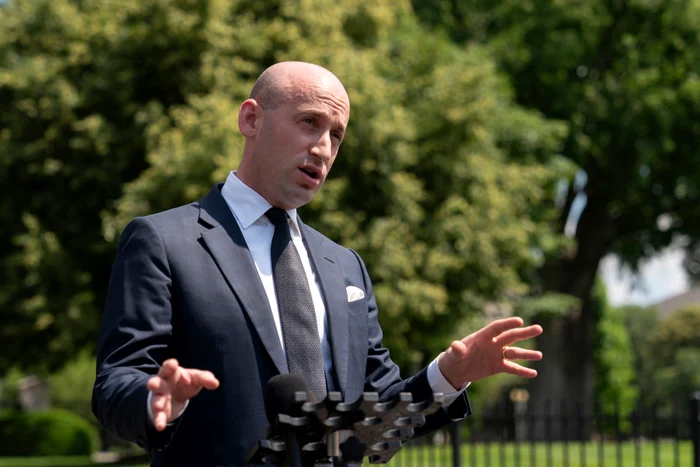
Stephen Miller, deputy chief of staff at the White House / PHOTO: Profimedia
Stephen Miller, deputy chief of staff at the White House and one of President Trump's most influential ideologues, put it bluntly: states are not entitled to keep territories they cannot defend. And Denmark, in his opinion, does not meet this criterion in the case of Greenland.
“The new international competition is moving to the polar zone,” Miller explained in an interview with Fox News. The Arctic, shipping routes, control of movements and resources – these would be the real stakes of the 21st century.
In this context, Trump's adviser questioned Denmark's right to Greenland, claiming that the Danish state “cannot defend” the territory, due to its military and economic limitations. “To control a territory you have to be able to defend it, develop it and populate it. Denmark has failed on all these fronts,” Miller said, in a statement that caused consternation among Western allies.
He also stated that the United States would already be forced to spend “hundreds of billions of dollars” on Denmark's defense within NATO, calling this arrangement “wrong” and “unfair to the American taxpayer” that would have “subsidized Europe's security for generations.”
It is a logic that recalls the 19th century rather than the international order built after the Second World War. A logic in which international law, sovereignty and alliances become secondary to the supreme criterion of military power.
This rhetoric is not accidental. It repackages an older Trump view: alliances are not values, but transactions. And if the balance is not in America's favor, the rules can be rewritten.
In Congress, the reactions are far from unanimous
Both Democrats and influential Republicans have explicitly rejected the idea of using military force against Greenland, an autonomous territory under Danish sovereignty. Republican senators Thom Tillis and Lisa Murkowski even went to the island in a gesture of preventive diplomacy to reaffirm cooperation with Denmark and NATO against Russia and China.
Tillis warned that any attempt at military intervention would meet serious opposition in Congress. Other Republicans are even more direct: Congressman Don Bacon called the idea “nonsense,” and Democrats are calling the statements “out of control.”
For Denmark, however, the threat is not treated as mere political bravado. Prime Minister Mette Frederiksen warned that a possible US military move would break the foundations of the North Atlantic alliance. “Everything would stop – including NATO and the security system built after 1945,” she said in a televised interview.
Herein lies the real stake: not Greenland itself, but the precedent. If a NATO ally can be pressured, threatened or even dispossessed of territory on the basis of “insufficient defense”, then the entire edifice of collective security becomes fragile.
Stephen Miller's statements say loudly what has been only hinted at so far: for a part of the Trump administration, the world is no longer organized by rules and alliances, but by raw power relations. Who can, take. Whoever doesn't, loses.
For Europe, this is not just a wake-up call. It's a stark lesson in what a world where guarantees are no longer guaranteed might look like.