The dark truth from Romanian folklore. The sacrificial rituals that inspired the ballad of Master Manole

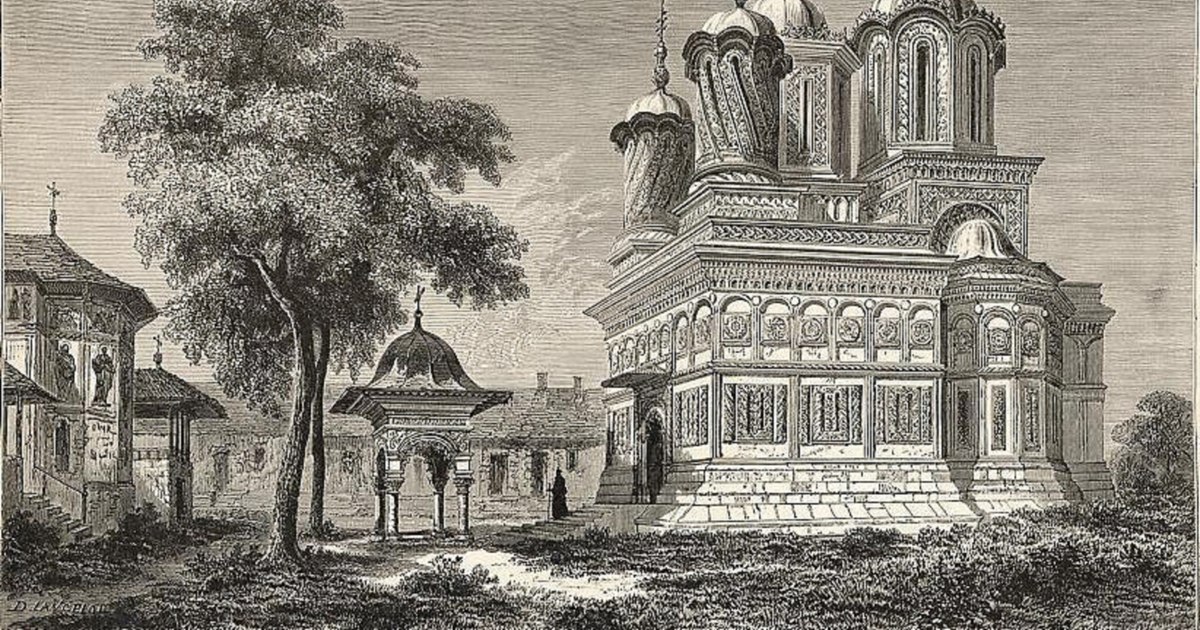
The legend of Master Manole, with the sacrifice of Ana built at the Argeș Monastery, experts say, indicates the practice in the Middle Ages, among Romanians, of bloody rituals that are several millennia old. Basically, there was the belief that something sustainable is done only with terrible sacrifices.
Argeș Monastery PHOTO wikipedia
The ballad “Argeșului Monastery” is one of the most important and, at the same time, well-known masterpieces of Romanian folklore. It is about the famous craftsman Manole, who built his wife in the structure of the church within the monastic complex in Curtea de Argeș, as a necessary sacrifice for the durability of the construction. Beyond the legendary aspects, this story indicates the existence of some earth-shattering practices and rituals, perpetuated by the Romanian people until the 16th century, when the church was built.
It is about the pagan sacrifices, respected with sanctity by certain professional categories or certain communities in the midst of the Christian era. They were called foundation sacrifices or foundation offerings and represented ancient ritual practices, found in various cultures, by which a sacrifice (human or animal) was offered when a settlement, house, fortress or important structure was built. Their purpose was to ensure the stability of the construction, to protect it from evil forces and to guarantee the prosperity of the future inhabitants. Specialists say that both the myth of Master Manole and the myth of the foundation of the Putna Monastery by Stephen the Great show that those ancient rituals were practiced by Romanians in the middle of the Middle Ages.
A legend that reveals disturbing truths
The ballad “Argeșului Monastery” was published for the first time by the writer Vasile Alecsandri, in 1852. This was collected from Romanian villages, being a legend that is supposed to have survived through oral transmission, from generation to generation, for hundreds of years. The ballad tells the story of the foundation of the Argeș Monastery and the construction of the church in the monastic complex — one of the most beautiful in Romania — built between 1512-1517 and founded by the voivode-scholar Neagoe Basarab.
Well, the ballad talks about the effort of Master Manole, a great craftsman from Wallachia, specialized in religious constructions, to fulfill the ruler's order: to build a church like no other. But everything that worked during the day collapsed at night, as if under a curse. The legend mixes historical truth with fiction (or perhaps it was intentionally altered by Alecsandri for more mystery) to give it the status of a national founding myth, much needed in that period.
More precisely, Master Manole is employed by the legendary Negru Vodă, the alleged dismounter of Wallachia in 1291. In reality, the only one who could have offered such a task to Master Manole would have been Neagoe Basarab. In any case, both Black Voda and Master Manole appear to be legendary characters. Back to the story: Desperate for not being able to finish the work, the craftsman decides to resort to an ancient ritual. To defeat the curse, he sacrifices his wife, Ana, building her into the foundation of the monastery. Thus, he sacrifices everything that is most precious to him in the name of creation.
Obviously, Ana's sacrifice “tames” the unseen forces, and the church can finally be completed. When the roof was finished, the ruler came to see the miracle and asked the craftsmen if they could build another one like it. They, filled with pride, answered in the affirmative. At that moment, Vodă ordered the scaffolding to be destroyed and the masons to be abandoned on the roof. They tried to jump using shingle wings, but they died one by one. Including Master Manole. At the place where he fell, a spring is said to have gushed forth. Even today there is a fountain in Curtea de Argeș that marks the place where Manole perished. At the same time, in the church there is a portion of the wall which is believed to indicate the place where Ana was built.
Beyond folk tales and legends, this myth with medieval roots reveals a disturbing reality from five centuries ago. Actually, experts say, it indicates that pagan construction rituals were practiced in the past, sometimes extremely violent.
Buildings “hallowed” with human blood and gruesome deaths
Specialists such as folklorist and historian Lazăr Șaineanu, Bulgarian folklorist Mikhail Arnaudov or Mircea Eliade say that these extremely bloody rituals were found all over Europe, including Western Europe. But they survived much later in the Balkans. And the example provided by the legend of Master Manole is not unique.
A suggestive legend in this sense is that of the foundation of the Putna Monastery. In short, after the battle of Chilia in 1465, Stephen the Great decides to build a monastery in the place indicated by Daniil Sihastru, his priest. On the top of the hill shown by the scoundrel, Stephen the Great proposes an archery contest. The monastery will be built on the place where the arrow of the most suitable will reach. Along with the voivode, three young boyars are competing. The farthest he manages to pull is a boyar, Sion. He is sacrificed by Stefan on the place where the foundation of the monastery was to be laid. He is simply beheaded, and the place of the foundation anointed with his blood.
“They also made three boyars to shoot, for the children's vatav and for two children from the house. So where they fell the arrow of the children's vatav they made the gate, and where they fell the arrow of a child from the house they made the bell tower. And a child from the house said to have surpassed Ştefan-voda and that his arrow had fallen into a grove called Sion, which is near monastery. And there is a pillar of stone. And I say his head be cut off there.” wrote chronicler Ion Neculce.
Evidence of human sacrifice rituals discovered in an archaeological site in Romania
At the same time, there are recorded customs from the people that specified that both in Wallachia, but also in Moldova, there was the custom of sacrificing an animal or draining the blood of a bird at the foundation of a house or building to be durable. Also in Moldova there is the legend of the development of the Dracșani pond, in Botoșani county, on the orders of Stephen the Great. For durability and cleansing the place of curses, a rooster and a slave are sacrificed.
Even in Transylvania such a legend is found. At the construction of Deva's fortress, the craftsman Kelemen builds his living wife at the foundation. “Let us specify that such beliefs and legends were part of a ritual sacrifice: whether it is a human effigy or the “shadow” of a victim, or whether one resorted to one of the countless forms of sacrifice by substitution (immolation of an animal on the foundations or when entering the house for the first time), a bloody sacrifice always ensured the solidarity and duration of a construction”wrote Mircea Eliade in the work “From Zalmoxis to Ghenghis Han”.
The ritual was extremely brutal. The victim was “lucky” if he got stabbed or decapitated before he was walled. In the worst cases, where a curse or an unclean spirit was supposed to exist, the sacrificed person was resurrected. He was simply suffocating in the walls of that building. “For a construction to last, it must be animated, that is, it must receive life and soul at the same time. The “transfer” of the soul is only possible through a sacrifice; in other words, through a violent death. It can even be said that the victim continues her existence after death, not in her physical body, but in the new body, the construction, which she animated through her sacrifice”stated Eliade in the same work.
The Balkans, experts in such rituals
According to some Balkan specialists, such as the Croatian ethnographer I. Skok, the Romanians were the ones who gave birth to these myths. They would also have been among those who continued to perpetuate the founding rituals until late, towards the 16th century. The Croatian specialist says that these legends appeared especially among the Macedonian-Romanians south of the Danube, who were part of the masons' guild. In any case, the best masons in the Balkans, from Skok's point of view, called to erect the great edifices, were the Romanians and, in particular, the Macedonian-Romanians called “goge”. They were also the best connoisseurs of the ritual of sacrifice.
It is supposed to have been a common practice of the masons' guild. They practiced the custom of sacrifice on the walls of a building and, in exceptional cases, resorted to human sacrifice. “Masons preserved until the last century “secrets of the trade” of an undeniable archaism. Construction works include a ritual and symbolism that come to us from a very distant past. Any trade, but especially those of mason and blacksmith, was loaded with a ritual significance and a symbolism strictly reserved for “initiates””specified Eliade.
However, foundation rites were not only found in the Balkans, but all over the world, in different eras and forms. At the European level, these rituals may have survived somewhat longer in the Balkans than in other regions, but they were practiced from the British Isles to Greece, from Antiquity and probably into the early Middle Ages. In any case, most of the sacrifices were symbolic and consisted of bird or animal blood sprinkled on the foundation. In extreme cases, human sacrifices were used, such as the one described at the Argeșului Monastery, the Putna Monastery or the Dracșani pond.
Ancient rituals
These sacrifices or founding rituals are extremely old in Europe and, including, in today's territory of Romania. They have existed since the Neolithic and have been proven by several important archaeological discoveries. More precisely, osteological remains deposited in the walls or foundations of houses.
A secret history of death in Romania. Children killed, people eaten and human sacrifices until the time of Stephen the Great
One of the best examples is found in Parța, in a site from the Banat culture developed approximately between the 5th and 3rd millennia BC. At the base of several buildings, vessels filled with human bones offered as an offering were discovered. “Three small vessels with bones were discovered in the foundation of the eastern wall of house P 8, built next to sanctuary II. GH Lazarovici and M. Merlini also discovered fragments of a jaw at level 7 a, pit number 30 and in hut 29, but also remains of human bones in other foundation pits”it is stated in the work “Tărtăria and the Sacred Tablets” by Gheorghe Lazarovici, Cornelia Magda Lazarovici and Marco Merlini.
The same ritual, in which people ended up being killed and deposited at the foundation of temples or important houses, is also identified in the area of the Tiszapolgar culture, but also in Moldova, within the Cucuteni culture, where human bones, most of them burned, were discovered in Scânteia. Archaeologists have identified that young men were usually sacrificed, but mostly children. The latter, through their purity, would have had an important magico-religious protective role.
The best example can be found at the temple of Căscioarele within the Vinca-Turdaș civilization (in the southern area, not Transylvania proper), about 4000 years ago. More precisely, two children's skeletons were found at the base of the temple. Research shows that they were the victims of a particularly bloody sacrifice. “The offering of such a perfect and pure being as a child was the necessary step in these civilizations for the consecration of the edifice”it is shown in the previously mentioned work.