The escape of Denis Bucayev – recently dismissed from the position of deputy minister of natural resources and environmental protection – from Russia to the United States is part of the a pattern that emerged after the launch of a full-scale invasion of Ukraine in 2022.
It is also reminiscent of earlier moments in Soviet history when waves of defections increased during periods of instability: during the purges in the late 1930s, the chaos following the start of Operation Barbarossa in World War II, after Stalin's death in 1953, and during the collapse of the Soviet Union in the late 1980s. Fugitives rarely decide to take such a step for just one reason. Personal and financial problems, conflicts with superiors and fear of punishment often play a role.
However, such difficulties are common in authoritarian systems such as the USSR or modern Russia, and most people who experience them do not choose to escape. Usually it's something else that tips the scales – a growing feeling that the regime has become unbearable.
Three kinds of escapes
As during periods of instability during the Soviet era, Russia is currently experiencing a wave of flights from the country. Currently, three forms of such escape can be distinguished: verbal, final and geographical. Verbal escape involves public statements against the regime and revealing its failures. The final escape is suicide. Geographical flight is leaving a country in protest or “self-exile”.
In the Soviet Union, all three were treated – explicitly or implicitly – as high treason. Suicides among Soviet officials increased during Stalin's purges in the 1930s, but the dead could not be brought to justice. However, those who spoke out publicly or ran away they were often sent to prison or mental institutions. Contemporary Russia largely reproduces this logic.
Verbal escape is the rarest because its price is very high. Despite this, significant examples have emerged in recent years. Vladimir Osiechkin, a human rights defender expelled from Russia, claimed that after the Kremlin announced “partial” military mobilization in September 2022. the number of messages of support coming to his organization Gulagu.net from Russia has skyrocketed. Subsequently, exiled Russian media reported that, according to an anonymous FSB official, sabotage and disobedience among employees who wanted to leave were increasing within the agency.
The article continues below the video
Mikhail Khodorkovsky, a former oligarch, later claimed that less than a third of FSB employees would support Putin in the event of another rebellion like Yevgeny Prigozhin's march on Moscow in June 2023. These estimates cannot be independently confirmed, but they are part of a broader trend of verbal flight in Russia. Prigozhin himself publicly criticized the defense ministry's actions during the war before initiating a “march of justice” demanding the removal of the military leadership. He died in a plane crash two months later.
In March, lawyer Ilya Remeslo, who has been close to the Kremlin for years, declared Putin an “illegitimate” leader and called for his resignation as a war criminal. He was then sent to a psychiatric hospital for 30 days.
However, in April, celebrity and influencer Wiktoria Bonia stated that Putin is kept in ignorance about the country's growing problems. In response, the pro-government television presenter called her a “whore” and demanded that she be considered a “foreign agent.” Bonia lives in Monaco, so any proceedings would most likely take place in absentia.
A vote of no confidence in the Russian state
The second form is the final escape, much more common. In modern Russia, “falling out of the window” has become a grim political meme. Suspicious deaths are often considered homicides, although this is not always the case.
My observations show that some representatives of the Russian elite – people who once benefited from their proximity to power but have begun to question it – chooses suicide rather than openly oppose it. Nevertheless, their choice can be seen as a way out of a political order that they no longer want to support.
The third form is geographical escape, i.e. physical departure from Russia. Bucayev can probably be included in this category. The immediate reason for his departure seems simple: he was reportedly embroiled in a corruption investigation and lost his position. It is not known whether he had deeper political motivations.
His departure is part of a series of high-profile escapes since the beginning of the invasion of Ukraine. Shortly after the war began, Igor Volobuyev, the manager of Gazprombank, and Boris Bondarev, a diplomat at Russia's permanent mission to the UN in Geneva, broke with the regime and publicly condemned it.
During the first nine months of the war, at least six Russian intelligence and security officials publicly resigned. Among them were officers of the GRU, FSB and – what was particularly surprising – Federal Protective Service (FSO), where no such cases have been reported so far. All of them consistently indicated that the main reasons for leaving were government corruption, concealing the truth about the war and being forced to participate in operations they did not support.
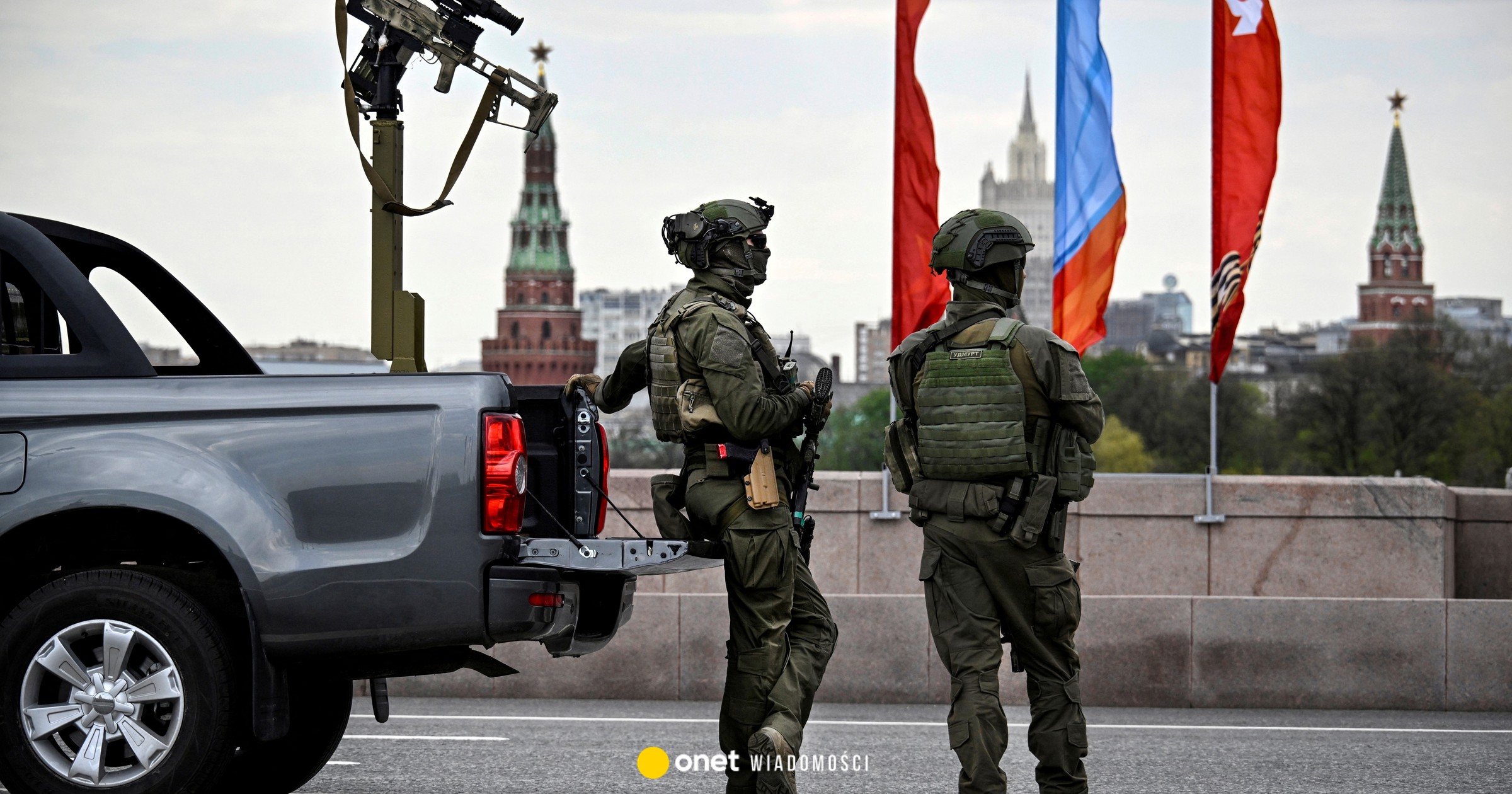
Russian soldiers practice before Victory Day. Moscow, May 4, 2026EPA/MAXIM SHIPENKOV / PAP
There are certainly many others who have left the country quietly without announcing it publicly. Russia's history of assassinating “fugitives” abroad – from the attempted assassination of former spy Sergei Skripal in the UK in 2018 to the murder of pilot Maksim Kuzminov in Spain in 2024 – is reason enough for former officials to disappear without publicity.
Most Russian officials with opposition views will keep them to themselves. The history of the USSR taught generations of officials how dangerous it is to openly oppose the government. Despite this, some people still choose to escape in various ways.
Their actions are tantamount to a vote of no confidence in the Russian state. More broadly, they suggest something the Kremlin doesn't want to admit: that Political cracks are growing beneath the surface of Russia's apparent stability.
I’m Ashley Davis as an editor, I’m committed to upholding the highest standards of integrity and accuracy in every piece we publish. My work is driven by curiosity, a passion for truth, and a belief that journalism plays a crucial role in shaping public discourse. I strive to tell stories that not only inform but also inspire action and conversation.