Support that makes a difference. How does PLN 250 million from the fundraising translate into the needs of oncology?

2026-04-27 18:00
publication
2026-04-27 18:00
The public system finances the treatment of patients on a scale of billions of zlotys annually and is based on solidarity, while the effectiveness of millions of online collections is determined by the reach and algorithms that work neither fairly nor in solidarity, said Maria Libura from the University of Warmia and Mazury.
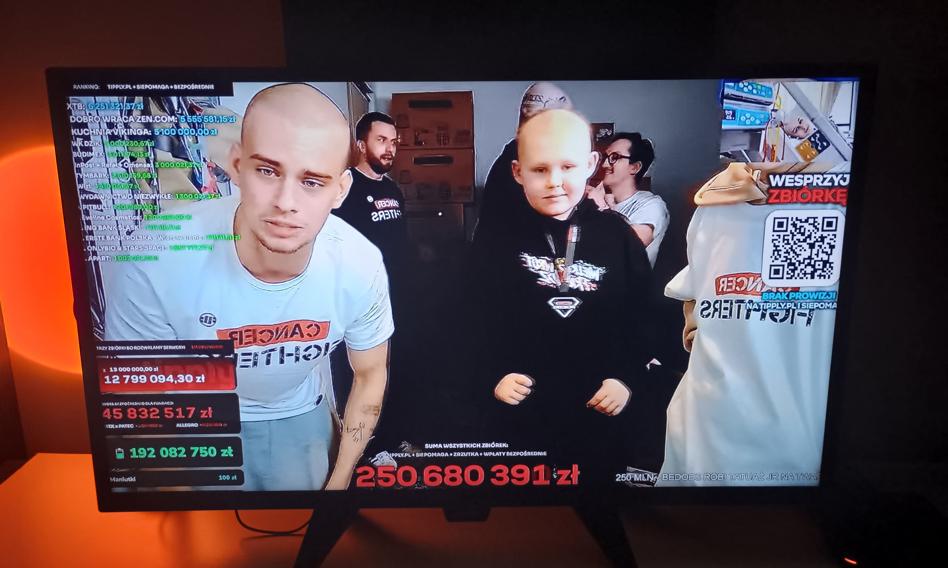
Sunday ended the nine-day collection for the Cancer Fighters Foundation, conducted on the YouTube platform in the form of a long stream, i.e. an uninterrupted live broadcast. Over PLN 250 million was collected for treatment and support for children suffering from oncology.
Collection against the background of the National Health Fund
However, according to the National Health Fund, the value of services and medicines, the cost of which can be attributed directly to a specific patient, amounted to PLN 169 billion in 2024.
Fund in 2024, it allocated PLN 357 million for the treatment of 100 patients. These are the most seriously ill patients who required the most expensive drug treatments. In turn, in the years 2020-2024 there were 756 thousand. patients whose therapy cost PLN 100,000 PLN and more. During this period, the costs of treating these patients accounted for 31.5%. National Health Fund expenses. The Fund allocated over PLN 47 billion for benefits for 1 percent. population.
According to Dr. Maria Libura from the Collegium Medicum of the University of Warmia and Mazury in Olsztyn, collections for treatment cannot replace the public system, because even such staggering amounts as those collected by the influencer Łagang, i.e. Piotr Garkowski, are a drop compared to the expenditures of the National Health Fund.
Libura noted that, according to prof. Andrzej W. Nowak National Health Fund the amount of PLN 250 million, i.e. obtained during the Łaganga collection, is spent on people suffering from cancer within approximately three days. – These are therefore completely incomparable amounts – she added.
According to the PAP interlocutor, The National Health Fund spends less than 1% on administrative costs. health contributionsand, for example, the Siepomaga collection portal reserves the right to collect 6%. commission on the collected amount. She pointed out that foundations have management boards, employees, and often employ external companies to perform various activities. – Inevitably, even if they act in the best of faith, they will allocate a relatively much larger part of the collected funds for purposes other than direct support for patients, than the National Health Fund in the case of contributions – she emphasized.
The expert pointed out that Thanks to its bargaining power, the National Health Fund can buy more and cheaper, and it also has data that, with appropriate financing, would allow the flow of money to be directed to where it is needed and can be absorbed. She assessed that even the best and most pious charity initiative does not have the potential for such rational and economical management of financial resources as the National Health Fund or ZUS.
Scope logic
Charitable collections are burdened with negative phenomena, including: “virtue signaling,” which denotes empty acts of public commitment to good causes. Another is the distinction between people whom society considers “deserving of help” (deserting poor), i.e., among others: sick children and people who do not deserve help (the undeserving poor), who, in society's opinion, are responsible for their situation.
According to Libura, the logic of coverage allows us to raise large amounts of money for specific, media-related health problems. – Non-media outlets can no longer count on the sympathy of the crowd, and even less on the support of PR specialists. That's why there are no major campaigns for drug addicts or stimulants addicts, because this is not a context that will sell goods or increase reach. In the sociology of medicine, we talk about more and less prestigious diseases. The latter include not only addictions, but also mental disorders and problems of older people, especially women – said the expert.
– If we want coverage to determine who will receive treatment, we will soon wake up in a dystopian world. Algorithms work neither fairly nor in solidarity, she added.
The public health care system is solidarity-based – its financing rests with the entire society, i.e. paying health insurance premiums. Access to the system and treatment does not depend on individual payments. In the financing of health care in the public system, as in many other areas, the so-called Pareto principle. Based on National Health Fund data, it can be seen that 80 percent almost 20% of the budget for benefits and medicines is allocated to health needs. the most needy population. Therefore, a significant part of the resources is allocated to a relatively small number of patients.
The National Health Fund's revenues in 2026 were initially planned at PLN 217.4 billion, and the gap was estimated at PLN 23 billion. (PAP)
kno/ pś/ js/