He is a specialist in Russia's war in Ukraine. Warns. “We're moving too slowly”

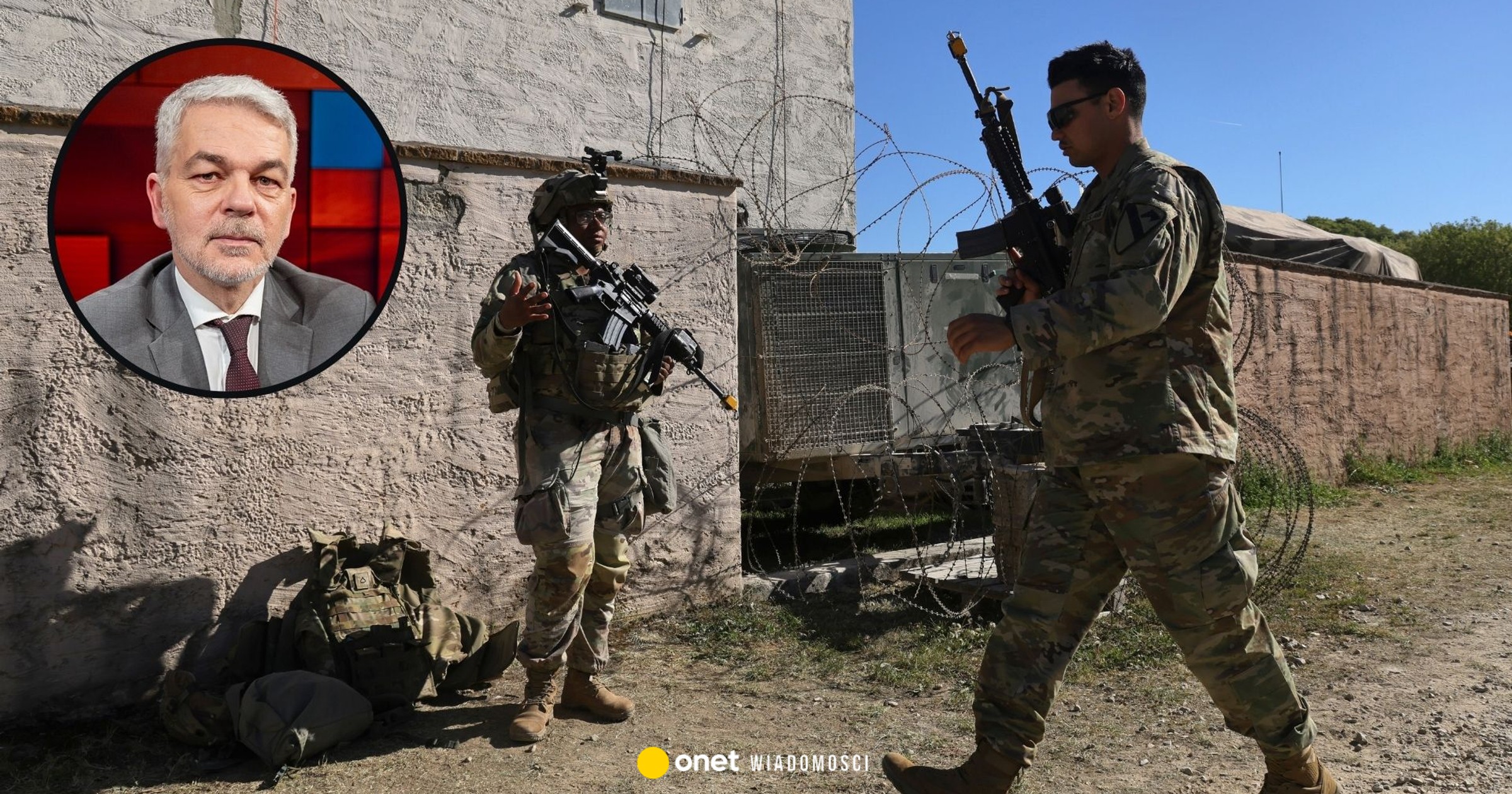
Thorsten Jungholt, Jacques Schuster, “Die Welt”: The German federal government is talking about a possible Russian attack on NATO territory after 2029. Why should Putin wait so long until the Bundeswehr and its allies are quite ready?
Carlo Masala: There is no reason for this. If we put ourselves in the position of Putin or his command, we will understand that it would be obvious for them to launch a military strike when NATO countries do not expect it. And this would not happen in 2029 or 2030, the period for which the alliance is currently preparing. One would rather expect it to happen sooner. Strategic surprise is, after all, one of the guiding principles of military operations.
On Thursday, the German Chancellor said in a speech to the army that they must be “ready to deter and defend here and now”, “ready to fight today.” Is the Bundeswehr preparing for the fact that a situation requiring alliance intervention may occur well before 2029?
The German military strategy, published two weeks ago, includes three stages. The first assumes that we must be ready to act tomorrow, because theoretically there could be an attack tomorrow. The second stage has a perspective until 2029. The third is the vision of making the Bundeswehr the strongest conventional army in Europe within NATO by the 2030s.
So there is an awareness that we may have to go on a mission tomorrow. The only question is: does this awareness mean that we are prepared for it? I would say not entirely. The Ministry of Defense does not make decisions aimed at quickly increasing the combat readiness of the army. Much of what is currently purchased on credit is intended for the years 2029 and beyond. The question of what we can do to be more ready for action tomorrow than today is not yet answered with the necessary consistency.
What decisions would need to be made to change this?
First, you need to acquire systems that are readily available – not perfect devices that will appear in three or five years, but what is currently on the market and can reach the military within a few months. Secondly: as of 2022, we have a large amount of Russian equipment from Ukraine for analysis. Based on this, conclusions could be drawn quickly – where we are vulnerable, what we need to improve. This is not done systematically enough in our system.
And thirdly, drones. We know how important they are. Germany is developing good systems, but they will be ready after some time. However, there have been drones available for a long time that are just as good. They can be obtained immediately and made available to soldiers as an interim solution. These would be classic “Fight Tonight” actions (readiness to fight tonight/in the evening): quick, pragmatic and effective.
Isn't all this of secondary importance as long as Russia is engaged in activities in Ukraine? Shouldn't we do everything in our power to support Kiev as much as possible?
There are two schools of thought on this topic. One assumes that as long as Russia is engaged in operations in Ukraine, it is unlikely that it will attack NATO territory – simply because it lacks the forces. Even in the case of limited action, for example in the Baltic countries, it would have to take into account the reaction of the alliance. However, representatives of another school argue that due to the difficult situation in Ukraine, Russia may try to test the alliance elsewhere. This cannot be ruled out. If you take this opportunity seriously, you need to pursue a Fight Tonight strategy.
Regardless of everything, the best strategy remains to support Ukraine in such a way that it binds Russia for as long as possible and inflicts high losses on it. Ideally, Russian calculations will then fail. So the assessments vary, but the military must prepare for the worst-case scenario.
The military defense provided by the Bundeswehr and allies is one thing. However, civil defense also influences the state's resilience. The German Interior Ministry is considering developing an operational plan – four years after the outbreak of the war in Ukraine. Why so late?
This is one of the biggest omissions since 2022. While the Bundeswehr developed its operational plan for Germany relatively quickly, not much has happened on the civilian side. The Ministry of Home Affairs simply did not do its job. And this is what is crucial. Even the Bundeswehr's excellent equipment will be of little help if the country lacks resilience – that is, the ability of the state and society to survive the crisis mentally and organizationally. Without social support, any military capability quickly becomes fragile.
Do you see any awareness of the threat in German society? Is there a sense of crisis beyond vague fear?
Polls are relatively clear – most Germans see Russia as the biggest threat. My conversations also show that many people are aware of the change in the situation. However, politicians do not take advantage of this awareness. The Chancellor has strong words – that “we no longer live in peace” – but no further action. When, as a citizen, I hear that the situation is so dramatic, I expect concrete measures. If they are not there, the warnings lose their credibility.
Polls are one thing. When you look at letters from readers and comments under articles, another question arises – is there still a social consensus in Germany as to what is actually worth defending?
I think not. The threat is perceived in the abstract, but there is no shared understanding of what exactly needs to be defended. Perhaps also because “Germany's defense” is an abstract concept for many. We have never developed normal, free patriotism and now it is showing itself. If you instead asked people to defend their lifestyle, family, or freedom, the answers would likely be different.
What does your preliminary assessment of the Merz cabinet's defense policy look like?
I have mixed feelings. In terms of material equipment, things are moving forward. The set of ordered military equipment can be debated, but at least something is happening. The issue of troop numbers remains a bottleneck – for political reasons, the ruling coalition reached a poor compromise, but everyone knows that current actions will not be enough to achieve the target number of troops. Also, from what I hear, the dropout rate seems to be high.
When it comes to infrastructure, we are just getting started and often lack pragmatism. For example, why do we have to create new barracks right away? Wouldn't the current solution suffice for the transition period?
The inspector general gave a target number of 260,000. active service soldiers and 200,000 reservists in the Bundeswehr. Is this enough to meet NATO commitments, or is it more of a political number?
There are voices in the Bundeswehr indicating greater demand. However, they are not heard outside the army, because this would immediately trigger another debate on compulsory military service. And currently it is quite a politically uncomfortable topic.
In autumn, the Minister of Defense commissioned his ministry with numerous tasks that were to be completed by Easter. Not all of them have been made. What does this say about the ambitions and pace of work in the ministry?
I think we are moving much too slowly. The whole issue of armaments and combat readiness is still being dealt with within structures that are in fact peace structures. Many things lack the necessary ambition. I also miss really brave decisions. This also applies to military strategy.
It's good that we have it at all. However, most of it contains information that we have already heard many times. Military strategy should not only describe what the war of the future will look like, but also how we intend to win it. There is very little information about this in the public part.
The secret part will consider a scenario in which NATO must cope without the US. What impact would this have on the target number of Bundeswehr personnel?
NATO's defense planning, along with regional plans, is based on the assumption that in the event of a Russian attack, several tens of thousands of American soldiers and equipment will be transferred to Europe. If the United States withdrew, Europeans would have to fill the gap. And this would mean the need to carry out a strategic reorganization on a completely different scale – not only in terms of personnel.
But even if the United States formally remains in NATO, one should already ask how realistic it is that under President Trump's government enough American troops will eventually be transferred to Europe to fight Russia here. It is our responsibility to address this potential gap.
U.S. Secretary of Defense Pete Hegseth ordered the withdrawal of approximately 5,000 American troops from Germany. How do you evaluate this step?
Withdrawal of approximately 13 percent. American forces stationed in Germany is more symbolic than substantive. Especially since it is currently unclear where they will be transferred – whether to one of the Eastern European countries or whether they will return to the USA. If these soldiers were transferred to Eastern Europe or the Baltic countries, one could say: bad luck for Germany, but not so bad for NATO.
Much more serious, however, is the information that the agreement concluded in 2024 between the US and Germany regarding the stationing of Tomahawk cruise missiles and Dark Eagle hypersonic missiles in Mainz-Kastel will not be implemented. This leaves a serious gap in Russia's deterrence capabilities, which can only be filled with European weapons after some time, as they are still in the development phase.
US President Trump was greatly irritated by the words of the Chancellor, who accused the US of lacking a strategy for the war with Iran. Wasn't Merz's tactic to maintain the best possible relationship with Trump?
As for this particular case, I believe that Merz's motivation for this statement was domestic rather than foreign policy. It seems to me that he is strongly oriented to the results of public opinion polls. The war in Iran is unpopular in Germany, the United States under Trump is unpopular – perhaps that is why he is trying to rhetorically distance himself from it. However, as we have seen, statements motivated by domestic politics can also have consequences for foreign policy.
How do you assess a possible European naval mission in the Strait of Hormuz?
I don't see the point of this mission. In the current conditions it is unnecessary. If the Strait of Hormuz is open and there is lasting peace, this mission is largely unnecessary – except perhaps for mine clearance. However, if it is not open, we do not send anything there. Sometimes I have the impression that we are still pursuing a foreign policy based on feel-good: something is done, but only in conditions in which any risk is virtually excluded.