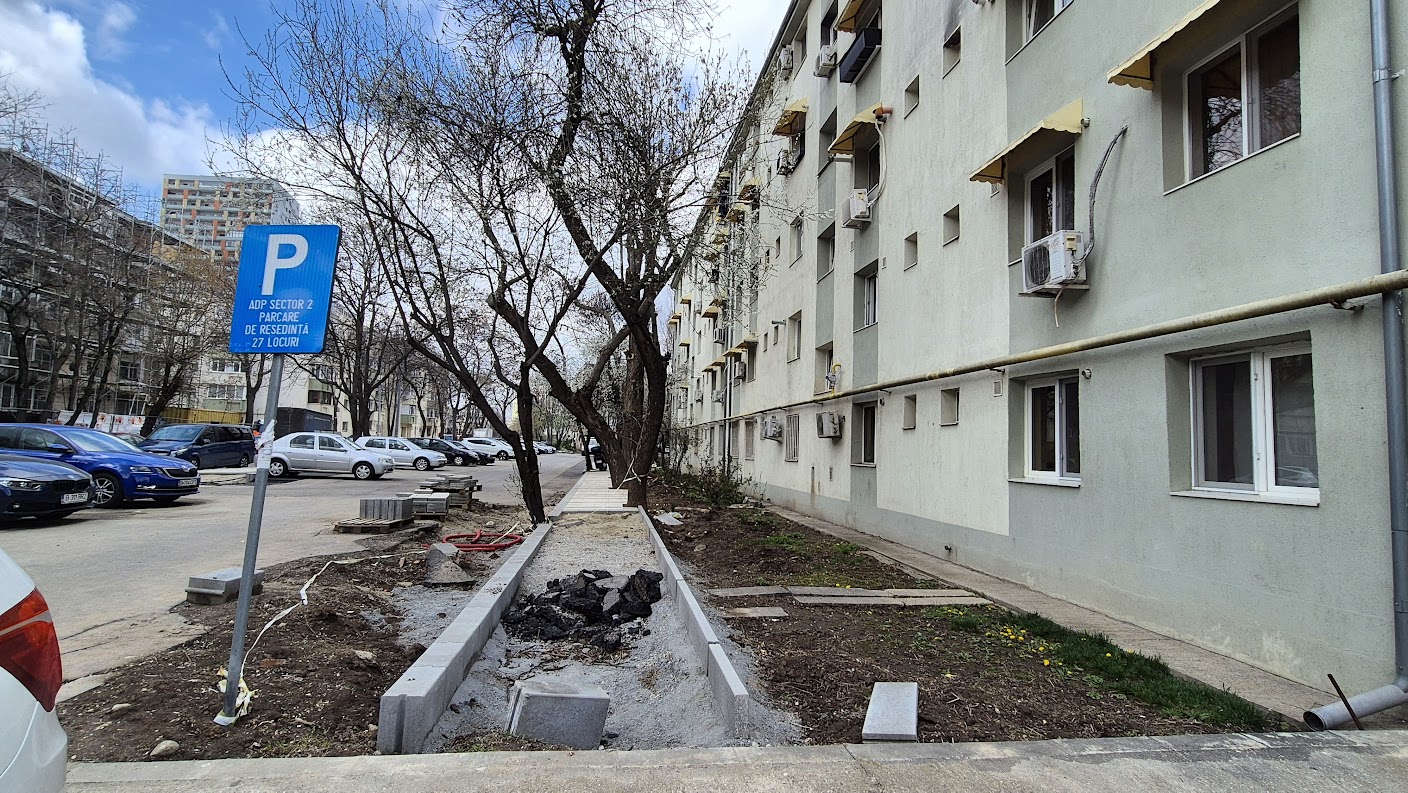
On patented model by Mayor Robert Negoiță, District 2 Town Hall he cut from the gardens of the blocks in the Baicului neighborhood, to make parking spaces. Such interventions were also made in Sector 5in the Rahova neighborhood.
Mayors say this is what people want, and the lack of parking spaces is one of the city's main problems. And they are investing hundreds of millions of lei to create the necessary infrastructure.
With these projects, however, Bucharest is exactly the opposite of civilized cities in Europe. And beyond money, Bucharest is losing an extraordinary advantage that it has, in a world that is changing rapidly and in which, in 10-20 years, the comfort will be not dying of heat in the city, not going by car.
In Paris people chose pedestrian streets and the abolition of parking spaces
First, all mobility studies have shown that the car is not the solution, sustainable mobility is.
From Paris, London, to Vienna and Madrid, not to mention the northern capitals, the trend is to discourage the use of personal cars and to take away from cars to create dedicated public transport lanes, cycle paths and pedestrian spaces or greening of the city.
For example, in March 2025, Parisians decided by referendum that 500 streets in the city become pedestrianized, which implies the abolition of approximately 10,000 parking spaces.
In Bucharest, in the last 10 years the number of cars has increased by 40%, reaching 1.7 million vehicles. Congestion has reached an unprecedented level. The mayors make passages to streamline traffic, which has proven useless or with poor results, they make parking lots, they even give gas vouchers, as the District 4 City Hall does, so that people can go by car, because they have nothing to take their “children to school” or to go to work, in the context of the economic crisis and the increase in fuel prices.
Of course, we must not confuse having a car with using a car, we are not demonizing the car, but it is not the job of the City Hall to provide parking spaces for each individual car.
There are not enough parking spaces for all the cars in any Capital in the civilized world, and parking costs money.
But the job of the Town Halls is to offer alternatives, quality public transport, bike lanes, safe sidewalks, schools/kindergartens/nurseries throughout the city and everywhere where they approve new real estate projects, hospitals, recreation spaces, so that people no longer depend on the car and use it less and less in daily trips or even give it up because they no longer need it.
And the parking lots can also be made by the private sector, as happens in many other European cities – not all parking lots are public, the City Hall just has to ensure a healthy climate. In our country, if everyone parks where they can and is not penalized, no one invests in such a thing, because no one pays a parking fee if they can park for free on the public domain.
Bucharest, as congested as it is, has an advantage that it risks losing
Secondly, it is about climate change. Summers are getting hotter, we have extreme weather phenomena, fires, and green spaces are the first line of defense in these situations.
Unlike other older or medieval cities, where much of the public space is paved or walled, Bucharest, even in densely communist-built areas – congested bedroom neighborhoods such as Militari, Pantelimon or Rahova – still has green spaces between blocks. Small block gardens, avenues with trees and shrubs, not very generous spaces, but which together give an extraordinary advantage in such a city in the context of global warming.
Other European cities, which massively developed car infrastructure in the 70s-80s-90s, are now demolishing this infrastructure to make more green spaces with permeable surfaces to increase the cities' resilience to climate change.
For example, in extreme cases, in Bucharest it can rain in a single day twice as much as the average for a month, as happened last year in October. The gardens of the blocks, the parks, if they are not concreted, can absorb a good part of the amount of precipitation that falls. This keeps us from flooding. Trees protect us from the heat wave, for example, in summer, on the streets where there are trees and shade, the temperature can be 10 degrees lower, greatly reducing the thermal discomfort.
Mayors should think about whether the cars they are parking for now will still exist in 20 years
Third, the conflict in Iran has caused a substantial increase in the price of fuel, and shows us a clear vulnerability of cities where the car is in power. And that it is important to have alternatives. In March, the International Energy Agency (IEA) recommended working from home, reducing speed on highways by at least 10 kilometers per hour and avoiding air travel when there are transport alternatives, using public transport, etc.
Clearly, now, there is a need for parking spaces in Bucharest, especially for residential parking lots, but before destroying green spaces, the mayors should think about whether the cars for which they are now making parking spaces in 10-20 years will still exist. And perhaps, to understand that the resilience of the city in the face of climate change is more important than the temporary comfort provided by the car.
Instead of encouraging pharaonic projects for cars, the solution would be to look to Europe and develop public transport, alternative transport, make communities less dependent on the car through sustainable urban planning – with schools and kindergartens in new neighborhoods, high-performing educational facilities in all areas of the city. It is not crazy to walk with the children around the city for two hours a day – to take them to school and bring them – if they have decent education services near the house, bundled with other quality services.