The “TikTok generation” and the cult of trickery: 60% of Romanians think it's better to be resourceful than correct. Psychologists' explanation


Romanian society is deeply divided when it comes to integrity and success. According to a recent barometer conducted by INSCOP Research, almost half of the country's population believes that it is more important to be resourceful than to be fair. This mentality prevails especially among young people and people with primary education. Psychologist Mihai Copăceanu analyzed these figures for “Adevărul” and provided a clear perspective on the reasons that fuel this social phenomenon.
Photo: Freepik
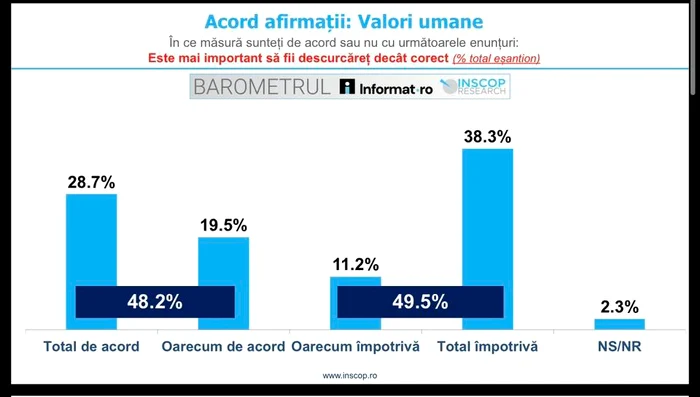
Overall, the data indicate an almost perfect fracture in society. To the statement “It is more important to be resourceful than correct”, 48.2% of respondents answered affirmatively. Of these, 28.7% totally agree and 19.5% somewhat agree. On the other hand, the camp of those who reject this principle totals 49.5% of the sample, with a solid segment of 38.3% who declare themselves totally against and 11.2% somewhat against. A marginal percentage of 2.3% represents non-responses.
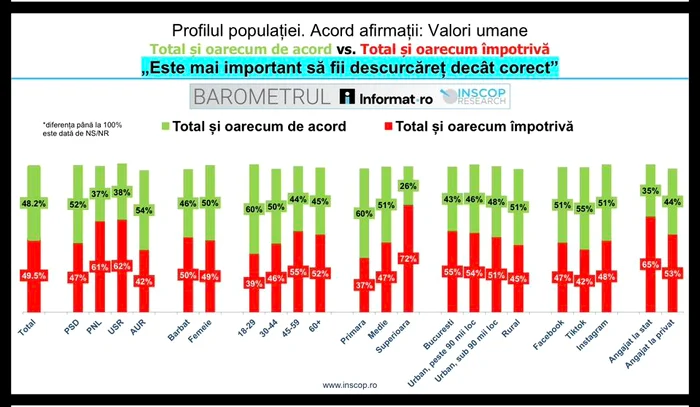
The differences become downright striking when we look at the socio-demographic categories. Young people between the ages of 18 and 29 validate this attitude by a whopping 60%. By contrast, highly educated people strongly reject the idea, with 72% of them clearly stating that they are against moral compromise in favor of “dealing”. Also, people with primary education (60% agree) strongly tilt the balance towards the model of the man who knows how to “enchant” the system.
Cleavage is also observed at the level of political affiliations or work environment. 52% of PSD voters approve of this mentality, while USR and AUR sympathizers reject it in similar percentages (61% and 62%, respectively). Another notable difference occurs in the labor market. State employees categorically oppose the statement (65% against), while private sector employees are more evenly divided. An extremely relevant aspect for today's generations is the consumption of social networks. Users of the TikTok platform lead the list of those who prefer to be hands-on, with a percentage of 55%, followed by those who use Facebook and Instagram.
“We're seeing a generation consuming content where trickery is rewarded”
Psychologist Mihai Copăceanu draws attention to the deep causes of this mentality, rooted in a chronic lack of trust in institutions.
“Romanian society has cultivated over the decades, often for reasons of survival, the myth of the resourceful man. The fact that 60% of today's young people believe that being resourceful takes precedence over correctness indicates a major failure of the value system transmitted by family and school. These young people have no faith at all that the rules work or that meritocracy is a tangible reality in Romania. For them, being correct is equivalent to being naive or a loser in a system that they perceive as deeply corrupt and dysfunctional,” says Mihai Copăceanu.
X-ray of the revolt: almost 40% of Romanians want to change the political system “by any means”
Exposure to easy success models on the Internet plays a determining role in forming these beliefs, the specialist notes.
“It's no coincidence that TikTok users are the most likely to endorse this attitude. These platforms constantly and aggressively promote the illusion of quick success, achieved by shortcuts, by speculating on loopholes, or by avoiding honest, sustained effort. We see a generation that consumes content on a daily basis where cheating is rewarded with views, fame and money. From a psychological perspective, this virtual environment normalizes cheating and reshapes behaviors from a young age. When higher education steps in, as shown by that 72% who reject the idea, develops critical thinking and a more mature understanding that a healthy society cannot function in the long term by exceptions to the rule and tinkering alone.” concludes the psychologist Mihai Copăceanu.
The educational system, for its part, can hardly counter this trend.
“The school environment often has less influence than that of the parents, because, in general, their influence is extremely strong in all stages of education in Romania: in primary, secondary and high school education. Parents exert significant pressure on the school environment and, even when they consider that students are wronged, they tend to advocate for the child's own interest and comfort rather than for the observance of correct norms and principles”emphasizes the psychologist.
Despite this picture, psychologist Mihai Copăceanu is of the opinion that change remains possible during life:
“Fortunately, in certain situations, these attitudes can be changed in adulthood. There are people who, either through university education or through the experiences accumulated throughout maturation, come to reevaluate their values. Coming into contact with people who have other moral benchmarks – such as a new circle of friends, life partner or colleagues at a new workplace – can significantly contribute to this change. Thus, even if we are talking about a minority, there are people who, once they reach maturity or even later, they begin to give more importance to fairness, cooperation and respect for healthy principles in life”, explained Mihai Copăceanu.