What is happening on the front in Ukraine? This may be the beginning of Russia's defeat

Reports of intensifying combat operations are coming from the fronts of the war in Ukraine. Russia's armed forces have increased intensity of his attacks. During a meeting on ensuring election security, Putin said that “the enemy is unable to stop the advance of our troops, our guys on the battle line. They are losing certain territories every day.”
The Russian Ministry of Defense constantly reports new victories and reports, for example, the capture of two towns of the same name – Novodmitrovka – in the Sumy and Donetsk regions of Ukraine. The Ukrainian commander-in-chief recently wrote on his Telegram channel that the Russians have intensified offensive actions practically on the entire front line. His words are confirmed by soldiers of the Ukrainian forces.
— The Russians have practically never stopped attacking in our direction, but now they have organized constant offensive — says an officer of the Ukrainian forces nicknamed “Kozyr”, who fights near Konstantinivka in the Donetsk region.
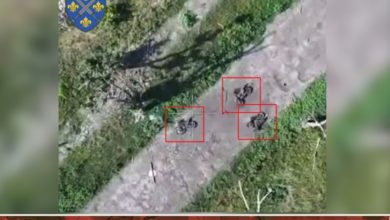
— Green leaves appeared on the trees, and they immediately set off through the forest towards the city. They try to use the cover of greenery to get through death zones and gather in urban buildings. We are recording the entry of dozens of small groups every day. The vast majority are detected and destroyed. No more than one-tenth of the stormtroopers successfully enter the city. We eliminate the rest using drones.
Crazy losses
Experts interviewed by Novaya Gazeta claim that despite a significant increase in the intensity of attacks, Russian forces have been virtually inactive for a long time they stomp on the spot. The story that has become an Internet meme about the Russians' months-long attempt to capture the village of Mala Tokmachka in the Zaporizhia Oblast is very telling.
The village, where fewer than 100 people lived in 2024, was completely destroyed in 2025. However, the ruins of the village remain under the control of Ukrainian forces to this day. The Russians stormed the buildings on Lenina Street and unsuccessfully tried to break through to the railway station.
— Since the beginning of this year, Russian troops have only been able to carry out actions at the tactical level — says Alexander Kovalenko, a military-political observer. — In January, the Kremlin army occupied 231 square kilometers. In the following two months, this indicator was 138 and 155 square kilometers. In April, the Russians advanced only 120 square kilometers. This involves occupying forest strips, fields and destroyed small villages with 10-15 houses, demolished a year ago. Ukrainian forces did not lose any regional centers, logistical hubs or other important facilities.
— The intensification of offensive activities means that the Russians began to move more intensively, conduct assaults and try to penetrate Ukrainian cities – explains a military expert, a Ukrainian colonel in the reserve Roman Switan. — This is primarily due to the appearance of greenery. Trees became covered with leaves, and tree belts began to better protect soldiers from drones.
It was possible to secretly bring troops to the battle line, crossing the death zone. However, in reality, the Russians are advancing tens or hundreds of meters a day, suffering enormous losses. They do not have enough forces to take any large city.
Strategic failures
According to Lakiychuk, the Russians began implementing the strategic plan in mid-April offensive operationgradually increasing your efforts. Apparently they hope that the necessary resources will be provided as it is implemented. The interlocutor calls this variant a “risky move.”
According to Kovalenko, along the entire front line of over 1.2 thousand kilometers. km, the most dangerous direction for Ukraine is currently Konstantynówka, which is part of the Sloviansk-Kramatorsk agglomeration. According to the expert, this section will become the hottest point during Moscow's spring-summer offensive campaign.
The Russians do not currently control any administrative building in Konstantynówka. They will try to infiltrate residential buildings, gather in basements and ruins, and strengthen themselves in the city, where they currently have no serious positions. Attackers will likely attempt to enter from the south, southeast and southwest, using major logistics routes. At the same time, according to Kovalenko's information, the Russian command apparently abandoned plans to completely occupy the town of Chasiv Yar, which would have allowed an attack on Konstantynówka from the east.
Roman Switan agrees that currently the most difficult direction is the area near Konstantynówka.
Hot spot
The Kremlin army is trying to surround this town with a half-ring, entering from the south and south-east. However, throughout the spring campaign, the Russians advanced here by a maximum of one kilometer.
— Apparently, the General Staff of the Armed Forces of the Russian Federation did not think much about the operation plan: for the third time they returned to the idea convergent impacts from the north and southto surround or threaten to surround the main group of the Ukrainian Armed Forces in Donbas, thus forcing Ukraine to capitulate, Lakiychuk believes. — At the same time, Zaporozhye remains an auxiliary direction. Given the availability of resources, an offensive should be developed on the flank of the southern group of defense forces south of the Donetsk-Zaporozhye route. The main strategic advantage is considered to be numerical superiority of forces. It should allow the attackers to concentrate their forces on the directions of the main attacks, and the defenders' resources should be extended to the maximum on the front, preventing the concentration of forces on the key directions.
Lakiychuk claims that on the Eastern Front the key battles are currently taking place north of Pokrovsk-Myrnohrad. These are attempts by the Russians to break through to the north.
Putin's soldiers are trying to surround Konstantynówka from three sides and, after breaking through the defense on the hills of the city of Chasiv Yar, to get to the rear, so far unsuccessfully. In the Slavic direction, there are attempts to outflank Łyman from the north and south.
— In the south, the offensive on a broad front from east to west has been divided into two sections: in the north, on the border of the Dnipropetrovsk Oblast, there are fights to gain the upper hand, and the offensive has been narrowed to a narrow strip north of Ukraine's fortified North-South defense line, Lakiychuk says. — The Russians are trying to solve tactical problems by entering the flank of the defense node in Orichiv, while creating as much room for maneuver as possible for a future offensive from the south.
Kovalenko claims that the eastern flank of the Sloviansk-Kramatorsk agglomeration is dangerous for Ukrainians. This is where it happened tactical move by the Russianswho attack despite heavy losses.
Bloody fighting continues in the Pokrovsk-Myrnohrad agglomeration. According to Kovalenko, Russia will not achieve significant successes in this direction. The interlocutor is convinced that the withdrawal of personnel of Ukrainian forces from the north-western areas of Myrnohrad will soon begin.
Fighting also continues in the Kupany direction. Russian stormtroopers are trying to infiltrate the northern districts of Kupyansk through the Oskol River. However, at the moment, Moscow's army does not control even part of this city.
Summer campaign
— I think that the Russians will put pressure on Ukrainian forces on the entire front to launch the summer offensive planned by the command, says Switan. — Currently, Russian generals are gathering reserves in the rear: human forces and equipment. They can use them in two directions: to try to occupy the entire territory of the Donetsk Oblast and in Zaporizhia to expand the land corridor to Crimea. However, judging by the current offensive of Russian forces, it will take them many years to take over the Sloviansk-Kramatorsk agglomeration.
It is a goal, an upper limit, the achievement of which, according to the plan, will render the enemy troops incapable of action. In fact, to deprive the Russian military of its advantage, it will be necessary to achieve results that exceed their ability to rebuild and create reserves.
Lakiychuk quotes Syrski, who claimed that Ukrainian forces focus on thoughtful planning, innovative solutions and effective use of means of destruction. As a result, the enemy suffers losses that exceed his ability to replenish troops.
And the systemic destruction of Russian production facilities further limits the air defense capabilities of the enemy, which is already struggling with a shortage of missiles to combat Ukrainian unmanned systems and means of destruction.
— The fact that, with the increasing intensity of fighting, there are no noticeable changes on the front line proves that both sides anticipate the enemy's actions and there are no unexpected decisions, explains Lakijczuk. — In such conditions, everything depends on the strength and stability of the combat defense. Or from the surprising nature of the strikes and counter-attacks that they can radically change the situation on a given section of the front. And on resources – for whom they will last longer.
— I am convinced that in the near future, Russian troops will try to maintain their offensive potential only at the tactical level, Kowalenko sums up. —We won't see any unexpected results. Russian loss rates force the command to stabilize the situation. Everything is heading towards general mobilization, which will be carried out using repressive methods. I think this step will be implemented in the near future. Without replenishing personnel, the Russian army will not be able to continue its offensive.