The latest IRSOP survey shows that Romanians view the future with an almost unprecedented distrust – a pessimism so deep that it risks becoming a self-fulfilling prophecy.
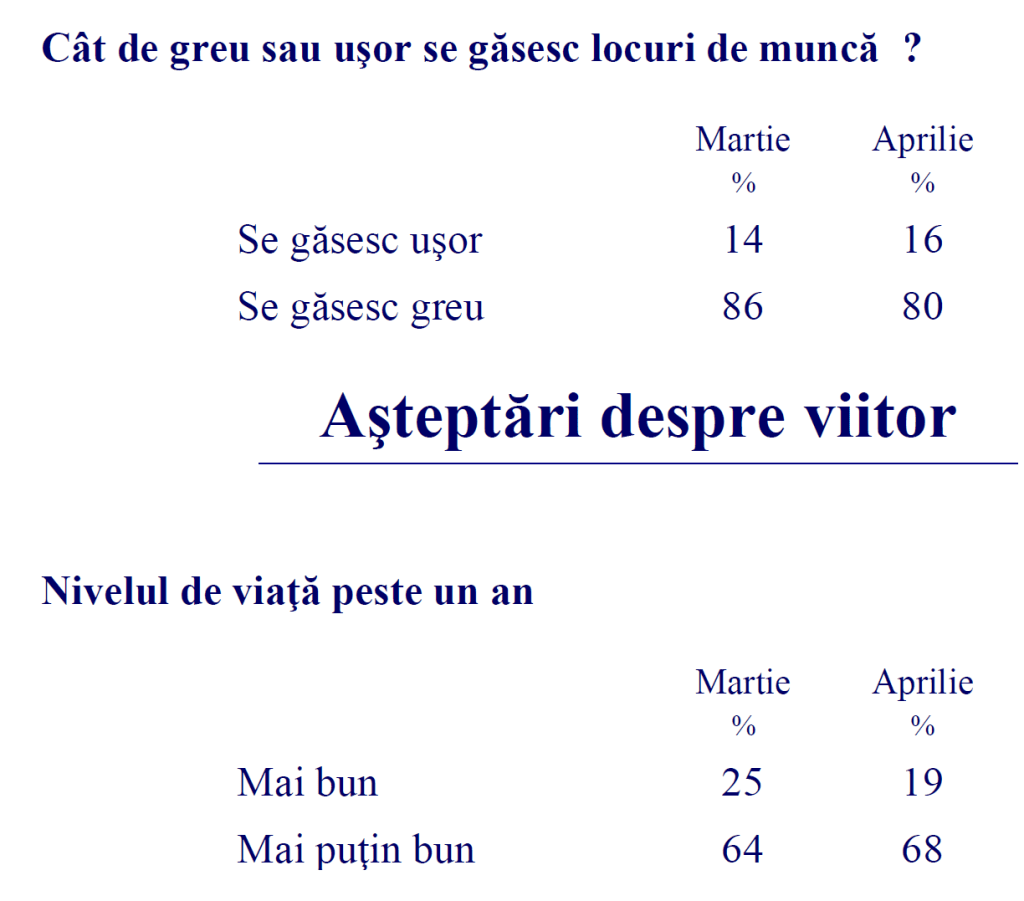
The April 2026 IRSOP economic survey is one of those moments. Three quarters of the population expect prices to rise further. Almost seven out of ten believe they will be worse off in a year's time. And almost half are convinced that the situation will be worse even in five years.
It is not a passing pessimism, but it seems a structural, slowly sedimented pessimism, which has already passed beyond the stage of concern and entered the stage of resignation. And resignation, behavioral economists say, is more dangerous than panic. Panic can be calmed. Resignation is self-perpetuating.
Inflation without a horizon
Inflation is not new for Romania. Whole generations grew up with her memory. But what makes the current situation special is not its level, but the absence of any visible downward horizon. When people can't see the end of the tunnel, their behavior changes fundamentally. They save less, spend less, don't go into business, put off big decisions.
High inflationary expectations have an almost narcotic effect on the economy: they become self-confirming. If everyone thinks prices will go up, no one negotiates today's prices – and prices go up. IRSOP documents this phenomenon with cold rigor: 76% of respondents expect price increases, compared to 75% in March. A small movement, but in the wrong direction.
Income scissors
The equation is brutal in its simplicity: prices rise, incomes stagnate. Only 34% of Romanians think their incomes will increase in the next year — down from 38% in March. The remaining 63% expect to remain on the same or lower income. When you juxtapose this with inflationary expectations, you get a picture of the slow erosion of purchasing power, seen in real time by the citizens themselves.
The implication IRSOP analysts arrive at – and which is worth taking seriously – is that the Government may find itself having to subsidize the cost of living on a large scale. It's not an alarmist prediction, it's a cold projection: if 71% of the population enters the winter with insufficient income relative to prices, the political pressure for intervention will become impossible to ignore.
The consumption that contracts
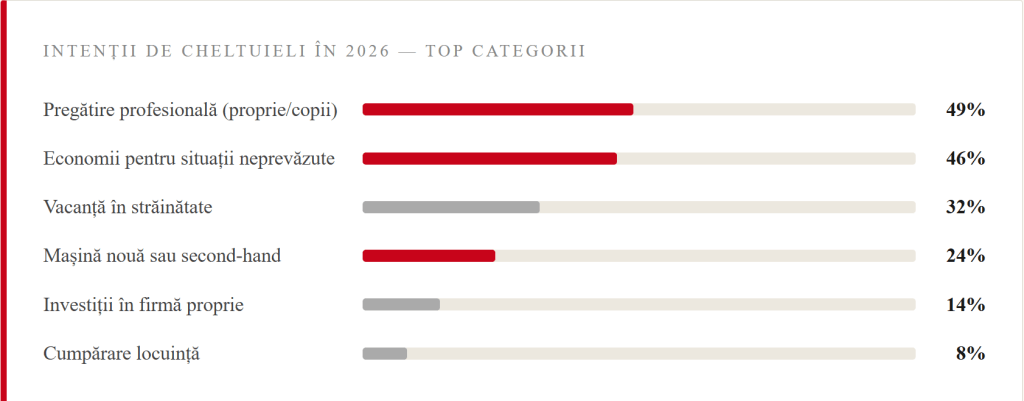
Retail figures confirm what every retailer feels: 55% of the population buys less for current consumption compared to a year ago. It is a significant compression, which will be seen in the turnover figures of the companies in the next quarter, if it is not already visible.
It is interesting, however, where the money goes to those who intend to spend it. Job training (49%) and emergency savings (46%) lead the way — both clear signals of anxiety, not optimism. People don't invest to grow, they invest to survive uncertainty. In third place, surprising for a crisis year, is the new or used car (24%, up from 20% in March) — possibly an effect of the currency's depreciation and the perception that tangible goods are safer than lei savings.
The labor market: fragile peace
The only relatively good news in the survey comes from perceptions of job security: 77% of employees feel safe, up from 71% in March. But the nuance is important: this sense of security does not mean mobility. Among those who feel that their job is at risk, 80% say that new jobs are hard to find in their area. The labor market isn't collapsing, but it has cooled noticeably—and the cooling means that even employees with steady jobs have lost the ability to negotiate higher wages.
It's a vicious circle elegant in its cruelty: prices go up, but no one can ask for a raise because the labor market no longer allows this luxury. The pressure builds in silence.
Crisis of confidence – the real problem
Beyond all the numbers, IRSOP correctly identifies the central stake: not inflation, not incomes, not even consumption – but the collapse of confidence in the future. When 68% believe that they will live worse in a year, and 45% believe that in five years things will be worse, we are facing a psychological phenomenon that transcends any normal economic cycle.
Behavioral economics studies, from Kahneman to Shiller, show that persistent negative expectations change the structure of decisions: people do less, risk less, plan less. The most worrying effect, also reported by IRSOP analysts, is emigration – not out of acute desperation, but out of cold calculation: if there is no prospect of improvement, why stay?
See the full results of the IRSOP survey here