Heated debates on labor taxation and progressive taxation: “It's not normal to give half of your work to the state”


The labor tax data recently published by the OECD have sparked extensive discussions among internet users, with some suggesting that progressive taxation would be a solution, while others say that in Romania, contributions to the pension and health systems burden Romanians beyond measure.
Heated debates on labor taxation in Romania. Archive photo
The “Taxation of salaries 2026” report recently published by the OECD has sparked wide debates among Internet users, given that, according to the graph below, Romania has among the highest labor taxes, while in countries such as Switzerland or Luxembourg they are much lower than here.
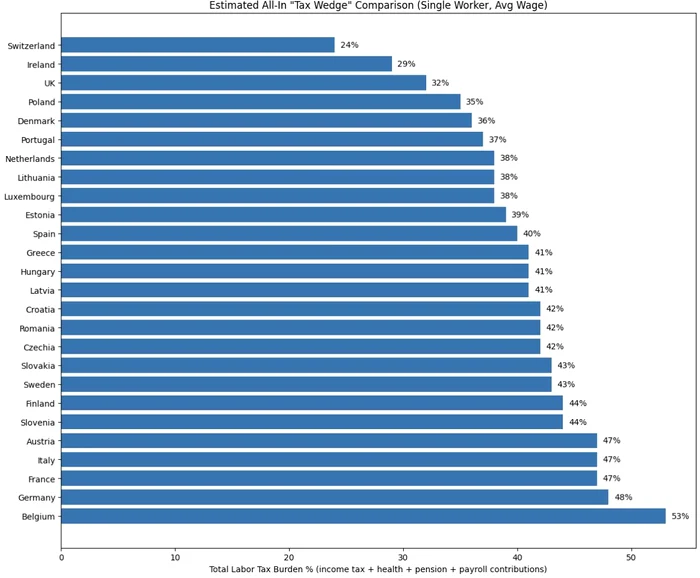
Graph made based on data from the “Wage Taxation 2026” report recently published by the OECD
“I keep hearing the idea promoted that payroll taxes in Romania are low and that the progressive tax should be introduced, that it is 'only' 10% compared to other countries that have 20-30% and it increases according to income. Ok, but other countries do not have 35% health and pension contributions. Contributions that in our country, anyway, are only paid by the suckers who work legally with a work permit and who are usually the first to give when It's about increasing taxes. Because the private sector cannot (read it) defend itself through various unions and protests, nor can it hide or fake the payment of taxes, as others do. You still go to the private hospital, and when you get to a public hospital, you're afraid that your child will get sick like what happened in Iași. I won't see one leu from that money in 30-40 years. I pay 25% now to support the specials and all the thieves in this country.” wrote an internet user on Reddit, challenging his interlocutors to debate.
The reactions did not take long to appear, one of the first interlocutors pointing out that, in Romania, the problem is not necessarily the total level of taxes, but their structure. “Romania has low taxes on companies, not on salaries, that's what it was always about. As for salaries, these are high taxes, I have nothing to say”, explains another participant, pointing out the difference between taxing capital and taxing labor.
Another Internet user pointed out that the tax advantages are concentrated in other areas of the economy: “Exactly. Taxation is low on micro, PFA in real system with very high incomes, and other taxed categories like car taxes, building taxes, etc. (although things seem to be changing here too). No one said payroll taxes were low.”
High taxes for employees, but low for companies
Another panelist explained the disincentive mechanism for high net wages: “If a company makes a profit of 10,000 lei, the state takes a fairly small amount through capital taxes (1% – 16% + dividends). But if an employer wants to give an employee 10,000 lei 'in hand' (net), he has to spend a total of approximately 19,000 lei. What do you think they are encouraging?”
From this perspective, some users conclude that tax benefits are not evenly distributed: “Exact. Low taxes are not for ordinary people, low taxes are for companies and investments. It is not common people who benefit from them, but rich and influential people. They are the ones who appear in the media and say that taxes in Romania are low, and that's where this impression comes from.”
Shifting the discussion to the demographic structure and sustainability of the system, one netizen explained that the fiscal pressure on labor is amplified by structural imbalances: “We have high social security taxes and a labor tax comparable to other progressive tax states. This is also because we have perhaps over 5 million Romanians working outside the country + special pensioners. So it's not enough to contribute, in addition to stealing caviar socialists, aka PSD.”
The same user adds a comparison between states: “Regardless of whether or not it is a progressive labor tax, it is not normal to pay half or more of your work to the state. More purchasing power means more consumption and a better life in the end. The French, after taxes, are left with about as much as you can earn in Bucharest or Cluj at a good company, but their rents are much higher. Switzerland and Poland remain the best taxation from my point of view.”
In contrast, there are also voices that move the discussion towards fiscal optimization and differences between types of income: “You didn't understand anything or you are functionally illiterate. Compare the salary tax, which is huge compared to other countries that tax progressively, with, for example, stock market taxes using Romanian brokers, where a fraudster if he puts in 1 million and makes 1.5 million RON after 1 year and 3 months will pay 3% of the profit or if an individual boy has cash money from unknown sources, builds a block per individual, sells it to other individuals and pays, you guessed it, also 3%. we do not even enter into the discussion of SRLs.”
The government wants to cut the labor tax. Vîlceanu: We will gradually eliminate the exceptions to the payment of contributions. Why should some pay and others not?
“Olguța moved the taxes from the employer to the employee” in order to artificially increase the gross
Other participants return to the structural reforms of the contribution system, recalling the changes of the last decade: “Olguța, in 2017, moved the taxes from the employer to the employee, a fact that led to an increase in the artificial gross, as a result of which also labor taxes. If you take, as the colleague above said, what it costs the employer to give you 1,000 euros net, then we are not so bad.”
Finally, the discussion closes on the idea of progressive taxation, seen by some as a theoretical solution, but disputed as a practical implementation: “The progressive quota would only solve this if it were implemented by a government that doesn't just want to plug the budget deficit. The reason why we talk so much about progressive taxation is to bring more money to the budget by keeping the 10% tax on low wages and increasing taxation on everything above the minimum wage. Anyone coming to tell us to wait for them to implement progressive charging before we comment is extremely naive.”
“With a progressive tax, you pay 0% for the first 1000 Ron, for example, regardless of global income, then a percentage for a range, another percentage for another range, and a very painful percentage above the last threshold. But what it gives you from a political point of view is that you can entice especially those with low incomes to vote for you and see with their own eyes that you also work for him“, wrote another.
What the OECD says
The OECD last week published the report “Wage Taxation 2026” in which it also examined the legal progressivity of payroll taxation.
For a single worker earning the median wage, the tax burden increased in 24 countries, decreased in 11 and remained the same in three in 2025 compared to the previous year. On average, across the OECD, the tax burden for this type of household increased by 0.15 percentage points (pp) in 2025, reaching 35.1%.
The largest increase (2.45 pp) was seen in the United Kingdom; this was partly due to an increase in employers' social security contributions (SSC) and partly a result of tax resistance, the phenomenon whereby effective tax rates rise mechanically when the parameters of tax systems are not adjusted for inflation.
Increases of more than 1 pp also occurred in Estonia (1.95 pp), Germany (1.34 pp) and Israel (1.09 pp). Estonia raised its income tax rate (IPP) from 20% to 22% in 2025, while increases in the tax burden in Germany and Israel were the result of higher SSCs for employers and employees, as well as tax resistance.
Decreases in the tax burden for this type of household exceeded 1 percentage point in Italy (-1.21 percentage points), Latvia (-1.44 percentage points) and Australia (-1.67 percentage points). The declines in Italy and Latvia were due to higher tax breaks for middle-income earners, while in Australia the decline was mainly attributed to a reform of the tax bracket that reduced statutory corporate tax rates.
What is Romania throwing a mountain of money at, and then taxing the people to the blood. Economists' solutions: “That's how we would get 50 billion”
The tax burden increased for all seven other types of households analyzed in the OECD average wage taxation study in 2025.
The biggest increase was for the single parent with two children earning 67% of the median wage, whose tax burden rose by an average of 0.52 percentage points to 16.3% and increased in 22 countries. The tax burden for this type of household increased the most in Slovenia (5.6 percentage points), the Slovak Republic (4.7 percentage points) and the United Kingdom (4.3 percentage points), due to a mix of factors such as fiscal restraint, higher social security contributions and lower tax breaks and cash transfers.
The largest decreases were seen in Luxembourg (-3.2 percentage points), Lithuania (-2.7 percentage points), Denmark, Ireland and Latvia (all -2.0 percentage points), reflecting lower PIT rates and tax benefits related to older children.
The tax burden on a single-earner couple with two children at the median salary increased in 22 countries and decreased in 15 in 2025; the 0.46 percentage point increase in the OECD average tax burden (to 26.2%) was the second largest increase among household types. The gap between the OECD average tax burden for this type of household and that of the single worker earning the average wage narrowed by 0.31 percentage points to 8.9 percentage points in 2025, indicating a reduction in the tax advantage for households with children.
The report includes a special column examining the legal progressivity of payroll taxation in OECD countries. Building on the statutory progressivity indicator introduced in the 2013 edition of the Wage Taxation paper, it examines how the tax burden on labor income varies by earnings and the composition of active households in OECD countries. Across the OECD, payroll tax systems tend to be most progressive for households with lower earnings levels and with children, due to the impact of tax breaks and cash transfers.