2026-04-27 14:45
publication
2026-04-27 14:45
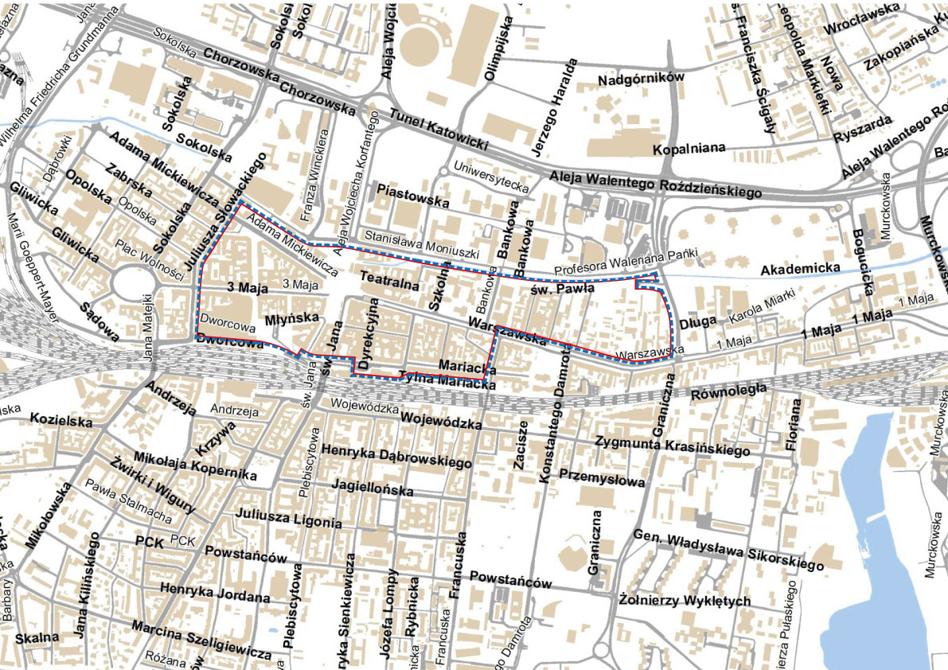
On Monday, the Katowice city council adopted a resolution on the introduction of a clean transport zone (SCT). The Katowice SCT has been operating since June 29 this year. include the very center of the city.
In accordance with the resolution the zone is to be limited by the following streets (or their fragments): Skargi, Moniuszki, Pańki, Dudy-Gracza, Warszawska, Francuska, Mariacka Tylna, Dworcowa and Słowackiego. These streets mark the boundaries of the zone and are not included in it.
Resolution inexcludes without restrictions the vehicles of residents of Katowice and other communes of the Upper Silesian-Zagłębie Metropolis, which were in their possession before the date of establishment of the SCT.
In the case of vehicles of residents from outside Katowice and the Metropolis, and when changing the vehicle to another one in the case of residents of Katowice and GZM, the following vehicles will be able to enter the SCT in Katowice:
- from June 29 this year until June 30, 2029, vehicles of Katowice residents with petrol engines from Euro 3 (or from 2000 and younger) and diesel engines from Euro 4 (or from 2005).
- From mid-2029 and from the beginning of 2034, these standards are to be tightened.
In turn, motor vehicles other than those of Katowice residents will be able to enter SCT:
- from June 29, 2026 until the end of 2033, provided that Euro 3 standards for petrol engines and Euro 5 for diesel engines are met,
- from 2034 – Euro 4 for petrol engines and Euro 6 for diesel engines.
By design the use of SCT will not involve the need to obtain permits or place special stickers on vehicles. There are no plans to introduce fees for entering the Zone in Katowice. Non-compliant vehicles will be able to reach their destination using alternative routes outside the SCT area.
As the city explains, the introduction of SCT results from the requirements of the European Commission, which in November last year submitted a case to the Court of Justice of the EU against Poland in connection with exceeding the standards of nitrogen dioxide (NO2) in the air (40 micrograms per cubic meter) – as the last step in the procedure for violation of EU law, launched in 2016. The EC noted that in the Kraków and Upper Silesia agglomerations the levels of NO2 exceeded the standards limits for 15 and 15 years, respectively. 14 years old.
In accordance with the position of the European Commission and the Ministry of Climate and Environment, the Katowice local government was obliged to introduce SCT, although it argued that the Commission's decision was based on historical data and the current results did not indicate exceedances of the permissible level for NO2 in Katowice (they are at the level of 60-70% of the norm).
Katowice is home to one of the 18 stations of the Chief Inspectorate of Environmental Protection in the country, monitoring air quality along roads. Until March 2025, this station was located next to the A4 motorway – one of the busiest transit arteries in Poland. The city argued that the intensity of transit resulted in exceedances of the permissible NO2 levels for the entire agglomeration, although the results were not reliable either for urban traffic or for assessing the justification for introducing SCT.
Therefore, last year this station – in consultation with the Chief Inspectorate of Environmental Protection – was moved to another part of the city, to ul. Duda-Gracza, about which the Ministry of Climate was notified. Its indications do not exceed the standards.
However, at the beginning of December last year, the Katowice city hall received a letter from the Ministry of Environmental Protection, which – in accordance with the ministry's interpretation – indicated that the location of the measurement point does not exempt from the obligation to create a SCT, and the introduction of the zone is crucial for the payment of funds from the KPO for Poland.
In this situation, the city began work aimed at preparing SCT assumptions, presenting variants that would reduce the nuisance for residents, ensuring compliance with the requirements of the European Commission and Polish law, and conducting public consultations.
In January this year the city council adopted a resolution on the intention to introduce SCT, and at the beginning of March it presented the project and announced public consultations. They received 13 comments, all of them were rejected.
The Katowice local government argues that due to the deadlines imposed by the European Commission and the local government, the project was created differently than in Kraków and Warsaw, where SCT was prepared for two years. The proposed solution was considered a compromise between what could be done in an ideal situation and what should be done. On Monday, the project was adopted with four votes against.
On Monday, the Katowice city council also passed an order for elections to local district councils on November 8 this year. Over the last several months, there has been a legal dispute over the allowances for members of electoral commissions, which prevented elections. It ended with the Supreme Administrative Court's judgment allowing the payment of allowances. (PAP)
mtb/ agz/