The saving minutes. What happens in an emergency response to an accident. “But it didn't take long?”| REPORT

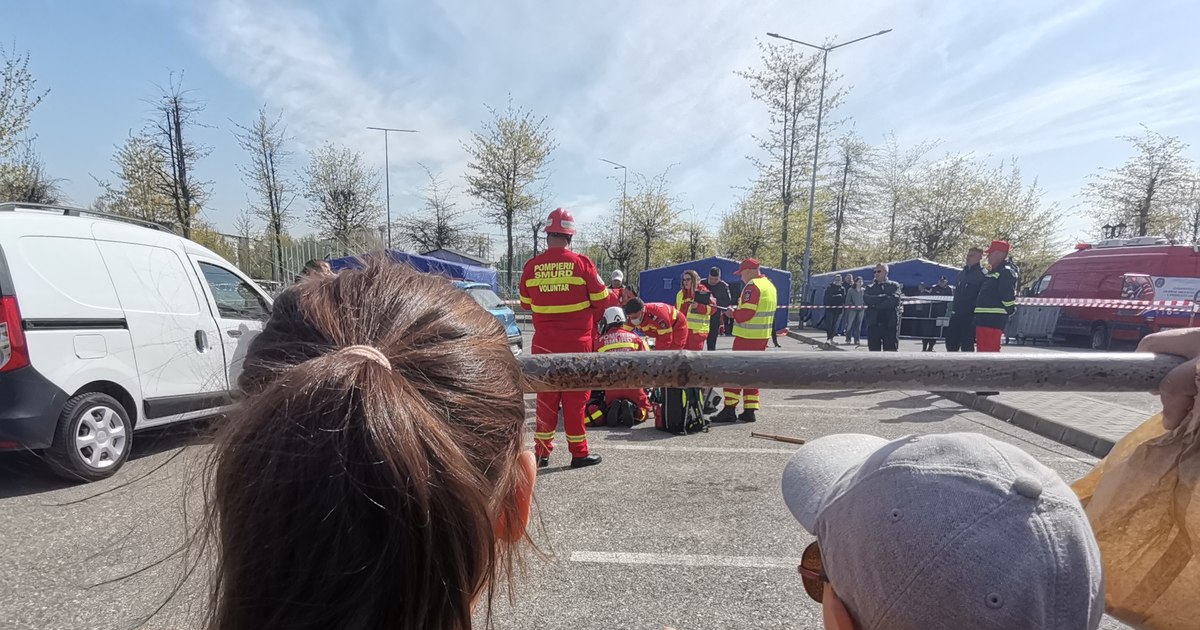
SMURD rescuers – who pull victims out of fire, water or contorted beasts and fight to save their lives – pass, year after year, through a competition with a huge stake. The best in the country end up representing Romania at the world competition. But the big gain is different.
The rescuers competed under the gaze of the curious PHOTO: Alina Mitran
The national competition for extrication and providing qualified first aid is an important milestone for the most skilled employees of the inspectorates for emergency situations throughout the country. Each county structure designates a crew that first enters a zonal competition, the winners of which reach the national stage. From here, the best crews represent Romania.
The scenarios the crews have to deal with are complex and inspired by real situations. The purpose of the competition is to develop professional skills. Contestants go through a rigorous evaluation process. At the same time, they observe their peers and have the opportunity to self-evaluate.
To be among the best, if not the first, is the goal they strive for year after year. But the competition, as confirmed by two crew chiefs I spoke with during the regional phase that is taking place these days in Slatina, has a much higher stake. It's the perfect training for real life, training that they can't afford every day, and those who participated in the confrontation of the crews, which took place in full view of the curious, in the area of the Youth Park in Slatina, also understood why.
16 brand new cars, destroyed to set realistic scenarios
In the zonal phase from Slatina, the representative crews of the inspectorates for emergency situations from Olt, Dolj, Gorj, Vâlcea, Argeș and Mehedinți face each other between April 22-24.
The competition includes two tests, carried out simultaneously: extrication from vehicles and provision of qualified first aid. The reaction capacity, coordination and mode of intervention of the participating crews are evaluated.
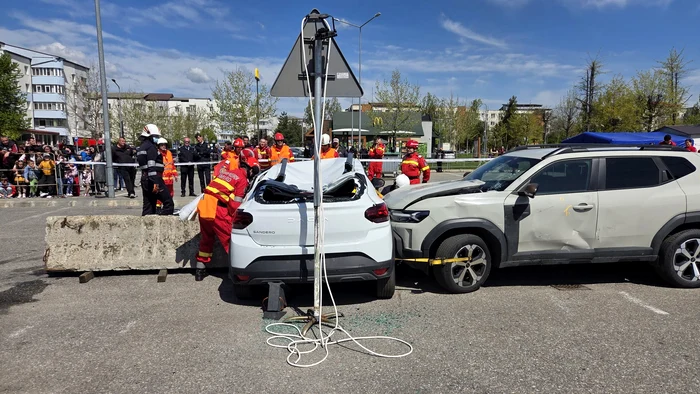
Firefighters had machines at their disposal to put the FOTo scenarios into operation. ISU Olt
The scripts are unknown to any of the crews, they come in sealed envelopes and are drawn on the morning of each competition day. Furthermore, members of the competing crews are camped in a tent from which they have no access to what is happening on the field except when it is their turn to show their skill and knowledge.
Adrenaline is high. The hosts also have the pressure of being followed step by step by relatives and friends, the majority of viewers being members of the rescuers' families.
To make the scenario as realistic as possible, the volunteers who play the victims are professionally made up, so that the blood, wounds, fractures, etc. to be reproduced faithfully.
Even the cars brought to the venue are damaged in front of the spectators, something that has recently been happening at regional competitions as well, although years ago this was a “luxury” that firefighters could only afford at the national stage.
It is another reason why rescuers strive to be assigned to represent their unit, because in regular training, they rarely get to practice extrication directly on cars.
And the competition begins. On the one hand, an extrication crew follows the received scenario, having to extricate a victim, while a few meters away colleagues have to give first aid to a driver who, according to the scenario, suffered several injuries following a scandal between two drivers in traffic.
The evolution of the crews is followed and scored carefully from the moment they get off the vehicle. What happens in the movies, where it seems that the rescuers are in a permanent agitation, you do not encounter in the exercise of the rescuers. The crew members coordinate their actions, talk constantly, interact with the witnesses found at the scene of the intervention, but all without leaving the impression of terrible urgency. This makes the spectators comment on the sidelines: “But it didn't take long?” And the rescuers, asked later, simply explain: “You have to hurry slowly.”
“We have to get out of the unit in a minute”
The rescuers from Olt entered the competition first, following the drawing of lots. Ilie Cojocaru, paramedic within ISU Olt and among those with whom ISU Olt started the SMURD actions in the county, 17 years ago, says that the objective is, obviously, ranking first in the area. They managed this feat only once, in 2017, but second and third places were not unattainable.
The scenario, says the paramedic, failed to surprise them. “The experience accumulated over the years as a first aid crew makes us no longer afraid. Only here is a timed competition and it's something else. Life beats the film and, you know it's about – where everyone runs, we go there”says Cojocaru.
The most difficult interventions in real life are those with multiple victims, the paramedic assesses, because they require a lot of coordination, calling in support forces, effective communication.
And, because the first of the scenarios involved giving first aid to a traffic victim, we want to find out what are the most common things that witnesses to an accident do.
“First of all, that instead of giving first aid, they sit and film”, says the paramedic without thinking. It's true that if they don't know how to do it, “it's better not to touch the victim, leave him in the position he found, call 112 and wait for the emergency crews to come”, indicates the paramedic next.
Dramatic moments in the Capital: the rescue climbers got off the block and entered through the window to save a woman
“Many do not have the courage to lay hands. More recently, through our program Savior from the Passionmore and more population started to learn first aid maneuvers and somehow help us in handling that situation. That is, you arrive at a case and you already see a person who knows how to do cardiac massage. And this is thanks to the Salvator din Pasiune program and our presence in schools to present first aid maneuvers”, adds Ilie Cojocaru.
Adults have more courage to intervene, while young people, even if they know how to do it, have reservations.
“I think that these first aid courses, at least basic, should be implemented at the level of the Ministry of Education. And somewhere, not the 4th grade, but from the 8th to the 8th, as if every student should know the basic first aid maneuvers. Instead of management, I would teach first aid”said the paramedic.
One piece of advice that the ISU Olt rescuer gives to those who witness an emergency and call 112 is to calm down and try to give as accurate an indication as possible of the victim's condition and location. “Keep calm and don't panic because the crews aren't coming. We, like the alert time, in one minute have to get out of the unit,” details the paramedic.
“It helps us a lot in real life”
The champions of the southern area were, for years in a row, the firefighters from Dolj, who are feared by all other crews. Craiova is also a training center. They feel almost obliged to defend their title year after year, says Laurențiu Burtoiu, commander of the ISU Dolj intervention team, twice participating in the World First Aid and Rescue Championship.
This competition, with all that it entails, is training that crews would not have the opportunity to do very often, says the paramedic.
“The experience gained at this competition is very extensive. New extrication techniques are being tested, for providing qualified first aid, they help us a lot in real life when we participate in interventions. We have reached a level where we can simulate almost anything, including we have mannequins, we can simulate a hand trapped under the body, which we have to work on for extrication, to be able to get the victim out of there. So anything can be simulated.
These competitions make it much easier for us to intervene, to not have emotions during interventions, because we know the intervention technique, we know the scenarios and we know how to approach in a real case”the savior explains, for “The Truth”.
And the Dolj crew chief insists on the need for people to be educated in such a way that they do not intervene if they do not know what to do, but keep calm and convey real information on the basis of which exactly the necessary forces can be sent into the field.
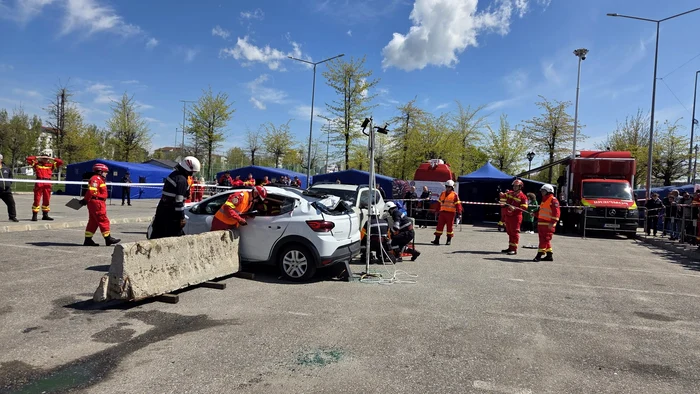
The accidents were simulated in the smallest details PHOTO: ISU Olt
Panic means that many times those who call for help do not give the correct data. Another mistake is when witnesses try to get the victims out and sometimes they do more harm than what already happened in the accident. “They can intervene to get the victim out of there in an emergency situation where there is a danger of explosion, of fire, but only if they can do it without putting their life in danger. Then, even if it causes them some more problems, they saved them”says the rescuer.
Serious accident on the A0, following an imprudent exit from the parking lot. A woman is in critical condition after her car overturned
On the other hand, even a fallen patient should be suspected of having a spinal fracture, so they should not be moved.
The rescuer has been active in the field for over 25 years, since the time when firefighters only intervened to extinguish fires, rescue animals and other interventions of this type.
In the past, the evolution is an extremely big one. The technique is incomparable, the personnel today perform operations that at first they were not allowed to perform.
“We have evolved so much that we also do telemedicine. That is, we go to the intervention and the people from the dispatcher see what is happening, the specialist doctor there evaluates”, the savior also specified.
Compared to the situation 20 years ago, there is also an evolution in the reaction of civilians.
“First and foremost, technology helps us. Now, if there is a young man at the scene of the intervention, just by the simple fact that he sends us a video on WhatsApp immediately, we know by the time we get there what forces to allocate and what to do. I mean, when I get a notification card, I call that caller, give him a hey on WhatsApp and he sends me the location and video or some pictures from there, so I know what forces to allocate. Not only on this part of extrication and providing first medical aid, but also on extinguishing and rescues from a height, on absolutely everything”Burtoiu also showed.
“We are very well seen internationally”
ISU representative Dolj participated in two editions of the World Championship and says that “we are very well seen on the international side”. “We have evolved so much that we are very well seen in many countries of the world. At the championship in France we saw teams that were not up to our level. We really evolved. We also go to international interventions. We were in Greece, we were in France to help them. We are really equipped“, said the savior.
The increasingly better results have meant that today Romania participates with more than one crew, as was the case at the beginning of the participation of our firefighters.