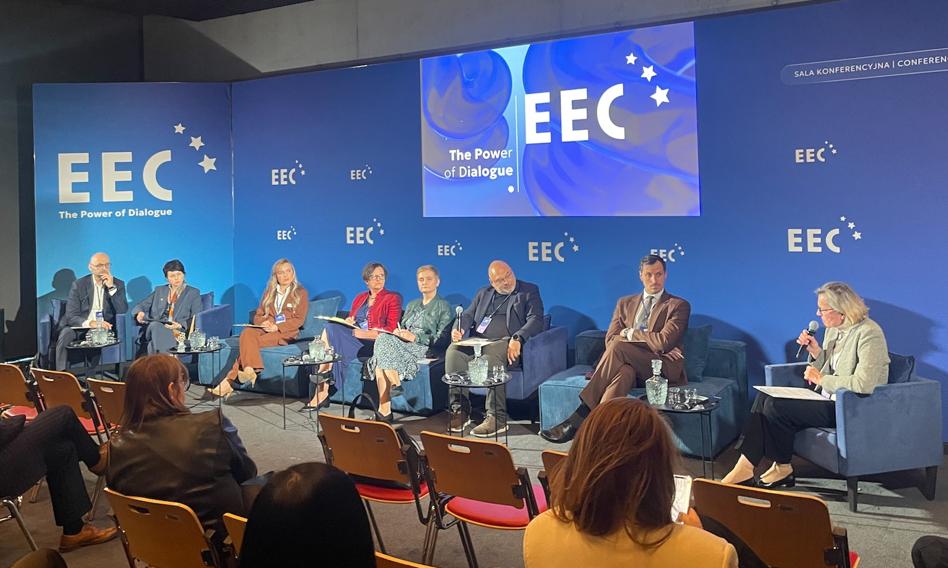
One of the topics discussed during this year's European Economic Congress was migration policy. Representatives of state authorities, large enterprises, organizations dealing with migrants and employers' associations talked, among others: about whether migrations can be a response to demographic challenges, what sectors and industries most need foreign workers and what the current regulations regarding foreigners look like.
According to the latest data, Poland has broken its record in terms of legal employment of foreigners. There are almost 1.3 million of them in the ZUS registers. Most of them are workers from Ukraine, but many of them also come from Belarus, and an increasing number also from outside Europe.
The problem is lengthy procedures
According to Rafał Rogala, director of EY and migration expert at People Advisory Services Tax, currently the biggest challenge is lengthy administrative procedures, which lead to a very large scale of uncertainty for employers.
– Today we no longer operate on an island with no connection to the world, but in a global village and we also have global business connections. And for a business to function, there must be not only a flow of capital, technology and knowledge, but also people who will support the development of companies operating and investing in Poland. The waiting time for a foreign expert often takes many months, sometimes exceeding a year or even 2 years. These are obvious costs for a given employer, says Rafał Rogala.
“100,000 migrants needed to maintain economic growth”
Piotr Kamiński, vice-president of the management board for financial affairs of Employers of Poland, cited data from a report prepared by his organization, which indicates that by 2060 the number of Poles of working age will decrease from over 32 million people in 2024 to probably about 15 million people of working age in 2060.
– Today, economic growth averages 3.7%. in recent years. However, with the prospect of reducing the number of people who can work and the natural desire to maintain this economic growth, we may have a problem without migrants, says Piotr Kamiński. – In 2023, we lost 184,000 people, in 2024, 151,000 people, and in 2025, 128,000 people of working age. These are people who are no longer on the labor market. Even though we have growing professional activation of retirees and developing technology, they will not replace these losses. We will need at least 100,000 people to migrate to Poland if we want to maintain this economic growth, so we have to get these people from somewhere. Or we start giving birth to them, and if we can't make them, we have to get those hands to work somehow.
Foreigners are no longer cheap labor
In turn, Edyta Krasoń, a member of the Cordis Logistics government, cited data from the Polish Economic Institute, which shows that 44 percent companies complain about a shortage of employees, while the TSL industry is one of the sectors that struggles with an even larger average staff deficit, amounting to 47%.
– This sector is very dependent on foreigners. However, in my opinion, migration does not completely solve the problem of code gaps. It certainly minimizes and soothes them. Yet we don't see these shortages going away. They are mainly in operational areas and concern, among others: drivers and forklift operators. This is due to the simple fact that the nature of this work is becoming less and less attractive to local workers. At the same time, the labor market for foreigners today is no longer Polish, but European. Currently, we are competing not with the company around the corner, but with Germany, with the Scandinavian countries, and the best employees do not disappear from the market, but choose directions where working conditions are better. Therefore, we cannot say that foreigners, as is commonly said, are cheap labor – says Edyta Krasoń.
According to her, from the companies' perspective, the problem is the uncertainty of procedures regarding migrants, very long waiting times for decisions, work permits and residence cards.
– The variability of these regulations makes it very difficult to plan employment today, and it is even impossible to manage resources if we do not know when the employee will be able to legally start or continue this work. I think that today the challenge is not to reach these foreign workers, to have access to them, but to ensure their stable functioning in our unstable system – adds the Cordis Logistics expert.
“We owe migration to Polish economic success”
According to Anna Papka, director of corporate relations and influence at McDonalds, the company employs 38,000 in Poland. people, of whom approximately 6 thousand these are foreigners – all employed under an employment contract.
– Most of our restaurants are run by franchisees, i.e. by about 120 Polish entrepreneurs. They bear the burden of all procedures related to the employment of migrants and prolonged waiting times for employees, says Anna Papka. – First of all, migration is not a problem, but a phenomenon that we owe at this moment to the fact that Poland has achieved incredible economic success. Over the last 20 years, we have changed from a country of emigration to a country of immigration. And the influx of these people, whether we want it or not, whether we limit it or not, will continue, because the only factor that influences migration movements is the pursuit of a better life and better living conditions. This is also a way to improve demographics.
Migrants are not only workers, but also consumers
According to Anna Papka, automation in the catering industry will not make staff shortages less noticeable for now.
– Similarly, in the case of fertility, this is not a five- or ten-year perspective, and the economy needs workers now. In ZUS, the number of Poles insured decreased by 75,000 in 2023, and by 90,000 in the first three quarters of 2025. At this point, foreigners are rejuvenating our pension system, the ZUS system and filling this gap. If there are no foreigners, the average pension in relation to wages will drop from approximately 47%. now, and up to 26 percent in 2060. If all foreigners staying here suddenly disappeared in the next few years, we would not be the 22nd power in the world.
According to Anna Papka, when we talk about foreigners, we always think about employees. – However, let us also remember that they are also consumers. We estimate that this is up to 10% of our guests. This means that they spend money here and it goes to local businesses. They also pay taxes, so the economic effects are much wider.
Can the situation in the West be a warning?
Meanwhile, according to Piotr Głowacki, there is a certain discrepancy between objective needs and social concerns.
– It seems to me that if we look at the attitude of Poles towards the West, it is marked by such ambiguity. On the one hand, we want to constantly catch up with the West economically, and there is still a strong development aspiration here. On the other hand, we also look at it from a cautionary perspective. It seems to me that a large part of society believes that as a country, as a political class, we should draw conclusions from certain things that went wrong in the West, and immigration is undoubtedly one of these things – says Piotr Głowacki. – Allowing mass immigration to be dictated by the labor market, as it were, leads to specific effects that we can see now. Today, we look at ourselves in such a mirror, looking to the West, and most Poles, I think, claim that they do not want such a reflection and prefer to avoid the mistakes that were made in the West. Therefore, we should not follow this path thoughtlessly. Labor shortages may act in some respects as incentives for greater automation or innovation. If we loosen this migration screw and allow mass, even illegal, migration, we limit these pro-development incentives.
Labor redirection needed?
According to Piotr Głowacki, in the long term we should not give up yet and raise the white flag when it comes to our demography.
– I do not delude myself that in the foreseeable future it will be possible to rebuild this generation replacement, but reaching at least the European average seems to me a real thing – says the representative of the President of the Republic of Poland. – Another issue concerns education, which is largely inadequate. Today, in relation to the needs of the labor market, we produce an excess of people with higher education, while we often need people with lower qualifications. We have very poor vocational and vocational education. This is definitely a topic that needs to be worked on and manpower resources redirected. Let me remind you that in 117 poviats we have double-digit unemployment. In my opinion, migration policy definitely needs to be conducted in a planned manner. It needs to be sorted out. The state should gain control over this sphere so as to provide entrepreneurs with some kind of predictability.
Piotr Głowacki supports the introduction of a quota system operating in many countries, such as Australia or Canada, with an emphasis on the dominant form of rotational migration and migration targeted primarily at key sectors in which robotization or automation will not replace humans.
– This includes, among others: for the care of the elderly and the sick, health care, or some innovative industries that simply need us to provide these workers to build the prosperity of the entire economy – adds Piotr Głowacki.
Migration is a bargaining chip in every election
According to Agnieszka Kosowicz, president of the Polish Migration Forum Foundation, the way we think about migration is largely influenced by the political narrative.
– Since 2015, migration has been an element of all election campaigns, often used in a very disgusting, brutal and instrumental way, so Poles are regularly fed a story about migration, which is an undesirable, unfavorable phenomenon, and migrants are shown to us as people who should be feared, whom we do not want here and whose presence is simply socially harmful in some way – says Agnieszka Kosowicz. – There is also a second economic narrative, which says that we lack 100-150 thousand people a year in the labor market and that migrants are beneficial here. Unfortunately, this does not translate into specific solutions.
– Migration should not only be a topic of political discussion, but one of the state management policies. This is a topic that can bring us great benefits. After all, today these 1.3 million foreigners paying contributions to ZUS give real money to pensioners – sums up Rafał Rogala.