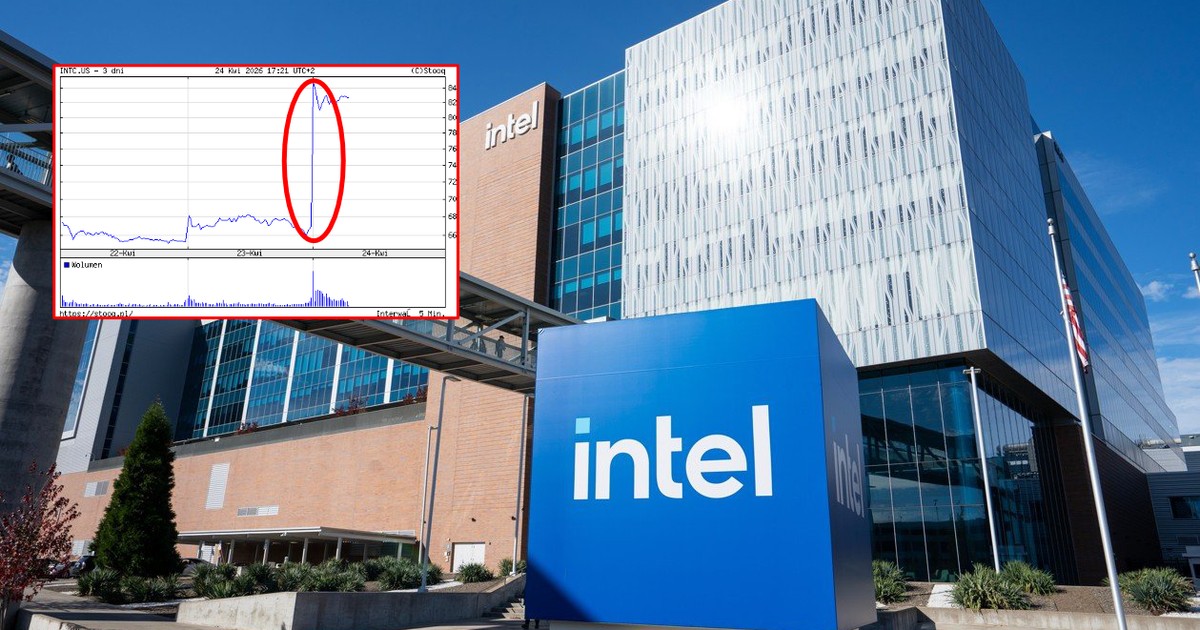
After the publication of its first quarter 2026 results, Intel shares rose by approximately 20% in after-hours trading, and on Friday, after the opening of the session, they broke the barrier of $80. and the historical peak from August 2000, i.e. during the dot-com bubble, which was $75.81. This was not mere enthusiasm after a better quarter in which the processor giant's revenues clearly exceeded market estimates. Investors have bought into a much bigger story: that Intel is in a place where the AI boom can actually work to its advantage. Not because it has suddenly become the new Nvidia, but because the AI market is no longer just a story about accelerators.
For the past two years, the narrative around AI has been simple: what matters most is GPUs and other accelerators, and classic processors are just an addition to them. As the market moves from training large models to inference, AI agents, robotics and systems operating closer to the user, the importance of classic CPUs as the control layer of the entire computing stack increases. In other words, the newest data centers need more processors and they need them to be fast processors.
During the presentation of the results, Lip-Bu Tan said about the “return of the CPU as the foundation of the AI era.” He is echoed by other companies related to this type of chips, such as AMD and Arm. These words were followed by specific numbers: Intel showed strong growth in the segment Data Center and AIwhose revenues increased to USD 5.1 billion, or 22%. year to year. Businesses powered by AI are already responsible for 60%. group revenues and increased by 40%. year to year. The company also pointed to the recently announced long-term cooperation with Google and Nvidia's choice of Intel Xeon 6 processors as hosts for NVIDIA DGX Rubin NVL8 systems. Company representatives also said that demand exceeds available production capacity.
| Q1 2026 revenues |
$13.6 billion; +7 percent y/y |
The market forecast was $12.42 billion. |
|---|---|---|
| Revenue forecast for Q2 2026 |
USD 13.8-14.8 billion |
The market forecast was approximately USD 13.07 billion. |
| Data Center and AI – revenues |
$5.1 billion; +22 percent y/y |
Intel is taking advantage of the rapidly growing interest in high-performance server processors. |
| Intel Foundry – revenues |
$5.4 billion; +16 percent y/y |
Revenues are still negative, but there is finally a chance that this business will start earning money. |
| Businesses powered by AI |
60 percent group revenues; +40 percent y/y |
The market received confirmation that AI is no longer a promise for Intel, but a real engine of growth. |
Strong interest in Intel's chip packaging factories
The second reason for market optimism is the development of advanced packaging services. In the world of AI, this is no longer the final, technical stage of production, but one of the key elements of building complex systems made of many chiplets and computational blocks. Intel has been signaling for months that this is where it can monetize its factory investments the fastest.
After the results, the company again emphasized the increased interest in its services related to advanced chip packaging (various versions of EMIB and Foveros technologies), and CFO David Zinsner talked about the demand already reaching billions of dollars a year. For investors, this is an important signal because it shows a more tangible growth path than the mere promise of catching up with TSMC in the most advanced technological processes.
The increasing importance of Intel factories
The third piece of this puzzle is Elon Musk. Intel and Elon Musk announced their cooperation a few weeks ago, and moments before Intel's presentation, Elon Musk said during Tesla's financial report that his company will use Intel's technological process called 14A in the Terafab project.
We still don't have exact details about what this use will look like (whether it's just a license or the production of chips for Tesla in Intel factories), but this is still a very important announcement for Intel. The company has long needed proof that its future production technologies are of interest not only to its own design department, but also to external customers. Musk's name – regardless of how one evaluates his announcements – acts as a credibility stamp for 14A. This also immediately changes the narrative around the future of Intel's factories and research. Last year, Lip-Bu Tan and David Zinsner said that if there are no customers, there will be no technological process 14A and subsequent advanced American semiconductor production processes. Now they inform that investments in their development are to be greater than initially planned.
The challenges are not over, but the near future looks much brighter
There are still many challenges ahead for Intel Lip-Bu Tan. Despite record orders for Intel server processors the long-term future of this business is still difficult to predictbecause it is not known at what point the rapidly growing importance of processors with the competitive Arm architecture, increasingly popular among hyperscalers, will stop. The Intel Foundry segment remains deeply unprofitable and posted a loss of $2.4 billion in the quarter. operating loss, and Elon Musk himself said that the 14A process he wants to use is not ready. And let's not forget that consumer processors are still an important part of Intel's business, and the overall PC market is expected to decline this year – and with it sales of consumer “blue” chips.
Intel factory services are slowly finding their first external customers.
|
Mieszko Krzykowski / Onet
For now, however, there is no doubt that Intel's situation looks much better than a dozen or so months ago. Intel simultaneously showed three things that investors have been missing for a long time: that the demand for its products is growing along with the new wave of AI, that advanced packaging is starting to look like a real source of large orders, and 14A is slowly ceasing to be just a promise from the presentation. This is not yet proof that the company has won the technological race. But for the first time in a long time, the market recognized that Intel is no longer standing next to the AI boom, but has become part of it.