The billions will stay in Poland. How do State Treasury companies want to build a national supply chain?

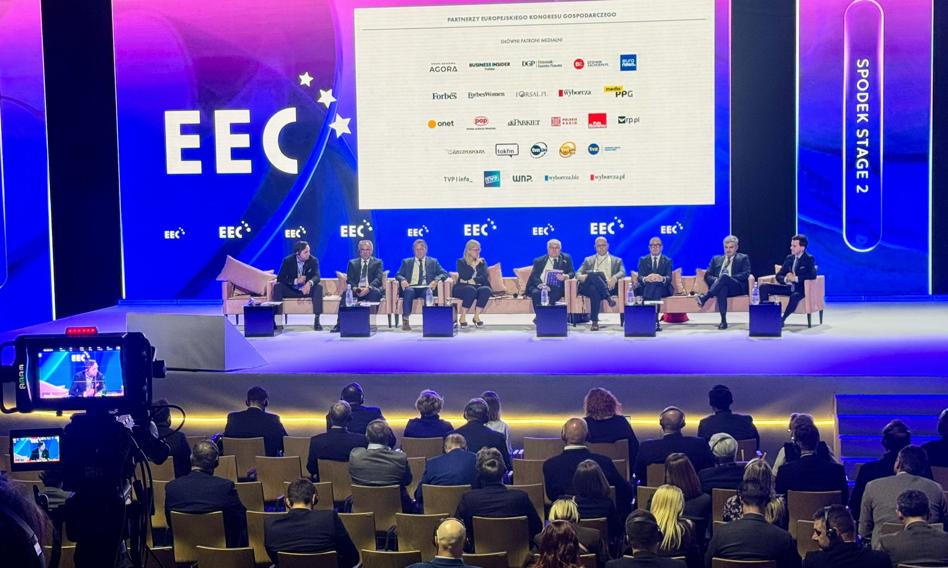
Building a national supply chain is a matter of Poland's security and sovereignty, and public procurement can be a tool for implementing the state's strategy – said the participants of Wednesday's debate during the European Economic Congress. The implementation of local content will not require an amendment to the Public Procurement Law.
“Examples related to the pandemic and the restrictions resulting from it, as well as the wars that are taking place in Ukraine and the Middle East, and the interruption of supply chains show that economic independence and self-sufficiency as much as possible is the key to security,” said Wojciech Balczun, Minister of State Assets, during the European Economic Congress in Katowice.
The minister announced that the implementation of the local content rules will start with the energy sector, where a pilot will be carried out, and will then be extended to other industries, including the arms industry.
He also emphasized that ultimately local content is to become an element that builds awareness throughout the economy, covering not only State Treasury companies, but the entire public sector and private entities.
“This does not apply only to State Treasury companies. It applies to the entire public sector, but it also builds an ecosystem and awareness in the entire economy, because local content can be used by private entities that order services or products and can take this element into account,” said Balczun.
The Minister informed that the implementation of local content will not require an amendment to the Public Procurement Law (PZP).
“For a long time now, the PZP has not said that you should be guided only by the lowest price criterion. (…) We are talking about choosing the most advantageous offer, of which price is only a part. We have to look at other elements, such as what we have defined as local content,” said Balczun.
Agnieszka Olszewska, president of the Public Procurement Office, informed that the provisions of the Public Procurement Law enable purchasing procedures to be conducted in such a way that they also achieve goals that are important from the state's point of view.
“Public procurement is not only an administrative instrument for spending public funds, but also a tool for implementing various policies, strategies and goals important from the state's point of view,” she said.
She added that the “State Purchasing Policy” is an important document.
The President of the Public Procurement Office indicated that the local content program can be implemented using instruments already available in law, such as preliminary market consultations, which allow to learn about the potential of domestic suppliers before launching the procedure.
Dariusz Lubera, president of PGE, pointed out that the PGE group's strategy assumes investment expenditures of over PLN 230 billion by 2035, and approximately PLN 150 billion would go – according to the assumptions – to Polish entrepreneurs.
He said that in the first offshore project, Baltica 2, the share of local content is estimated at 25-30%.
“About 40 proceedings related to the Baltica 2 project will be announced this year alone,” Lubera said.
As he pointed out, in the distribution segment the share of the domestic component exceeded 85%, and the construction of the energy storage facility in Żarnowiec is based in 75%. on the national component.
He also pointed out the importance of the so-called “local opex content”, i.e. maintenance and renovation services that will last long after the investment itself is completed.
Ireneusz Fąfara, president of Orlen, announced that while in Orlen's first offshore project the share of the domestic component is 21 percent, in the next one it is expected to increase to 41 percent.
“Local content is not only because it is Polish. It is because it is Polish, it is good and it is reasonably priced. We want to build such a model of cooperation with suppliers and partners,” said Fąfara.
According to the president of Tauron, Grzegorz Lot, it is not enough to create regulations, because they can always be circumvented.
“Local content must be inside the body, in the head, in the heart and in the soul,” he said.
He added that the local content strategy can be combined with responsibility for the development of regions.
Enea's president, Grzegorz Kinelski, announced that in the group's mining area, i.e. in Bogdanka in Lublin, the share of local content is close to 100 percent, because the mine is supported by companies located in its immediate vicinity. In the case of the distribution segment, the share of the domestic component is over 90%.
Enea estimates that in the case of construction of new gas units in Kozienice, the level of local content may be approximately 75%, despite the use of American technology, because key components are produced in Poland.
Remigiusz Paszkiewicz, president of KGHM, drew attention to the security aspect in the context of local content.
“In today's global situation, it is easy to imagine the tightening of international relations, causing even far-reaching consequences, for example cutting off Europe, including Poland, from the supply of certain key materials or raw materials, or even services in the case of advanced technologies,” said the president of KGHM.
The president announced that in the Polish part of KGHM, supplies of materials and services from domestic companies account for 98.5 percent (PAP Biznes)
pel/ asa/