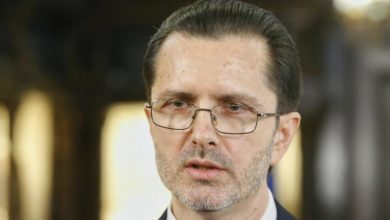
After the PSD withdrew its support from Ilie Bolojan, Cristian Pîrvulescu sees a possible scenario also taken into account by the social democrats


The political crisis triggered by the PSD's massive vote (97%) to withdraw the support given to Prime Minister Ilie Bolojan is not a simple conjunctural dispute, but the symptom of a “chronic governmental instability” that has affected Romania since 2007, says political scientist Cristian Pîrvulescu, in an interview for the News.ro agency.
- Pîrvulescu explains why a minority government is now the most plausible hypothesis and what are the risks of traditional parties becoming dependent on AUR.
A problem in the Constitution
According to Cristian Pîrvulescu, the root of the evil is not a personal one, but resides in the faulty relationship between the formal institutions (the Constitution) and the informal ones (the Coalition). The political scientist emphasizes that the formal institutions were not adapted to the functioning of the coalitions, which created a functional break.
In this context, “the prime minister believes that he has absolute power that he can use, and the parties believe that they cannot be treated as partners.” This divergent view of power has made the current crisis “inevitable”.
Pîrvulescu's script
Although PSD's political support is to be withdrawn, Prime Minister Ilie Bolojan refused to resign. Pîrvulescu believes that, instead of a spectacular fall of the Government, it is much more likely to witness a limited survival formula.
“I am one of those who believe that we will rather have a minority government”, he says, noting that the PSD takes this hypothesis into account.
One of Bolojan's variants
One possible strategy would be to use the 45-day window until a new vote of confidence in Parliament. The political scientist explains that, at that moment, a Minority Government (made up of PNL and USR) could be voted in under the pretext of the need to ensure stability and the continuation of austerity policies.
A critical aspect of the current parliamentary configuration is the rise of the AUR in the role of decision-making factor. “PSD and PNL are equally in the area of influence of the AUR. The AUR has suddenly become a kind of arbiter”, warns Pîrvulescu. However, an alliance with George Simion is seen as an act of desperation:
For the PSD, the external and internal political costs are huge in the case of an “informal combination” with the AUR.
The AUR leader declared that he wants early elections for the people to decide, a direction that Pîrvulescu ironically describes as being towards “fraternal Russia” and a “Christian paradise” similar to the Bulgarian model.
I play on the opponent's error
The political scientist is categorical: “Anyone will do [guvern cu AUR] is definitively compromised”, because this party only benefits and strengthens itself from such associations.
The current situation is compared to a chess match between international masters, where each side knows its moves, but expects a strategic error from the opponent. Time plays an essential role, being able to completely change the balance of forces.
“While PNL wants to prove that it can govern and achieve its administrative goals alone, PSD hopes to strengthen itself in the opposition for a possible return to power in a few months”, Pîrvulescu explained to News.ro.