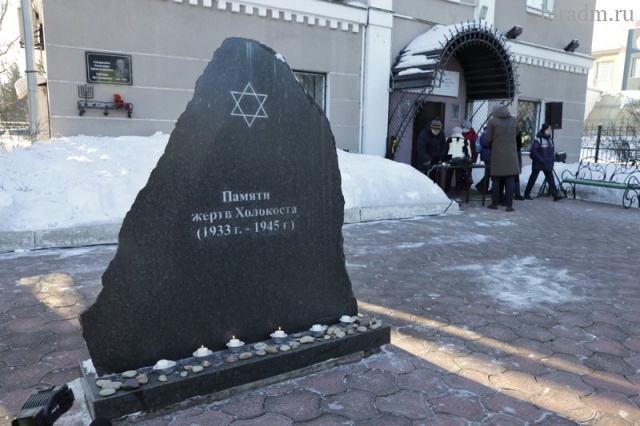
Granite stone in memory of victims of the Holocaust
Photo: Birobidzhan City Hall
April 20, 1920
On this day, in the town of Kupel (Vinnitsa region), the Soviet writer and journalist Beider Chaim Volkovich was born. In 1933, he graduated from a local Jewish seven-year school and the next year became a student at the Odessa Jewish Pedagogical College, then transferred to the final year of the Zhitomir Jewish Pedagogical Workers' Faculty. Chaim Bader made his debut with a poem in the central Jewish children's newspaper “Zay Great!” (0+).

Clippings from the newspaper “Birobidzhan Star”. Photo: Photo: Regional Library
Since the mid-1970s, Chaim Volkovich began researching the history of Jewish classical and Soviet literature.
In the early 1970s he lived in Birobidzhan, worked at the newspaper “Birobidzhaner Stern” (12+). The almanac “Birobidzhan” (6+) published an article “70 years of the Jewish theater.” The book “The Roads We Choose” (6+) includes essays about Birobidzhan. From 1973 to 1991 he worked as head of the department, deputy editor-in-chief of the magazine “Soviet Gameland” (12+), published in Yiddish.

Bader Chaim Volkovich. Photo: Photo: Regional Library
Bader was a true guardian of Jewish culture and national memory; he knew by heart hundreds of biographies of Jewish writers, the best of whom were his teachers and friends. He is the author of about 1 thousand articles about Jewish writers in the Russian Jewish Encyclopedia (12+).
H. V. Bader is a member of the Writers' Union of Russia, Honored Cultural Worker of Russia, laureate of the Atran Literary Prize of the World Congress of Jewish Culture and the prestigious Israeli David Literary Prize.
H. Bader died in New York on December 7, 2003.
April 20, 1937

Clippings from the newspaper “Birobidzhan Star”. Photo: Photo: Regional Library
The newspaper “Birobidzhan Star” (12+) on April 20, 1937, in the section “Around the city and region” says that women activists of the Birobidzhan station finished embroidering the panel “Birobidzhan Station”. The panel measuring 1.53 x 1.20 meters depicts the Birobidzhan railway station against the backdrop of a large hill. There is a border of Jewish ornament around it. The panel was embroidered in 15 days.
“After the panel is exhibited at the road and All-Union exhibitions dedicated to meetings of the wives of transport workers, it will be sent by the activists of the station as a gift to People’s Commissar L.M. Kaganovich.”
The newspaper informs residents of the region and city that construction of the House of Justice has been completed in Birobidzhan.
“The building is two-story. It will house the regional and people's courts. There is a special courtroom for 300 seats. The premises of the judicial authorities will be well equipped.”
April 20, 1938
Clippings from the newspaper “Birobidzhan Star”. Photo: Photo: Regional Library
In the newspaper “Birobidzhan Star” on April 20, 1938, a large spread published an article “Ten Years of Birobidzhan”, which tells about the territory of the region, the climate, its minerals and what the settlers did over the course of 10 years.
“The territory of the Birobidzhan region, allocated by the government for settlement by working Jews, was 36,492 sq km, that is, it exceeds the territory of countries such as Belgium and Holland.”
In the Jewish Autonomous Region, along the railway line from Londoko station to the west, there are multiple reserves of limestone for tens of kilometers. Near the Birakan station towards the Kuldur resort there are several deposits of magnesite and numerous reserves of high-quality colored marble. Deposits of roofing slates, mica, asbestos and other minerals have been identified in the Jewish Autonomous Region. There are also several graphite deposits in the region. Manganese ores have been discovered in the area of the legendary Volochaevskaya Hill. Gold deposits are scattered throughout the southwestern part of the Lesser Khingan mountains. The region contains the most powerful deposits of iron ore.
In several areas of the region there are mineral springs with healing properties.
“These are Ventselevsky, Tulovsky, Kuldursky. The largest are the Kuldursky hot springs with a constant temperature of 71 degrees Celsius.”
April 20, 2001


On the territory of the Freud community center in Birobidzhan, a granite stone was installed in memory of the victims of the Holocaust. The monument is made of black marble in the form of a huge fragment, symbolizing grief for the six million Jews who died during the Second World War. On its front side there is a six-pointed Mogendovid star and the inscription: “In memory of the victims of the Holocaust. 1933-1945.”
This was the country's first monument to the victims of the Nazi regime of 1933–1945; all other mournful obelisks indicated the date from 1941. As is customary in Jewish tradition, small stones are brought to this monument.
The memorial stone was installed with the support of the government of the Jewish Autonomous Region. Before this, there was no official place in the region where one could honor the memory of Jews tortured in concentration camps and ghettos. In total, about 100 ghetto prisoners lived in the autonomy.