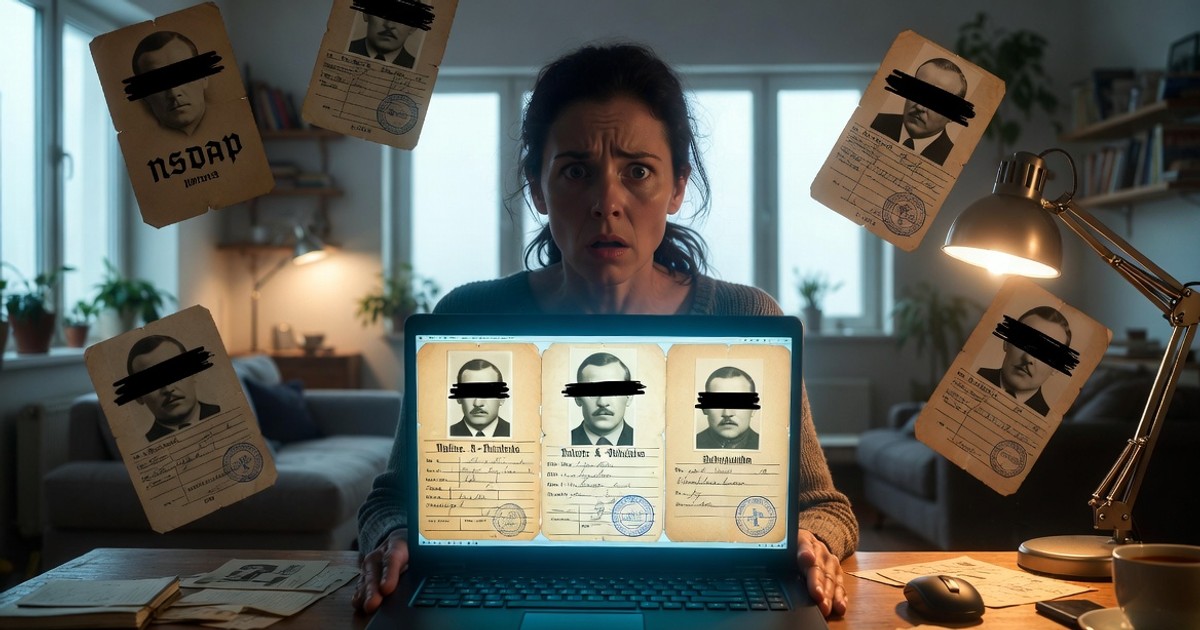
A new search engine based on artificial intelligence was launched on April 2, 2026 by a German newspaper Die Zeit in cooperation with German and American archives. Thanks to it, anyone (after purchasing a subscription for 1 euro) can check in a few seconds whether their ancestors belonged to the National Socialist German Workers' Party (NSDAP) – Adolf Hitler's party. The tool gives you access to over 12 million documentsincluding membership cards that catalog most of the 10.2 million Germanswho belonged to the party in the years 1925–1945.
This is not a dry archive for historians. This is a tool that penetrates directly into family albums and stories passed down at the Christmas Eve table. Enter your surname – and you will receive names, dates and places of birth, the date of joining the party and a scan of the original membership card, sometimes with a photo. Effect? Millions of visits within the first hours and thousands of shocked people discovering the dark past of their loved ones.
How does a tool that destroys family legends work?
Until now, access to NSDAP cards – documents proving membership in the Nazi party of the German Third Reich – was only possible through a formal request to the archives, which took weeks or months and was subject to strict data protection regulations. The situation changed in March 2026, when the US National Archives published a digitized collection of documents that almost miraculously survived World War II.
- Read also: Germany wants to knock the ace out of Trump's sleeve before he pulls it out. Their spies will be given the green light to take more aggressive actions
On this basis, Die Zeit employees created a simple, AI-based tool. Just enter your family's name and the system instantly shows you the results – just like browsing through social media profiles. Clicking on the result displays a scan of the card with the membership number and often a photo. The tool has already visited several million people.
Membership cards come from the NSDAP headquarters in Munich and local branches. At the end of the war, in April 1945, the Nazis wanted to destroy them – a total of about 50 tons of paper. They were saved by Hanns Huber (in some sources Josef Wirth), the director of a nearby paper mill, who hid the documents and handed them over to the Americans after the war. In 1994, they were transferred to the German archives. Microfilm copies are still available in the US.
10.2 million members
By 1945, as many as 10.2 million Germans belonged to the NSDAP. Membership was not obligatory – it required signing a declaration and individual consent. The party recruited from all social classes: workers, officials, teachers, entrepreneurs, as well as many women (often through youth organizations). People born between 1900 and 1915, who spent their childhood or youth in the shadow of World War I, joined in particularly large numbers.
In 1935, admission of new members was suspended for two years to distinguish “old fighters” (Alte Kämpfer) from the opportunists who joined after Hitler took power in 1933. After that point, the pressure was enormous – the party had a monopoly, and membership often made a career easier or protected against problems. This created an additional sense of “elitism” among party members, which further fueled new applications when they began in the second half of the 1930s.
Personal dramas: “It was a shock at the age of 71”
The reactions are immediate and very emotional. As reports available online indicate, thousands of letters were sent to the editorial office of “Die Zeit”. One reader wrote: “I have already found two close relatives. This destroys the myth that no one in our family was involved. Changing perspective at the age of 71 is a bitter shock.”
Christian Rainer, an Austrian journalist, discovered within seconds that his grandfather Franz Rainer had joined the party on April 21, 1938 – just five days after the Austrian Anschluss. “I always knew he was close to the Nazis, but I was surprised by how quickly he did it. He should have known in 1938 who the Nazis were,” he said.
- Read also: The extreme right prevails in Germany. A disturbing survey has emerged
Such stories destroy myths built on shame. After the war, many NSDAP members hid this information from their families and did not share this information with their grandchildren. This means that the new “Die Zeit” tool is not just a technological curiosity. It is a powerful instrument of historical truth that, in the digital age, makes family secrets from almost a hundred years ago available with one click. For many Germans and Austrians, this means a painful awakening – the end of comfortable myths about “our family that knew nothing and did nothing.”
At the same time, it provides an opportunity to gain a deeper understanding of the mechanisms of totalitarianism and how ordinary people become part of the criminal system. At a time when the memory of the Holocaust and World War II is increasingly receding into the past, such tools remind us: history is not only in books – it is in our family trees.
“Die Zeit” emphasizes that the goal is not to accuse, but to better understand one's own history. However, for thousands of families who are currently entering names into the search engine, the effect is one: shock, sadness, and sometimes relief when the myth of the innocent family turns out to be true. Germany is just entering a new phase of coming to terms with the past – this time very personal and inevitable.