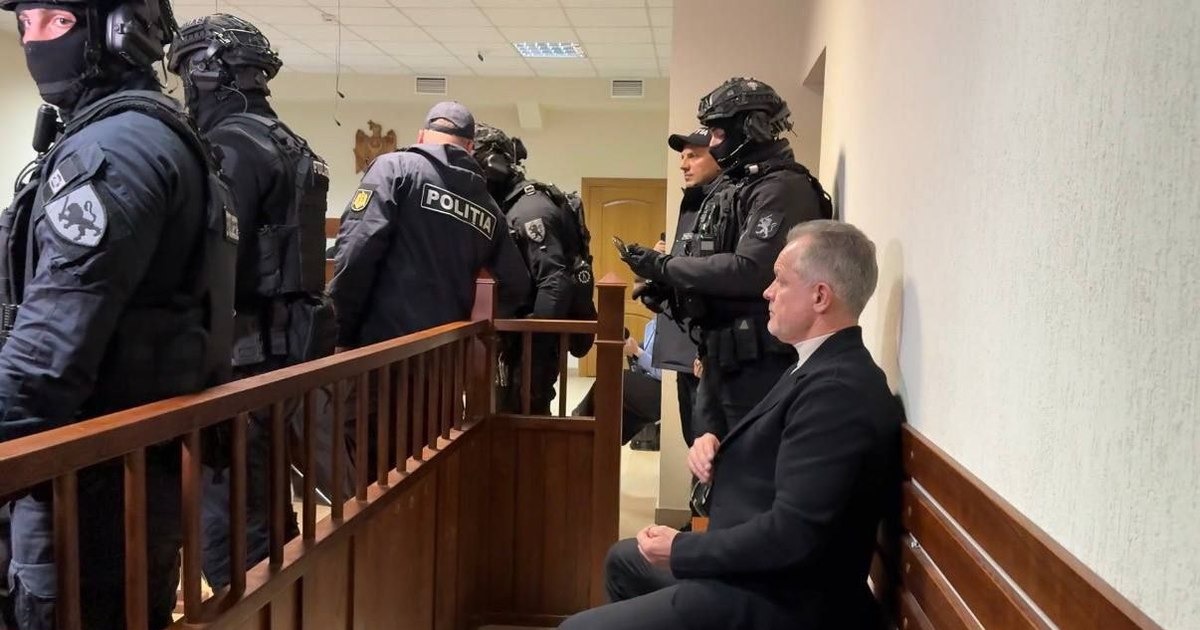
The price of oil fell sharply after the announcement of the reopening of the Strait of Hormuz


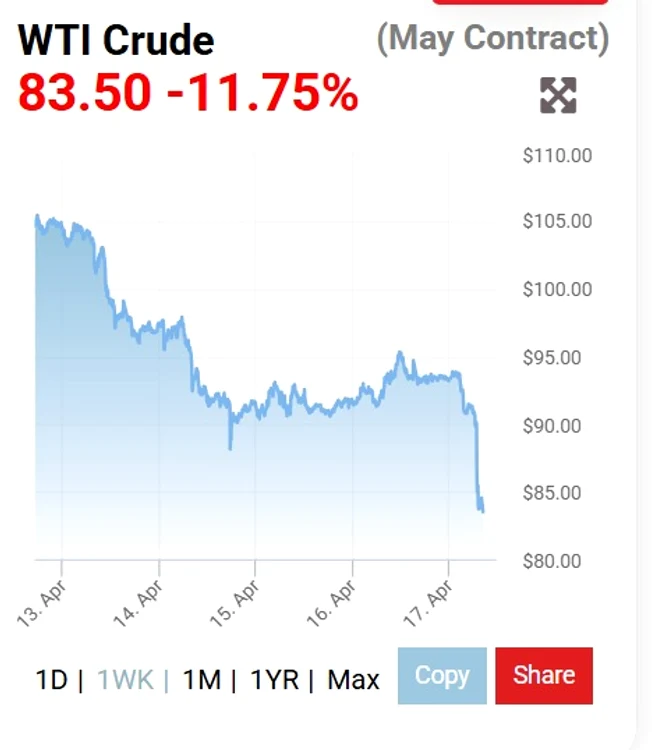
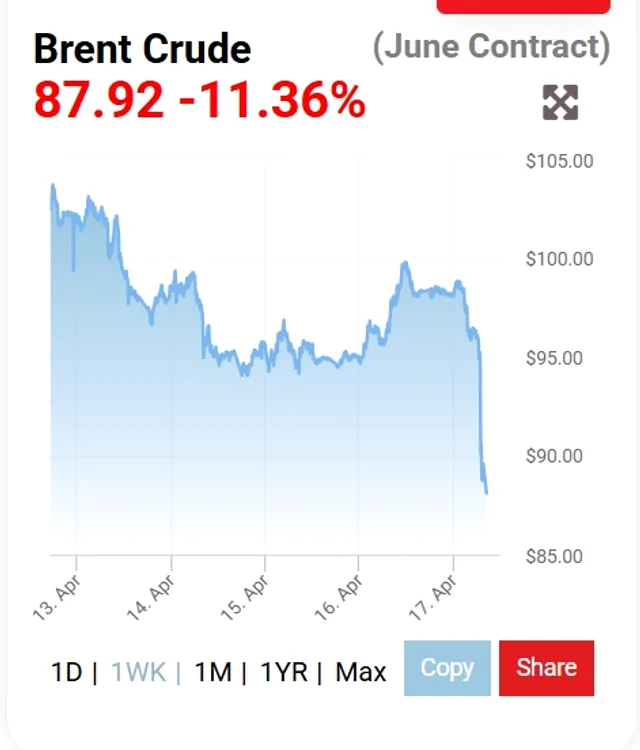
Oil prices fell sharply after the announcement of the reopening of the Strait of Hormuz, with both Brent and WTI crude falling below $88 a barrel, according to official data.
The price of oil fell sharply after the announcement of the reopening of the Strait of Hormuz. Photo by Shutterstock
At the time of publication, Brent oil prices had reached $88 a barrel from $96, and WTI oil prices at $83 from $93 a barrel earlier in the morning.
The Strait of Hormuz is a narrow strip of water connecting the Gulf to the Arabian Sea, through which a fifth of the world's oil and liquefied natural gas is typically transported.
“The passage of all merchant vessels through the Strait of Hormuz is declared fully open for the remainder of the armistice period“, said the Iranian Foreign Minister, Abbas Araghchi.
Global markets also rallied following the announcement, with major US stock indexes rising in early trade. The S&P 500 rose 0.8 percent, while the Nasdaq and Dow Jones Industrial Average (DJIA) both rose more than 1 percent.
European stocks also rose in reaction to the news. Paris's Cac and Frankfurt's DAX both rose more than 2 percent, while London's FTSE 100 rose about 0.5 percent.
The Strait of Hormuz has been virtually closed by Iran since the US and Israel launched military strikes in the country in late February.
Tankers could not get through, drastically reducing the amount of oil and gas available on global markets and causing prices to spike.
Before the conflict, Brent crude was trading below $70 a barrel. It rose above $100 before hitting a peak of more than $119 a barrel in March.
The sharp rises in oil prices have pushed up the price of petrol and diesel for motorists, while also raising concerns about the supply of jet fuel, leading to fears that airlines will be forced to cancel flights, the BBC writes.
The closure of the main waterway has also cut off an important fertilizer supply line used by farmers, raising the possibility of higher food prices as a result of the conflict.
A third of the world's main chemical fertilizers pass through the strait, and prices have risen sharply since the outbreak of war.
Iran's decision to reopen the Strait of Hormuz came after a cease-fire agreement between Israel and Lebanon.
Tehran's Foreign Minister Abbas Araghchi said that under the ceasefire agreement, maritime traffic through this strategic route is being resumed for the duration of the ceasefire. The announcement was made public via a message on the X network.
Diesel has become cheaper, but it is still much more expensive than before the outbreak of the Iran war
According to the Iranian official, all commercial ships can transit the Strait of Hormuz on a previously established route, the decision being coordinated with the maritime authorities of the Islamic Republic.
Fragile truce and hopes for dialogue
The decision comes shortly after US President Donald Trump announced a ten-day truce between Israel and Lebanon, which took effect on April 16. The initiative is seen as an important step to reduce tensions and relaunch diplomatic dialogue between Washington and Tehran.
The leader of the White House suggested that a new round of negotiations between the US and Iran could take place as soon as this weekend, fueling speculation about a possible de-escalation of the conflict.
Trump welcomes the announcement
American President Donald Trump immediately welcomed the announcement of the reopening of the strait, a key point in the negotiations between Washington and Tehran in order to stop the Iran War.
“Iran has just announced that the Iran Strait is fully open and ready for a full crossing. Thank you“, writes the American head of state in capital letters on the Truth Social platform.
The US will continue to block Iran's seaports
The US has said it will continue its maritime restrictions on Iran, despite claims that shipping routes through the Strait of Hormuz have been fully reopened. Generally, these measures will remain in place until a future peace agreement between the parties is fully implemented.
The price of oil will experience large fluctuations in the coming period. How much will the diesel end up costing
Trump suggests he may personally travel to Pakistan to strike a deal with Iran
Donald Trump announced this on his Truth Social page. In his post, he also mentioned that he made the statement after reports surfaced that the Iranian side had announced the full opening of the Strait of Hormuz and its willingness to ensure the unimpeded passage of ships.
In addition, Trump emphasized that despite this decision, maritime restrictions on Iran remain in place until the agreements are finalized and implemented.
He added that the negotiation process is in the final stages, and most of the key points of the potential agreement have already been agreed. Finalization of the agreements is expected to take place shortly.
Iran's state-run Mizan news agency earlier on Friday denied any deal with the United States on uranium.
Donald Trump told the press on Thursday, in front of the White House, in Washington, that Iran has accepted “to hand over the nuclear dust to us”.
No negotiation regarding a “transfer of the ballot box enriched Iran to the United States never took place, nor is there, of course, any agreement on the subject”, writes Mizan citing sources.