Against the background of the accelerated increase in energy prices and uncertainties in the market, more and more homeowners in Romania are analyzing the possibility of becoming energy independent. For a house of approximately 100 square meters, this independence no longer means just the installation of photovoltaic panels, but the implementation of an integrated system that includes production, storage and optimized energy consumption.
Energy independence does not only mean installing photovoltaic panels. Archive photo
Market data shows that a fully electrified home – without gas – has an annual consumption of between 4,500 and 7,000 kWh, depending on the level of efficiency and the way of use.
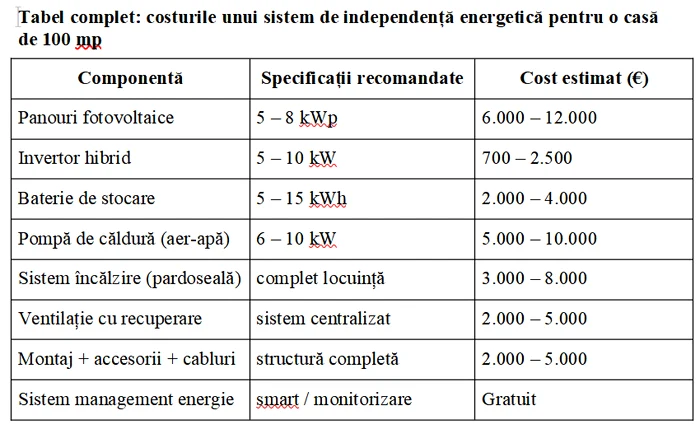
According to the calculations made for “Adevărul” by Răzvan Iordache, energy specialist of Hexing Technologies Europe, the complete system includes a series of equipment, starting from photovoltaic panels, to the heat pump and the distribution system.
Photovoltaic panels are the basis of the energy system
A photovoltaic system is the main source of energy for the home, the specialist says, adding that for a 100 sqm house, correct sizing is essential.
According to him, the recommended power is between 5 and 8 kWp, which allows an estimated annual production between 5,000 and 8,000 kWh, enough to cover both domestic consumption and the needs of a heat pump.
“The panels transform solar energy into electricity that can be used directly in the home. In the absence of a storage system, the unconsumed energy is injected into the grid, and the consumption during the night is covered by the grid”, he said, stating that such a system costs between 3,500 and 8,000 euros, depending on the equipment and the complexity of the installation.
From a market point of view, photovoltaic systems have become the basic standard for any strategy to reduce energy costs, but alone they cannot ensure total independence.
The heat pump is the core of efficient consumption
The heat pump completely replaces the classic heating and air conditioning systems, being one of the most efficient solutions available today.
For a 100 m2 home, air-to-water heat pumps with a power between 6 and 10 kW are generally used. They work on the principle of energy transfer from the outside air to the inside, having a high performance coefficient: for every kWh consumed, they generate between 3 and 4 kWh of thermal energy.
In practice, the heat pump covers heating the home in winter, cooling in summer and preparing domestic hot water
The annual consumption for such a home is estimated between 2,000 and 3,500 kWh.
The cost of a heat pump varies between 5,000 and 10,000 euros, depending on the brand, power and complexity of the installation, and in this context, the heat pump is considered the central element of home electrification, being essential for eliminating gas and reducing long-term costs.
Storage batteries – the difference between discount and independence
The storage battery is the component that transforms a photovoltaic system from a cost reduction tool into a system capable of providing real energy independence.
In the absence of the battery, the energy produced during the day and not consumed is delivered to the grid, and the home becomes dependent on the supplier at night or during periods without solar production.
A battery with a capacity between 5 and 15 kWh allows the use of the energy produced during the day during the night, the almost total reduction of consumption from the network and the operation of the home in case of power cuts (backup)
Technically, modern batteries use lithium-ion technology and are integrated with the inverter to manage power flows in real time.
Their cost varies between 2,000 and 4,000 euros, depending on the capacity and manufacturer.
In the market, the growth in demand for batteries is accelerating, as users move from simply reducing bills to the goal of energy autonomy.
Hybrid inverter – the control center of the system
The inverter is the element that manages the entire energy ecosystem of the home.
A hybrid inverter allows converting the energy produced by the panels into usable energy, managing battery charging and discharging, and interacting with the electrical grid.
For a house of 100 square meters, inverters with powers between 5 and 10 kW are used.
Their cost is between 700 and 1,200 euros.
In modern systems, the inverter becomes an optimization tool, not just a conversion tool, being able to prioritize consumption and maximize the use of its own energy.
Heat distribution system – critical efficiency factor
The efficiency of a heat pump directly depends on how the heat is distributed in the home.
The most efficient solutions are underfloor heating and low temperature radiators.
They allow the pump to operate at low temperatures, which increases efficiency and reduces consumption.
The cost of a complete heating system is between 3,000 and 8,000 euros.
Ventilation with heat recovery – control of energy losses
A ventilation system with heat recovery ensures air exchange without major energy losses.
It recovers between 70% and 90% of the energy of the exhaust air and transfers it to the intake air.
Benefits include reducing energy losses, increasing indoor comfort, improving air quality.
The cost of such a system is between 2,000 and 5,000 euros.
Household appliances and energy management
The use of energy-efficient household appliances and smart systems contributes to the optimization of consumption.
Energy management systems can schedule consumers based on solar output, reducing grid dependency.
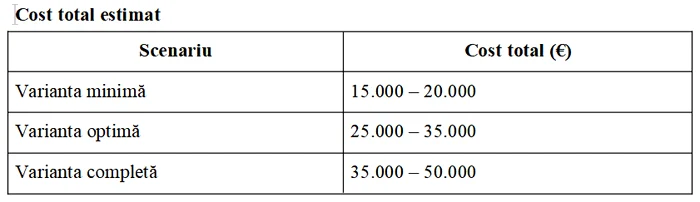
The specialist estimated the total costs for three realistic scenarios, starting from the cheapest, to the most complete, which really brings energy independence.
The bottom line – cost reduction, not independence
This variant includes:
• 5 kW photovoltaic system
• without battery
• partial use of the energy produced
Total cost: 3,500 – 4,500 euros
Level of independence: 60–70%
This solution is mainly used by prosumers who are looking for reduced bills, not full autonomy.
The optimal variant – real energy independence
This is the configuration that begins to almost completely eliminate network dependency.
Include:
• photovoltaic system of 6–8 kW, sized for full annual consumption
• battery of approximately 10 kWh, sufficient for night consumption
• heat pump that completely replaces gas
• hybrid inverter and optimized system
Total cost: 5,000 – 8,000 euros
Level of independence: 80–95%
From an economic perspective, this is the configuration considered optimal in the market, as it offers a balance between investment and cost reduction.
In most scenarios, the monthly bills drop to symbolic values, and the home becomes almost energy self-sufficient.
Full variant – almost total autonomy
This variant is intended for those who seek maximum independence, including in situations of network interruption.
Include:
• oversized photovoltaic system (8–10 kW or more)
• high capacity batteries (10–15 kWh or more)
• backup systems and advanced management
• complete optimization of consumption
Total cost: 6,000 – 10,000 euros
Level of independence: 95–100%
In this scenario, the home can operate almost completely independently of the grid, including short periods without solar production.
How much does an energy storage battery cost and how do you choose it to have energy autonomy
Return on investment, between 8 and 15 years
There are three main configurations of a home energy production and storage system, each with different levels of investment, autonomy and economic efficiency.
The first is the minimum option – cost reduction, but network dependency. This configuration includes a photovoltaic system without a battery and without full consumption optimization. Basically, the system consists of photovoltaic panels of approximately 5 kW and does not include storage batteries, which means that the home only partially consumes the energy produced. The total investment for this type of system is between 3,500 and 4,500 euros, and the annual savings reach 1,000 – 1,500 euros. Under these conditions, the investment recovery period (ROI) is approximately 8 – 12 years. The operation is relatively simple: the house produces energy during the day, but since there is no storage, the surplus is injected into the network, and at night the consumption is covered from the classic supply system. The result is a significant reduction in bills, but not their elimination.
The second option is the optimal option – the balance between investment and independence, currently considered the most widespread on the market. This is the first configuration to offer true energy independence. The system includes 6–8 kW photovoltaic panels, a battery of approximately 10 kWh, a heat pump for heating and hot water preparation, as well as a hybrid inverter. The total investment is between 5,000 and 8,000 euros, to which is added the cost of the heat pump. Annual savings are estimated at 2,000 – 3,000 euros, and the investment recovery period is 7 – 11 years. This variant works as an integrated system: the energy produced during the day is stored in the batteries and used during the night, and the heat pump completely replaces the gas, transforming the electricity into efficient heating. In this context, the energy bill drops close to zero, grid dependency becomes minimal, and savings are constant and predictable. From an economic point of view, this is considered the optimal configuration, as it maximizes the use of the energy produced.
What can Romanians do who want to install photovoltaic panels in the absence of the state support program
The third option is the complete option – almost total autonomy, intended for those who seek maximum independence, including in situations of network interruptions. This configuration involves an oversized PV system of 8–10 kW or more, high capacity batteries of 10 to 15 kWh or more, and a fully optimized system with energy redundancy. The total investment varies between 6,000 and 10,000 euros, to which are added the costs for auxiliary equipment and the heat pump. The annual savings are between 2,200 and 3,200 euros, and the investment recovery period is longer, 10-15 years. In this scenario, the system is sized to cover almost all consumption situations, including periods of no sun or possible power outages. Costs increase significantly due to additional batteries, and the recovery of the investment is slower, since a significant part of the amount is paid for safety and autonomy, not just for economic efficiency.
“In the current conditions in Romania, energy independence is no longer an investment with a long paybackbut one with comparable or even superior returns to other types of long-term investments. The minimal variant reduces costs, but does not eliminate dependency. The optimal variant offers the best balance between investment and autonomy. The full version offers total control, but at a higher cost”Răzvan Iordache declared for “Adevărul”.